
For generations, the heartbeat of an Indian boutique has been the rhythmic scratching of a pen against a paper bill book. Whether it is a dedicated boutique ladies tailor bill book format or a generic duplicate pad, these physical records have been the standard. However, as fashion businesses scale and customer expectations evolve, many owners are asking: is the traditional paper method helping or hindering growth?
A tailoring application is a digital platform designed to replace manual paperwork with automated workflows, allowing boutique owners to manage orders, measurements, and invoicing from a single mobile-first interface. Unlike generic billing apps, a specialized system like GrowStitch is built around real tailoring workflows, adding an intelligence layer that helps owners move beyond WhatsApp, diaries, and manual follow-ups to run their business with structure and clarity.
The Creation Speed: Handwriting vs. Auto-Fill
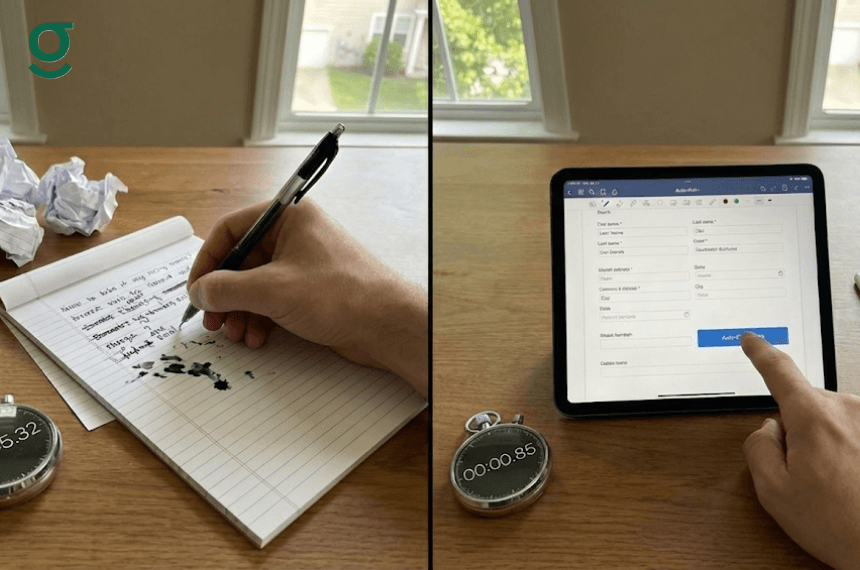
The most immediate difference between a paper boutique bill book and a tailoring application is the time spent at the counter.
- Handwriting (The Manual Way): Every time a customer walks in, staff must manually write down the name, contact number, date, and a detailed description of the garment. This often leads to errors due to a rushed environment or reliance on memory.
- Auto-Fill (The GrowStitch Way): With a tailoring application, staff can create a complete and accurate order in a single, guided flow even during peak hours. Contacts can be imported directly from a phone book, and for repeat customers, their entire history and measurement records are pulled up instantly. This ensures nothing is forgotten at the source and reduces the time a customer spends waiting at the counter.

Comparison: Order Creation Efficiency
| Feature | Paper Bill Book | GrowStitch Tailoring Application |
|---|---|---|
| Data Entry | Manual handwriting for every field | Guided flow with minimal typing |
| Customer Lookup | Searching through old pages | Searchable digital contact list |
| Instructions | Scribbled notes on the side | Voice descriptions and reference images |
The Math Headache: Calculator Errors vs. Automated Totals
Errors in billing often occur because of manual calculations, especially when dealing with complex customizations and advance payments.
- The Calculator Struggle: In a traditional boutique bill book format, the owner must manually calculate the base stitching price, add-ons like lining or embroidery, and then subtract any advance payment. One small mistake with the calculator can lead to significant revenue leakage over a month.
- Automated Totals: In GrowStitch, the total bill amount is calculated automatically once items and extra charges such as padding, cups, or embroidery are added. The system handles partial payments and provides real-time clarity on paid vs. pending amounts. This "Payment Intelligence" protects your cash flow by ensuring you always know exactly what is pending and what has been collected.
The "Duplicate Copy" Struggle: Carbon Paper vs. Instant Sharing
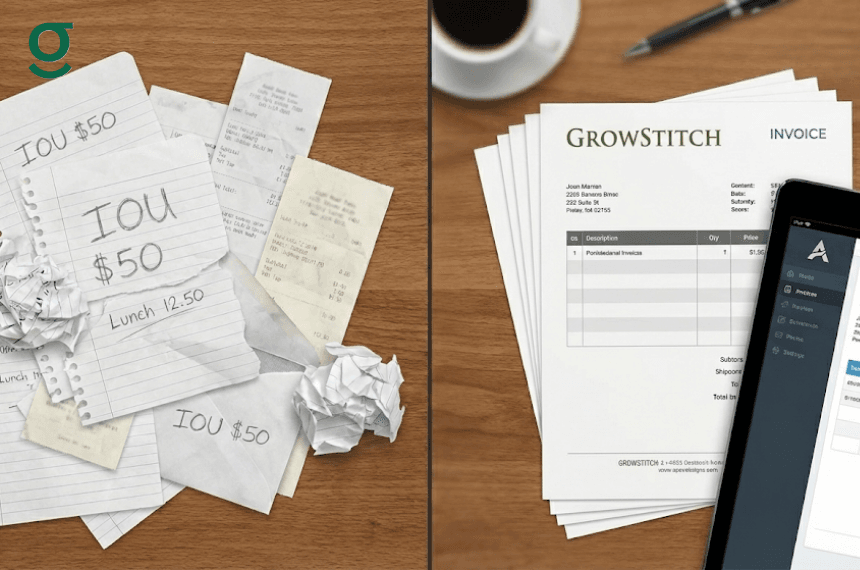
The traditional method relies on carbon paper to create a duplicate copy for the customer. These copies are often hard to read, easily lost, or forgotten in the shop, leading to disputes later.
The Limitations of Carbon Paper
- Readability: Faded carbon makes it difficult for the production team to read specific fitting notes or design instructions.
- Physical Storage: Piling up used bill books takes up physical space and makes the shop floor look cluttered.
- No Real-Time Updates: Once the customer leaves with their paper slip, they have no way of knowing their order status unless they call and interrupt your work.
The Power of Instant Sharing
A modern tailoring application uses digital communication to bridge this gap. GrowStitch sends order confirmations and payment receipts (including the balance due) directly via WhatsApp. Instead of a flimsy piece of paper, the customer receives a professional digital record. Within the shop, a digital "Job Sheet" with all order details can be downloaded or shared with the team, ensuring that cutting and stitching instructions are followed perfectly every time.
The Retrieval Nightmare: Dusting Off Old Books vs. Search Bar
When a customer returns six months later and asks for the same fitting as last time, a paper-based boutique faces a major operational bottleneck.
- The Manual Search: Staff must find the old bill book, flip through hundreds of pages, and hope the ink hasn't faded. This process is slow and often leads to the business depending too much on one key person who "remembers" where everything is.
- The Digital Search Bar: Because GrowStitch keeps a complete history of every customer including past orders, measurement records, and preferences finding old details takes seconds. This allows you to turn repeat customers into your biggest strength by providing a personalized experience that doesn't depend on one person's memory.
The Professional Image: Scraps of Paper vs. Branded Invoices
Your billing process is a reflection of your brand identity. A boutique using a manual bill book may appear traditional, but it often fails to provide the level of professionalism that modern, high-value customers expect.
Digital Invoicing Benefits for Your Brand Image:
- Transparency: Clearly itemize charges for services, fabric, and add-ons like "material dyeing" or "express delivery."
- Reliability: Automated order tracking means you can tell a customer exactly where their dress is whether in cutting, stitching, or finishing rather than giving a vague "In Progress" update.
- Consistency: Using a standard digital format ensures your brand looks professional across every branch or location you manage.
Moving Beyond Basic Billing: Business Intelligence
The biggest advantage of a tailoring application over a paper book isn't just the billit is the data behind the bill. A paper book can tell you what you sold today, but it cannot easily tell you how to grow your business.
GrowStitch provides an "Intelligence Layer" that paper books cannot match:
- Target Tracking: Set monthly store targets and track sales and Average Order Value (AOV) in real-time.
- Growth Insights: See how your boutique ranks in your city or area based on sales and order volume compared to market benchmarks.
- Geography Tracking: Understand which geography India or overseas is driving your revenue growth and where your order sizes are improving.
- Production Insights: Identify bottlenecks in the production department before customers start calling to complain about delays
Conclusion
Transitioning to GrowStitch isn't just replacing paper, it's about taking control.
Move from manual chaos to clarity by automating orders and centralizing customer measurements. Eliminate the "retrieval nightmare" and ensure your business runs on data, not just memory.
the first 1,000 customers get exclusive Early Bird Access!
FAQs
Is GrowStitch suitable for small boutiques?
Yes, the tailoring application is designed to start simple and scale gradually as your fashion business grows.
Can I track production stages like stitching and finishing?
Yes, tracking actual production stages such as cutting, stitching, finishing, and QCis a core part of the system's workflow
Does GrowStitch provide market comparison?
Yes, the Growth Insights feature allows you to see how your boutique's sales and order volume compare with others in your specific area and category
Can I track India vs. overseas orders separately?
Yes, GrowStitch provides clear geographic performance insights to help you understand whether your growth is driven by domestic or international customers.
Is the app available in multiple languages?
Yes, the application currently supports Hindi, Telugu, and Urdu, with plans to expand to other regional languages like Tamil, Marathi, and Kannada.
How does the digital invoicing help with payments?
The app provides real-time clarity on paid, pending, and partial amounts for every order, preventing revenue loss due to forgotten balances or lack of visibility.