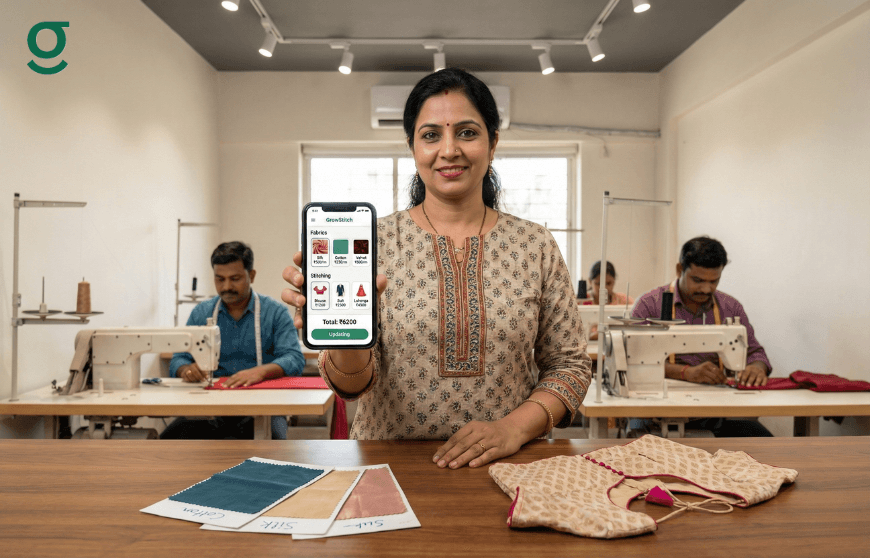
Pricing in the bespoke fashion industry is inherently complex. Unlike a retail store where a shirt has a single fixed price tag, a custom-stitched garment is a sum of multiple moving parts: the cost of the fabric, the base stitching charge, the complexity of the design, and the cost of additional materials like linings or buttons. For boutique owners, calculating this manually for every customer is not only time-consuming but also prone to costly errors. Implementing a tailor app simplifies this multifaceted pricing structure, allowing businesses to manage fabric rates and stitching charges separately yet cohesively within a single digital system.
The Complexity of Pricing Custom Stitched Garments
The "price" of a custom outfit is rarely a single figure. It is a calculation that must account for:
- Service vs. Product: The stitching is a service, while the fabric and embellishments are products.
- Variable Consumption: A size small requires less fabric and lining than a size extra-large, yet a fixed rate card often fails to account for this variance efficiently.
- Design Intricacies: A simple neckline costs less than a hand-embroidered collar.
- Fluctuating Material Costs: The price of raw silk or cotton lining changes, and manual rate cards are rarely updated fast enough to reflect this.
A tailor app creates a structured framework where these variables are pre-defined, ensuring that the final bill accurately reflects the time, skill, and materials invested in the garment.

Separating Fabric Costs from Stitching Charges in the App
One of the most common billing challenges is distinguishing between the service charge (stitching) and the material cost (fabric). This distinction is crucial for understanding profit margins, as the margin on service is different from the margin on fabric resale.
A robust tailor app like GrowStitch allows for a clear separation during the order creation process:
- Stitching Service Line Item: The user selects the garment type (e.g., "Blouse Stitching"), which pulls the standard service rate.
- Material Line Item: If the boutique provides the fabric, it is added as a separate line item (e.g., "Raw Silk - 1 Meter").
- Customer-Provided Fabric: If the customer brings their own cloth, the app allows the user to record the fabric details (type, color, length) without adding a monetary charge, while still charging for the stitching.
This separation ensures transparency for the customer, who can see exactly what they are paying for, and clarity for the business owner regarding inventory usage versus labor income.
Managing Variable Rates for Linings and Add-ons
"Add-ons" are the small details that significantly impact the final cost. In a manual system, charges for items like lining, piping, tassels, or fancy buttons are often estimated or forgotten entirely during the rush of closing an order.
Standardizing the Extras:
A tailor app like GrowStitch manages these variables through a modular selection menu.
- Lining Charges: Instead of calculating lining costs mentally, the user selects "Cotton Lining" or "Crepe Lining" from the menu. The app automatically adds the pre-set price per meter to the bill.
- Design Add-ons: Specific design elements such as "Princess Cut," "Padded," or "Elbow Sleeves"can be configured as chargeable attributes. When selected, the additional cost is instantly applied.
- Embroidery and Handwork: For high-value items, embroidery charges can be input as a fixed cost or calculated based on the complexity level defined in the system.
By digitizing these variable rates, the boutique ensures that no material or extra effort goes unbilled.
Automating Total Bill Calculation to Eliminate Errors
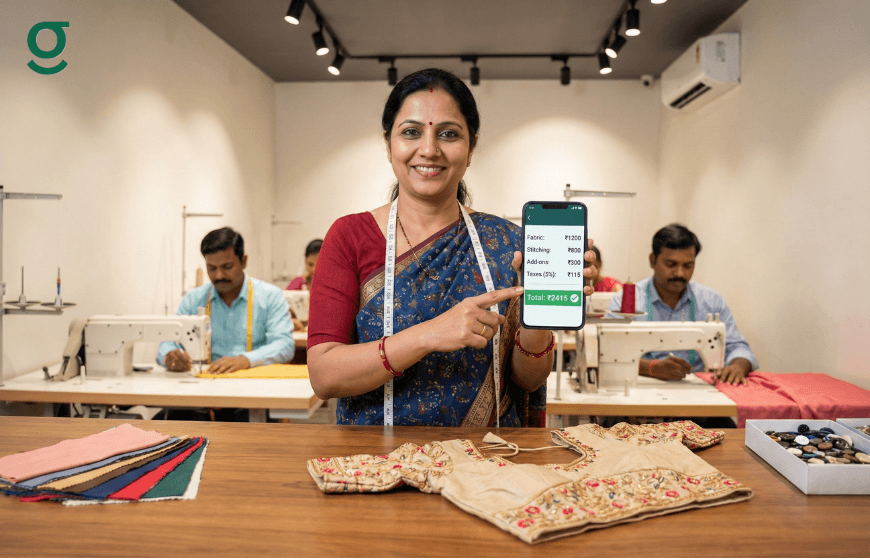
Manual arithmetic is the enemy of profitability. When a staff member has to manually sum up the stitching charge, fabric cost, lining cost, and three different design add-ons, the chance of a miscalculation is high.
The Calculation Engine:
The GrowStitch tailor app eliminates human error by automating the math.
- Selection: The staff member simply clicks the relevant options (e.g., Blouse + Silk Fabric + Padded + Maggam Work).
- Aggregation: The software aggregates the base price and all selected modifiers in the background.
- Taxes: If applicable, the system automatically calculates GST on the total or on specific line items.
- Final Total: The accurate grand total is displayed instantly.
This automation not only protects revenue but also speeds up the checkout process, leaving a professional impression on the customer.
Using Pricing Data to Track Profitability and Trends
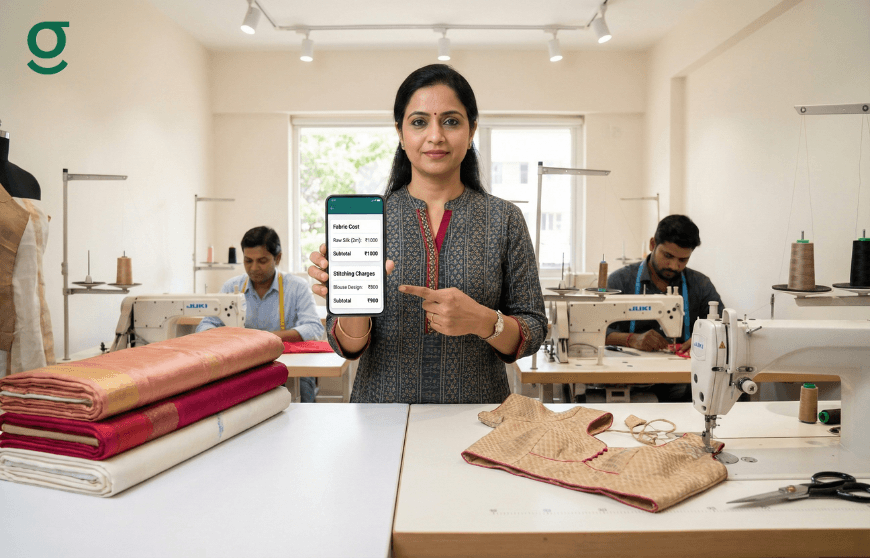
When pricing is managed digitally, every transaction generates valuable data. A manual bill book cannot tell you which fabric is most popular or which type of add-on generates the most revenue.
Business Intelligence:
Using the Business Insight and Growth Insight features of the tailor app, owners can analyze:
- Revenue Split: See how much revenue comes from stitching services versus fabric sales.
- Top Add-ons: Identify which customizations (e.g., "Padded" or "Embroidery") are most frequently requested. If embroidery is in high demand, the owner might consider hiring a full-time embroidery specialist.
- Margin Analysis: By tracking the cost of materials against the final bill, owners can identify if their current pricing for fabrics and linings is profitable or if rates need adjustment.
Conclusion
Managing the complex pricing structure of a tailoring business requires more than a calculator and a notepad. It demands a system that can handle the nuances of fabric rates, stitching charges, and variable add-ons with precision. By adopting a tailor app, boutique owners can automate these calculations, ensure complete transparency for their customers, and gain the data-backed insights needed to maintain healthy profit margins. This shift to digital pricing is a fundamental step in professionalizing operations and scaling the business effectively.
And if you move now, the first 1,000 users get exclusive early-bird access, download the app today and stay ahead while others struggle to catch up
Frequently Asked Questions
1. Can I set different prices for the same garment type?
Yes. You can create multiple variations for a garment (e.g., "Simple Blouse" vs. "Bridal Blouse") with different base prices in the tailor app.
2. How do I handle costs if the customer brings their own fabric?
The app allows you to record the customer's fabric details for tracking purposes without adding a cost to the bill, ensuring you only charge for the stitching service and any shop-provided materials like lining.
3. Can I update the prices of lining or buttons frequently?
Yes. You can edit the prices of materials and add-ons in the master catalog at any time. The new prices will apply to all future orders immediately.
4. Does the app calculate GST separately for fabric and stitching?
Yes. If your business requires it, the software can be configured to apply the appropriate tax rates to different line items automatically.
5. Can I see which add-ons are generating the most money?
The Business Insight feature provides data on sales trends, allowing you to see which services and add-ons are contributing most to your revenue.
6. Is it possible to offer a discount on the total bill?
Yes. While the component prices are fixed to ensure consistency, the admin can apply a manual discount to the final total during the billing process if needed.