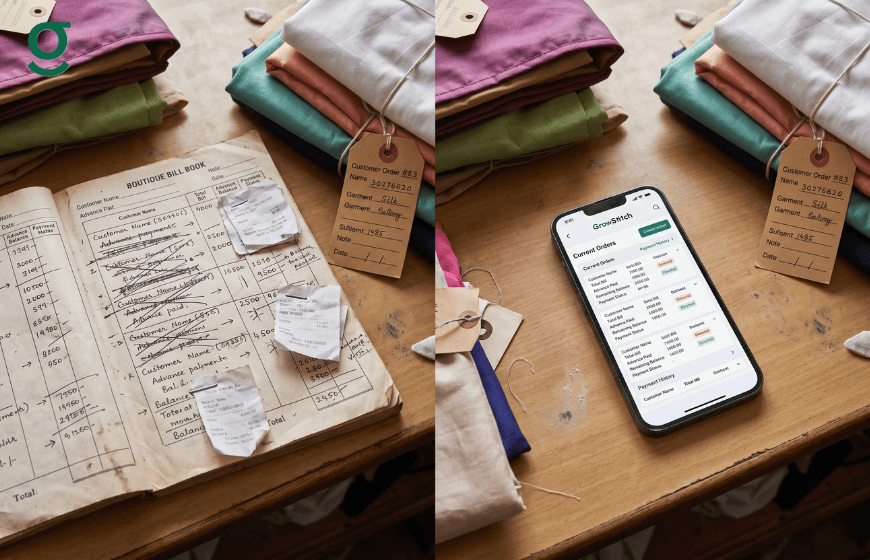
A boutique bill book tracks advance payments as the first entry in a transaction: the amount paid at booking, the balance remaining and the date by which the balance is expected. In a manual bill book, this information lives on a single page that must be located and updated each time a customer interacts with the boutique. In a digital system, it is a live record that updates automatically and triggers reminders when balances are due. GrowStitch replaces the physical boutique bill book with a digital order record that manages advance and balance tracking without any manual reconciliation.
Advance payments are the financial foundation of a custom tailoring business. They fund the fabric purchase, they confirm the customer's commitment and they determine the boutique's working capital position for the month. A boutique bill book that does not track advances accurately creates a cash flow problem that compounds across every month. Tracking partial payments and advance balances is the first step in fixing the boutique's cash flow.

How a Manual Boutique Bill Book Handles Advances
In a traditional boutique bill book, an advance payment is recorded when the customer books the order. The entry typically shows the customer's name, the garment type, the total agreed amount and the advance received. The balance is calculated manually or noted in a separate column. When the customer comes for a trial, the balance is confirmed verbally. When the garment is delivered, the balance is collected and the bill is marked as Paid.
This process works when the boutique has 15 to 20 active orders. The owner or the front-desk staff member can keep the open bills mentally accessible. They remember that Mrs. Kapoor's lehenga still has a Rs. 2,400 balance and that the garment is nearly ready. When volume increases to 40 or 50 active orders, this mental tracking becomes unreliable. Balances are forgotten. Garments are handed over without collecting the remaining amount. The bill book entry that would have shown the outstanding amount was not referenced at the delivery counter.
The physical boutique bill book has no mechanism to flag this. It is a static record. It shows what was written when the advance was taken. It does not alert the counter staff that a balance is due. The limitations of a manual bill book format are most visible at scale during busy season.
The Advance Payment Tracking Problems a Digital System Solves
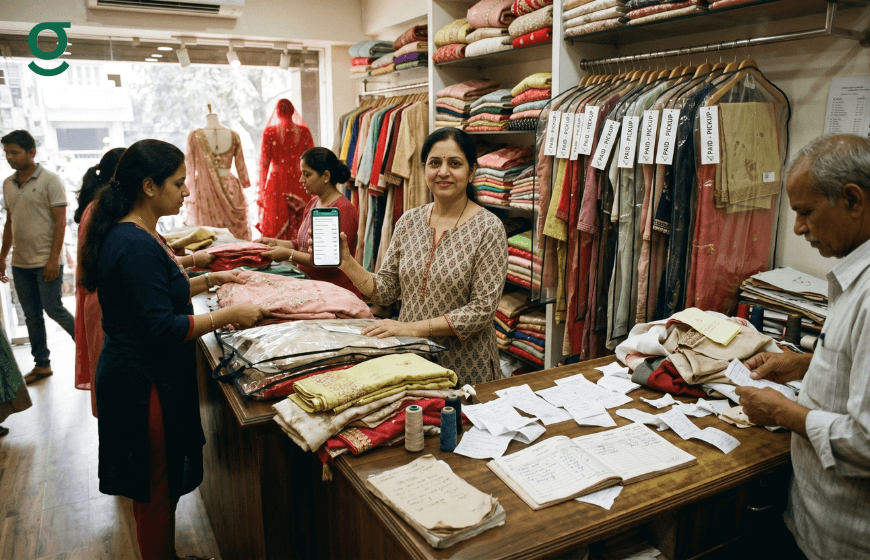
A digital boutique bill book solves four specific advance payment problems that a manual system cannot address.
1. The Missing Balance Flag at Delivery
In GrowStitch, when a staff member opens an order at the delivery counter, the outstanding balance is visible on the order screen before the garment is handed over. The counter staff does not need to remember the balance or refer to a separate bill page. The balance is on the screen. The collection conversation happens before the garment leaves the boutique.
2. The Unrecorded Partial Payment
In a manual bill book, a customer who pays Rs. 500 of a Rs. 1,800 balance at the trial is noted in a brief entry that may or may not be clearly connected to the original advance record. Two weeks later, when the garment is ready, the staff member at the counter sees a balance of Rs. 1,800 rather than Rs. 1,300 because the partial payment was not consistently tracked. GrowStitch logs every payment against the order in real time. The balance updates immediately. Stopping revenue leakage from unrecorded partial payments starts with a system that logs every transaction in one place.
3. The End-of-Month Reconciliation
A boutique that uses a manual boutique bill book typically spends two to four hours at the end of each month reconciling which orders have been paid in full, which have outstanding balances and what the total receivables position is. GrowStitch produces this view instantly from the pending balance dashboard. The reconciliation that took hours takes seconds. The 7 most common billing problems in boutiques all trace back to manual reconciliation failures.
4. The Cash Flow Visibility Gap
A boutique owner who does not know how much advance revenue has been collected this month and how much balance revenue is expected cannot make confident cash flow decisions. GrowStitch's dashboard shows total advances collected, total balance expected and total overdue balances in one view. This visibility informs decisions about fabric purchasing, staff payments and investment in the next month's marketing. A tailor app that tracks every rupee from advance to balance is the cash flow foundation the boutique needs.
Setting Advance Policy Using a Boutique Bill Book
A digital boutique bill book also supports the boutique's advance collection policy. For bridal orders, many boutiques require a 50 percent advance at booking. For simple alterations, no advance may be required. For repeat customers, a smaller advance may be accepted on trust. GrowStitch allows the boutique to configure minimum advance requirements by order type, prompting the front-desk staff to collect the appropriate advance at booking.
The advance policy configuration also serves as a financial safeguard. When a large bridal order is booked without the required advance, it represents a commitment of fabric cost and Karigar time that the boutique has not yet secured. A system that flags the shortfall at order creation gives the owner the opportunity to confirm the advance before production begins rather than discovering the gap when the order is delivered.
When the advance policy is embedded in the system, the boutique does not depend on individual staff members to apply it consistently. A new counter staff member follows the same advance collection standard as the experienced one because the system flags it at order creation. A tailoring software platform that embeds billing policy reduces the variability that manual systems produce.
How GrowStitch Replaces the Physical Boutique Bill Book
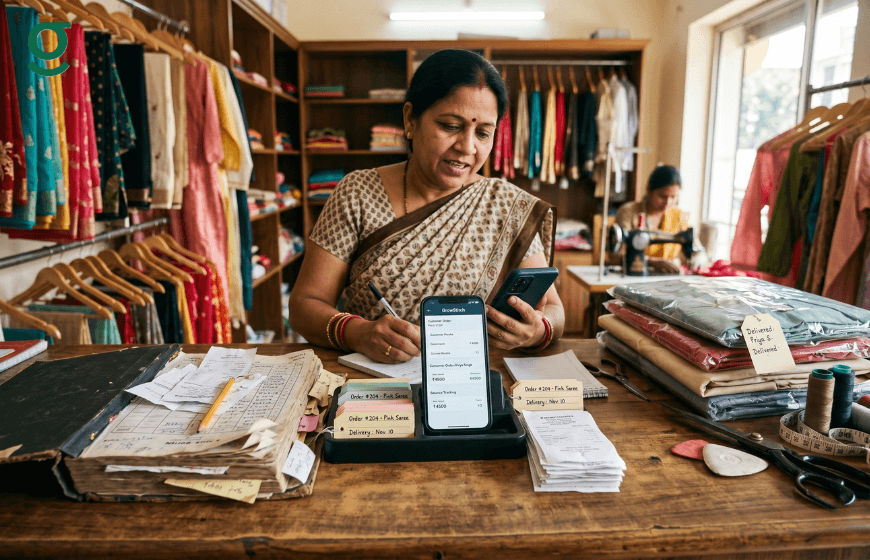
GrowStitch replaces the physical boutique bill book with a digital order record that contains everything the bill book contains plus the real-time payment status, automated reminders and a consolidated receivables view. Every advance is recorded at booking. Every partial payment updates the balance instantly. Every overdue balance is flagged on the dashboard. The counter staff opens the order at delivery and the payment status is visible before the garment is handed over.
For boutiques that have operated with a manual bill book for years, the transition to GrowStitch does not require a complete workflow change. The same information that went into the bill book goes into GrowStitch. The difference is that GrowStitch makes that information active rather than static. A digital bill book app saves 10 or more hours per week by eliminating manual reconciliation.
The physical bill book is not wrong. It is just limited. It cannot flag a balance. It cannot send a reminder. It cannot produce a consolidated receivables report. A tailor app that replaces it with a live digital record delivers all the same information plus the operational functions that the paper version never could. How a tailoring application outperforms a boutique bill book covers the full comparison.
Conclusion: Advance Payments Need a Live System
The boutique bill book is where advance payments begin. For most boutiques, it is also where they get lost. A Rs. 1,200 balance forgotten at delivery is not a customer problem. It is a system problem. GrowStitch makes every advance visible, every partial payment tracked and every outstanding balance impossible to overlook. The boutique collects what it has earned without chasing and without embarrassment. Run your boutique like a Pro: know every rupee from the first advance to the final payment. Download GrowStitch and replace your physical bill book with a live digital payment record today.
Frequently Asked Questions
1. How does a boutique bill book track advance payments?
A boutique bill book tracks advance payments by recording the amount paid at booking alongside the total billing amount and the calculated balance. In GrowStitch, this record is digital and live: the advance is entered at order creation, every subsequent payment updates the balance automatically and the outstanding amount is visible on the order screen at all times. The system flags balances that are not collected by the delivery date.
2. What happens when a customer pays a partial payment between advance and balance?
In GrowStitch, a partial payment is logged against the order immediately. The balance field updates to reflect the new outstanding amount. This updated figure is visible to all staff members with access to the order. When the garment is ready, the system shows the remaining balance rather than the original advance balance, preventing the most common source of balance collection errors at the delivery counter.
3. How does a digital boutique bill book improve cash flow visibility?
A digital boutique bill book improves cash flow visibility by producing a consolidated view of total advances collected, total balances expected and total overdue balances in real time. In GrowStitch, this view is available on the owner's dashboard without any manual calculation. The owner can see the boutique's receivables position at any moment, making fabric purchasing and other cash flow decisions more informed.
4. Can GrowStitch enforce a minimum advance policy?
Yes. GrowStitch allows boutiques to configure minimum advance requirements by order type. For bridal orders, the boutique can set a minimum 50 percent advance requirement. The system prompts the front-desk staff to collect this amount at order creation. This removes the inconsistency that occurs when different staff members apply different advance standards based on personal judgment or customer familiarity.
5. How does tailoring software handle overdue balances?
Tailoring software like GrowStitch handles overdue balances by flagging them on the owner's dashboard and sending automated WhatsApp reminders to the customer. When an order has been in Ready status for more than a configured number of days and the balance has not been collected, the system escalates the flag. The owner sees the overdue balance and can choose to send a personal follow-up or rely on the automated reminder sequence.
6. Is a digital boutique bill book secure?
Yes. GrowStitch stores all billing and payment records in an encrypted, access-controlled platform. Staff members see only the payment information relevant to their role. The owner has full visibility across all orders and payments. Unlike a physical bill book, the digital record cannot be lost, damaged or accessed without authentication.
7. How does a tailor app reduce the time spent on month-end billing reconciliation?
A tailor app reduces month-end billing reconciliation time by maintaining a live payment status for every order. At any point in the month, the owner can see total billing, total collected and total outstanding. There is no manual totalling of bill book pages, no cross-referencing of payment records and no separate list of outstanding balances to compile. The reconciliation view is always current.