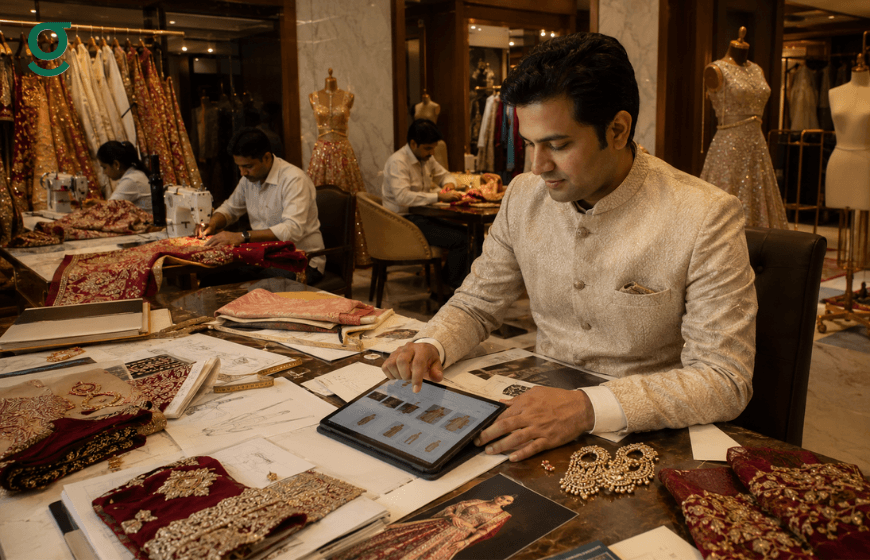
A tailoring application manages multiple garment types in a single order by creating a separate sub-record for each garment component, with its own measurement set, production stage, delivery timeline and billing line item. A lehenga-blouse-dupatta set is entered as one order containing three components, each tracked independently through Cutting, Stitching and Finishing, each billed separately and each with its own quality checkpoint before the full order is marked complete. GrowStitch handles this multi-component order structure natively, without requiring the boutique to create separate orders for each garment.
Most high-value Indian boutique orders are multi-garment orders. A bridal set includes a lehenga, a matching blouse and a dupatta. A groom's outfit includes a sherwani, a churidar and a dupatta. A festive family order may include four different garments with four different fittings. Managing each garment as a separate order multiplies the admin work. Managing them as one record without garment-level tracking loses visibility at the production stage. A tailoring application solves both problems by combining them under one order with individual component tracking. Managing bridal orders through a tailoring application is the most complex test of multi-garment order management.

Why Multi-Garment Orders Are Difficult to Manage Manually
A bridal lehenga set managed in a physical measurement book requires the Masterji to note the lehenga measurements on one page, the blouse measurements on an adjacent page and the dupatta specifications separately. The delivery date is written at the top of the booking page and applies to the whole set. When the blouse is ready but the lehenga is still in Stitching, there is no structured way to record this partial completion in a physical book. The counter staff who takes a delivery call from the customer cannot quickly confirm which components are ready and which are not.
In a WhatsApp-based system, the situation is worse. The bridal order is in a chat thread that contains measurements, design photos, the advance confirmation and a delivery date all mixed together. Finding the blouse measurement from six weeks ago requires scrolling. Confirming the current production stage requires calling the Masterji. The customer who asks 'Is my blouse at least ready even if the lehenga isn't?' gets a delayed answer. Physical measurement books cannot surface the right garment-level information at the right moment.
How a Tailoring Application Structures Multi-Garment Orders
A tailoring application like GrowStitch handles multi-garment orders through a component structure within the same order record.
Separate Measurements Per Garment Component
When a bridal lehenga set is created in the GrowStitch tailoring application, the order contains separate measurement templates for the lehenga and the blouse. The lehenga template captures waist, hip, length, flare and waist drop. The blouse template captures bust, waist, shoulder width, sleeve length and all the blouse-specific fields. The dupatta specifications are noted in the design fields. Each component's measurements are complete and distinct from the others. The Karigar who cuts the lehenga reads from the lehenga measurement record. The Karigar who stitches the blouse reads from the blouse measurement record. There is no cross-referencing required. Error-free measurements for each garment component depend on separate templates that enforce complete capture.
Individual Production Stage Tracking
Each garment component in GrowStitch moves through its own production stages independently. The lehenga may be in Finishing while the blouse is still in Stitching. The Masterji updates each component's stage separately. The owner opens the order and sees the production status of each component at a glance. When the customer calls to ask if her blouse is ready for a pre-delivery fitting, the answer is visible without calling the workshop. Tracking each production stage independently is what gives the owner real-time visibility into a complex multi-garment order.
Per-Component Billing and Pricing
In a multi-garment order, the billing breakdown matters. A lehenga set should show the lehenga stitching charge, the blouse stitching charge and any add-on services like embroidery coordination or lining as separate line items. A combined total without the breakdown leaves the customer unable to understand what she is paying for each component. GrowStitch generates an itemised invoice that shows each component's charge separately. When the customer asks why the total is Rs. 18,400 rather than the Rs. 17,000 she expected, the invoice shows the Rs. 1,400 embroidery coordination charge that was discussed at booking and is now visible in writing. The most common billing problems in boutiques trace back to missing itemisation on multi-component orders.
Separate Trial Dates Per Component
A lehenga and a blouse may require separate trial fittings because they are constructed by different Karigars on different timelines. GrowStitch allows the order to have a blouse trial date and a full-set trial date set independently. The customer receives automated WhatsApp reminders for each. The Masterji sees both on the production dashboard. No fitting is missed because it was assumed to be covered by the other component's trial date.
Multi-Garment Orders During Peak Season
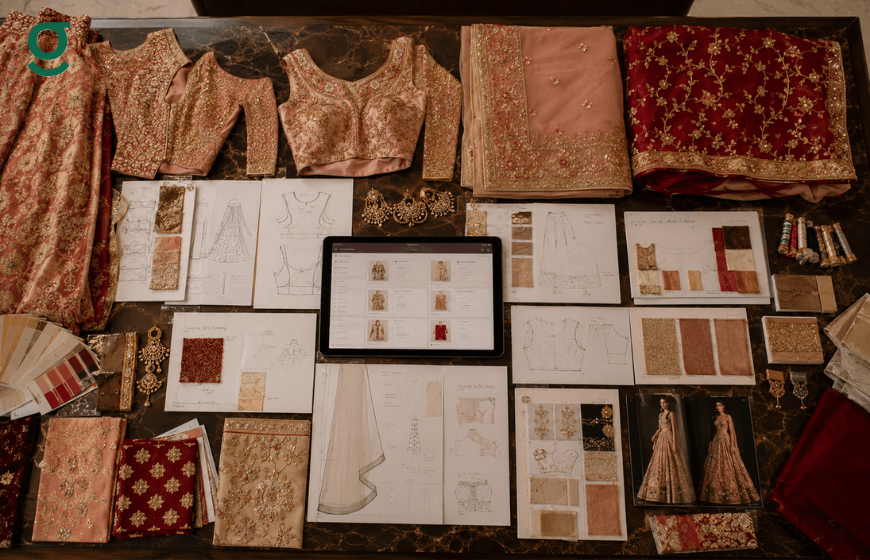
During Diwali and wedding season, a boutique may have 20 to 30 bridal sets in production simultaneously. Each set contains 2 to 4 garment components. Managing 60 to 120 individual garment components in a physical register is the point at which manual systems break completely. The Masterji cannot hold the status of each component in his head. The counter staff cannot answer status queries accurately. Delivery promises become unreliable. Handling high-volume festive season orders without slowing production requires component-level tracking at any order volume.
GrowStitch scales to this complexity without requiring additional staff. The owner opens the dashboard and sees every component of every active bridal set, its current stage and its delivery timeline. The production queue is filterable by component type: the owner can see all active blouses in production across all orders and immediately identify which are approaching their deadline. Eliminating late deliveries during peak season starts with this component-level production visibility.
GrowStitch Marketplace: Every Tailoring Application Order Needs the Right Materials
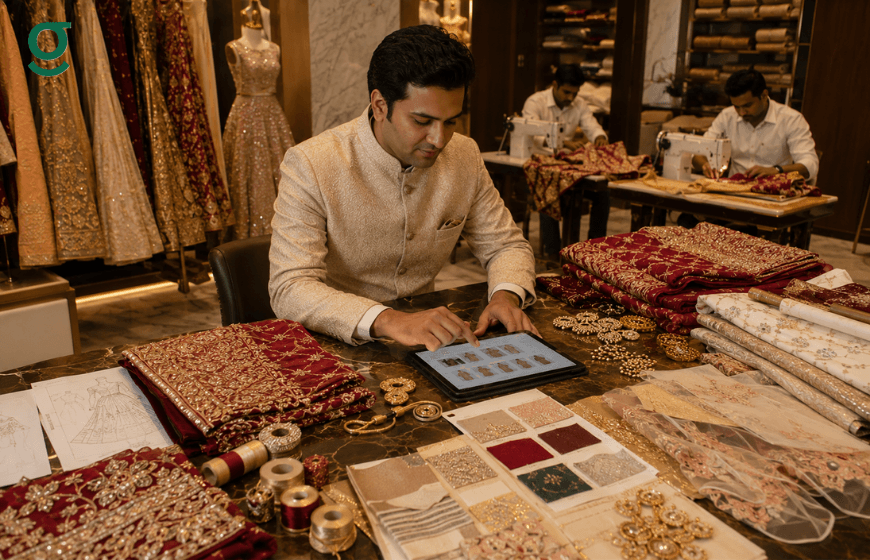
A multi-garment order has multi-material requirements. A lehenga set with a raw silk lehenga and a net blouse requires different lining fabrics, different thread weights, different zip types and potentially different hook-and-eye sizes for each component. Sourcing these materials from local markets introduces the risk of a mismatch between components or a delay when one item is unavailable.
GrowStitch Marketplace is a tailoring-material sourcing platform built inside the same app. When the Masterji identifies the material requirements for each component of a multi-garment order, the boutique owner can order all the required materials in one session: lining, threads, zips, hooks and trims for all components from Marketplace. Materials are delivered to the boutique at competitive prices with next-day delivery available. The production timeline for a complex bridal set is not held up by a missing spool of matching thread from a local supplier who is out of stock.
For boutiques that manage 20 to 30 bridal sets simultaneously during peak season, Marketplace removes the single most common cause of component-level production delay: a missing small material that requires a market visit to source.
Consider a boutique in the third week of November with 22 active bridal sets in production. Each set has 2 to 3 garment components. A total of 55 to 66 individual garments are at various production stages. If a matching thread for one lehenga runs out, the Masterji cannot complete that component until it arrives. In a manual sourcing system, that means a market visit the next morning and a half-day production delay. With GrowStitch Marketplace, the owner orders the thread from the same app while reviewing the production dashboard. It arrives the next morning. The schedule holds.
Conclusion: Multi-Garment Orders Need Multi-Component Tracking
A tailoring application that treats a lehenga set as one undifferentiated order loses the visibility that makes multi-garment delivery reliable. GrowStitch tracks each component separately: measurements, production stages, trial dates and billing line items, all under the same order record. The customer's experience is seamless. The owner's visibility is complete. The Masterji's production instructions are precise for each garment. Run your boutique like a Pro: manage every component of every order with the clarity each one deserves. Download GrowStitch and create your first multi-garment order today.
Frequently Asked Questions
1. How does a tailoring application handle multiple garment types in one order?
A tailoring application handles multiple garment types in one order by creating separate sub-records for each component within the same order. In GrowStitch, a lehenga-blouse set has separate measurement templates, separate production stages, separate trial dates and separate billing line items for each component, all linked under the same customer order and delivery record.
2. Why is it important to track each garment component separately in production?
Tracking each garment component separately in production gives the owner visibility into whether the set is on schedule as a whole. When the lehenga is in Finishing but the blouse is still in Stitching, the owner knows the blouse is the delivery risk and can focus attention on it. Without component-level tracking, the production status of a multi-garment order is a single aggregate stage that tells the owner nothing about which component is the bottleneck.
3. How does GrowStitch handle billing for a multi-garment order?
GrowStitch generates an itemised invoice that shows each garment component's charge as a separate line item. The lehenga stitching charge, the blouse stitching charge and any add-on services are listed individually. The customer sees exactly what she is paying for each component. This itemisation prevents billing disputes on high-value multi-garment orders. Tailoring software that itemises by component is essential for bridal and festive occasion orders.
4. Can a multi-garment order have different trial dates for different components?
Yes. GrowStitch allows each garment component within an order to have its own trial date. A blouse trial can be scheduled before the lehenga is ready if the blouse requires a fitting before the full set is assembled. The customer receives separate tailoring application reminders for each trial date. The Masterji sees all trial dates on the production dashboard.
5. How does Marketplace support multi-garment order production?
Multi-garment orders require multiple material types for each component. GrowStitch Marketplace allows the boutique to order all materials for all components in a single session from the app: different lining fabrics, thread weights, zip types and trims for each garment. Next-day delivery eliminates the market visits that delay individual components and create mismatches between materials sourced from different vendors.
6. What types of multi-garment orders does GrowStitch handle?
GrowStitch handles any multi-component order structure: lehenga-blouse-dupatta bridal sets, sherwani-churidar-dupatta groom's outfits, salwar suit sets, saree-blouse combinations and any boutique-defined combination. Each component type can have its own measurement template, its own production stage tracking and its own billing rate. The tailor app is configured by the boutique owner to match the specific garment categories the boutique produces.