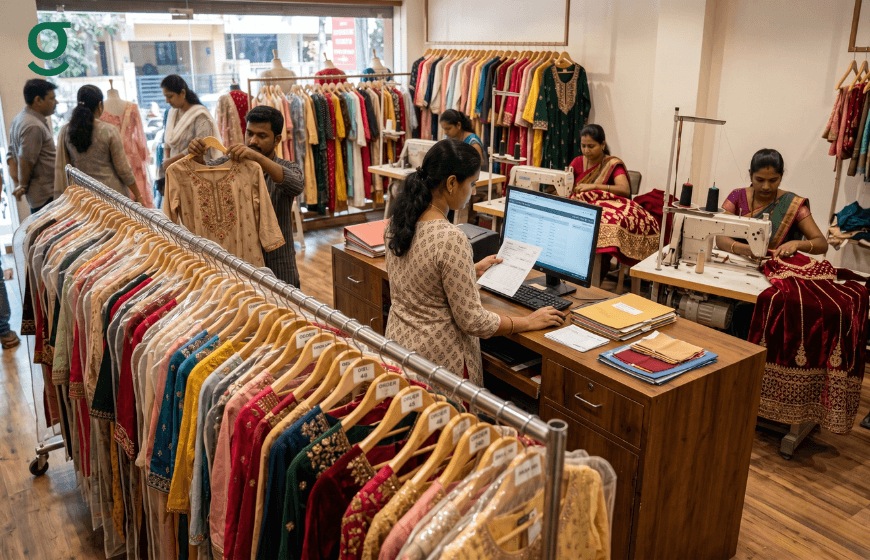
A monthly delivery target is a commitment: to deliver a specific number of garments within their promised timelines across a given month. For most boutique owners running manual systems, this commitment is honoured more by effort and memory than by system. The Masterji works long hours. The owner follows up constantly. Customers call and are told the outfit will be ready tomorrow. Sometimes it is. Sometimes it is not.
A tailoring application replaces this effort-and-memory model with a system-and-visibility model. GrowStitch is a tailoring application designed specifically for Indian boutiques that provides the production stage tracking, delivery date management and team task assignment that allow owners to set realistic monthly delivery targets and hit them consistently rather than reactively. For boutiques evaluating what a tailoring application actually does at the operational level, this complete guide to what a tailoring application manages covers the full platform scope.

Why Delivery Targets Fail Without a Tailoring Application

Delivery target failures in boutiques follow a predictable pattern. An order is created with a delivery date that seemed achievable at the time of booking. Two weeks later, the order is still at Stitching stage with three days to the promised delivery. The owner finds out when the customer calls. The Masterji works overtime to finish. The quality of the rushed finishing is not what it should be. The customer is told the outfit is ready, arrives to find a fitting issue, and the relationship is damaged.
The root cause of this pattern is not effort. The Masterji was working hard. The owner was trying to manage the queue. The root cause is visibility: nobody had a clear picture of where each order stood relative to its delivery date until the gap was too small to close comfortably. A tailoring application provides that visibility before the gap opens.
How to eliminate late deliveries and optimise timelines using GrowStitch's production management layer covers the specific mechanisms that prevent the delivery target failure pattern from becoming the boutique's recurring reality.
How a Tailoring Application Helps Set Realistic Monthly Delivery Targets
Understanding production capacity from historical data
GrowStitch as a tailoring application accumulates production stage history over time. After two to three months of consistent use, the owner can see average stage durations for different garment types: how long a standard blouse spends at Cutting, Stitching and Finishing, how long a bridal lehenga takes across its production stages compared to a simple suit. This historical data allows the owner to set monthly delivery targets based on the boutique's actual demonstrated production capacity rather than optimistic estimates.
Capacity-based booking decisions
With a tailoring application showing the current production queue in real time, the owner can make informed booking decisions. When a customer wants an order delivered in 10 days during wedding season, the owner can open GrowStitch, see how many orders are at each production stage and confidently tell the customer whether 10 days is achievable or whether two weeks would be more reliable given the current load. This confidence is not intuition. It is data.
Monthly target setting with GrowStitch
GrowStitch's tailoring application allows the owner to set a monthly revenue target. This target connects directly to the delivery target: if the boutique's average order value is 3,500 rupees and the monthly revenue target is 105,000 rupees, the implied order delivery volume is 30 orders. Comparing this delivery volume target against the boutique's demonstrated production capacity per month tells the owner whether the target is realistic or requires additional staffing. Monitoring store targets and average order value in GrowStitch covers the specific target-setting workflow in the platform.
How a Tailoring Application Helps Hit Monthly Delivery Targets

Real-time production stage visibility
The GrowStitch tailoring application shows every active order's current production stage alongside its delivery date. When an order is two stages from completion with three days to delivery, it is visible at a glance. When an order is one stage from completion with the delivery date today, it is flagged. The owner does not discover delivery risks when the customer calls. She identifies them during the daily dashboard review.
Karigar task assignment and workload visibility
GrowStitch's tailoring application assigns each production stage to a specific Karigar. The owner can see which Karigar is carrying the heaviest load and which has capacity to absorb reassigned work. When a particular garment is at risk of missing its delivery date, the owner reassigns it to a less burdened Karigar. Daily task assignment and team accountability in GrowStitch covers the specific workflow for managing Karigar assignments through the platform.
Delivery date buffer management
A discipline that boutiques using GrowStitch's tailoring application develop quickly is buffer management: setting internal delivery dates in GrowStitch two to three days earlier than the customer-facing delivery date. This buffer absorbs minor production delays, fitting adjustment time and pickup scheduling variability. The tailoring application tracks the internal deadline while the counter staff communicates the customer-facing date. The boutique delivers to the internal deadline and the customer receives the outfit on or before the promised date.
Production insights for bottleneck elimination
GrowStitch's tailoring application generates production insights showing which stages create the most delays across the monthly order volume. If the Finishing stage is consistently the bottleneck, the owner can investigate: Is it under-staffed? Is the Karigar assigned to Finishing also carrying Stitching work? Is the quality check standard creating excessive rework? How to track production stages and eliminate bottlenecks covers the specific production management capabilities in GrowStitch that support this bottleneck elimination process.
The Monthly Delivery Target Review Process
At the end of each month, GrowStitch's tailoring application provides the data for a systematic delivery target review. How many orders were set for delivery this month? How many were delivered on time? Which orders were delivered late and at which production stage did the delay originate? Which team members' assigned orders had the highest on-time delivery rates?
This review, conducted from the GrowStitch dashboard, takes 15 minutes and produces actionable intelligence for the following month: which stages need more capacity, whether the monthly delivery target needs to be adjusted based on current team size and whether any specific production practices need to change to improve the on-time delivery rate.
Conclusion
Monthly delivery targets are achievable when a tailoring application gives the owner the production visibility to set them accurately, the task assignment tools to manage the queue proactively and the bottleneck intelligence to improve the system continuously. GrowStitch is a tailoring application built specifically to give Indian boutique owners this operational control.
The boutique that sets and hits its monthly delivery targets consistently builds something that no marketing investment can directly create: a reputation for reliability. GrowStitch's tailoring application is the operational foundation that makes that reputation systematic rather than coincidental.
Run your boutique like a Pro. Download GrowStitch free: Download GrowStitch
FAQs:
1. How does a tailoring application help set realistic monthly delivery targets?
GrowStitch accumulates production stage history over time, showing average stage durations for each garment type. This historical data allows owners to set monthly delivery targets based on the boutique's demonstrated production capacity rather than optimistic estimates. The real-time production queue view supports informed booking decisions when customers request specific delivery windows.
2. How does GrowStitch tailoring application flag at-risk delivery orders?
GrowStitch shows every active order's current production stage alongside its delivery date. When an order is falling behind schedule relative to its delivery date, the production dashboard makes this visible during the owner's daily review rather than when the customer calls to ask where the garment is.
3. What is buffer management in a tailoring application and why does it matter?
Buffer management means setting internal delivery dates in GrowStitch two to three days earlier than the customer-facing delivery date. This buffer absorbs minor production delays and fitting adjustment time. The tailoring application tracks the internal deadline while the boutique communicates the customer-facing date, significantly improving on-time delivery rates without any additional production speed.
4. How does a tailoring application help manage Karigar workload for delivery targets?
GrowStitch assigns each production stage to a specific Karigar and shows the owner which team members are carrying the heaviest loads. When an order is at risk of missing its delivery date, the owner can reassign it to a less burdened Karigar from the dashboard. This rebalancing capability is the most direct operational lever for improving monthly on-time delivery performance.
5. Can GrowStitch tailoring application generate a monthly delivery performance review?
Yes. GrowStitch provides the data for a monthly delivery review: orders set for delivery, on-time delivery rate, late orders by stage of delay and team member delivery performance. This review takes 15 minutes from the dashboard and produces actionable intelligence for capacity planning and process improvement in the following month.
6. How does a tailoring application connect delivery targets to revenue targets?
In GrowStitch, the monthly revenue target and the production capacity data together imply a delivery volume target. If the revenue target requires 30 deliveries per month and the current production capacity supports 25, the gap is visible before it becomes a problem. This connection between financial targets and operational capacity is what makes tailoring application-based target setting more reliable than intuition-based target setting.