
A tailoring application simplifies trial scheduling by attaching a trial date to every order at booking, triggering automated WhatsApp reminders to customers 24 hours before each trial and giving the owner a complete trial calendar view across all active orders. Fitting notes captured after each trial are stored permanently against the customer profile and are available for every future order. GrowStitch manages trial scheduling as part of the order workflow, not as a separate administrative task that relies on a diary or a WhatsApp reminder set by hand.
Trial management is one of the most chaotic and most avoidable operational headaches in Indian boutiques. Missed trials, overlapping appointments, last-minute reschedules and forgotten fitting notes are all symptoms of a manual system that cannot scale reliably past 20 to 30 active orders. This guide explains how a tailoring application brings structure to trial scheduling and what changes in the boutique when it does.

Why Trial Scheduling Is a Bigger Problem Than It Appears
A missed trial does not look expensive in isolation. The customer calls to reschedule, a new slot is found and the order continues. But the cumulative impact is significant. When a trial is missed, the garment's production timeline slips. The Masterji cannot complete fitting adjustments without the customer present. The next available trial slot may be a week away. The delivery date the customer was expecting is now in jeopardy before the boutique has made any visible mistake.
Multiply this across three or four missed trials in the same week and the workshop's production schedule begins to fragment. Orders that should be at Finishing are waiting on re-trials. Other orders pile up behind them. This production bottleneck is one of the most common causes of delivery delay that boutiques experience.
The second problem is trial data loss. When a customer arrives for a fitting and the Masterji cannot locate her fitting notes from the last visit, the session is less precise and the risk of a repeat alteration rises. Physical measurement books cannot reliably surface the right fitting history at the right moment. A tailoring application does this automatically, without anyone searching.
What a Tailoring Application Does for Trial Scheduling

A tailoring application handles four trial management functions that manual systems cannot perform consistently at scale.
1. Trial Date Attached at Order Booking
In GrowStitch, every order includes a trial date field filled at the time of booking. The trial date is part of the order record, not a separate diary entry. The Masterji sees which orders have upcoming trials directly on the production dashboard. The front-desk staff sees the same. There is no separate trial register to maintain and no risk of the trial date being stored in one place while the order details are in another. A dedicated tailor app centralises all order details including trial dates in a single accessible record.
2. Automated Trial Reminders
GrowStitch sends an automated WhatsApp reminder to the customer 24 hours before their scheduled trial, including the time and the boutique's address. The customer does not need to remember the date from the verbal mention at booking. No-show rates fall significantly in boutiques that implement automated trial reminders. Capturing detailed fitting information requires the customer to actually be present, which makes the reminder a direct investment in fitting quality and garment accuracy.
3. Trial Calendar View for the Owner
The owner opens GrowStitch and sees all upcoming trials across the next seven days. Each trial is linked to the order and the customer profile. The owner can see at a glance if two bridal trials are scheduled at the same time and reschedule one before both customers arrive. This visibility is impossible with a diary-based system where trial appointments may be spread across multiple pages, WhatsApp threads or verbal agreements.
4. Fitting Notes Captured Against the Order
After each trial, the Masterji records fitting adjustments directly in the order record in GrowStitch. These notes are stored permanently against the customer profile. When the customer comes for a second trial or places a new order in future, the full fitting history is available instantly. Error-free adjustments depend on accurate notes captured precisely at the trial itself.
The Trial Scheduling Problem During Peak Season
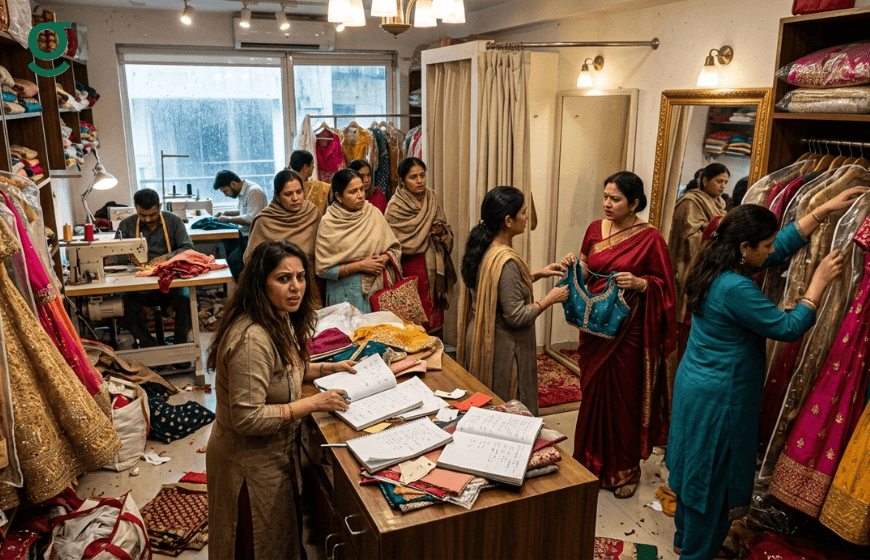
Trial scheduling is manageable during quiet months when a boutique has 20 to 25 active orders. It becomes acute during wedding and festive seasons when 60 to 80 orders may be active simultaneously. In a manual system, trial appointments for October and November bridal orders are spread across a physical register that multiple staff members need to access and update throughout the day. Handling high-volume festive season orders without slowing production requires a scheduling system that does not depend on a single physical register.
With GrowStitch, every trial date is visible in the digital order record and accessible from any device. Scheduling conflicts surface before they become problems. Rescheduling updates the order record and generates a new customer WhatsApp notification automatically with no separate step required.
What Happens to Production When Trial Scheduling Improves
Trial scheduling and production efficiency are directly connected. When trials happen on time and fitting notes are captured accurately, the workshop receives clear adjustment instructions and moves the garment to the next stage without waiting for a re-trial. Production stage tracking is only reliable when trials complete on schedule.
In a boutique that manages trials well, the owner can commit to delivery dates confidently because the production timeline between trial and final delivery becomes predictable. In a boutique where trials are frequently missed or rescheduled, every delivery date is provisional and customer trust gradually erodes even when the quality of the garments is high.
The tailor app creates this reliability by embedding trial management into the order workflow. The trial is not an external event managed separately from production. It is a tracked stage in the production process that the system reminds, records and surfaces to the right person at the right time.
How GrowStitch Handles Trial Rescheduling
Rescheduling is inevitable in a boutique. A customer calls to move her trial from Tuesday to Thursday because of a work commitment. In a manual system, this requires finding the diary entry, crossing out the date, writing the new date, updating the Masterji verbally and hoping nothing is missed in the chain. In GrowStitch, the owner or front-desk staff updates the trial date in the order record in two taps. The customer receives a reschedule confirmation via WhatsApp automatically. The Masterji's production dashboard reflects the new trial date immediately.
Using Trial Data for Boutique Planning
Every trial record in GrowStitch is also a data point for business planning. Over time, the boutique can see which garment types require multiple trials most frequently, which customers consistently reschedule and which Masterjis complete fittings accurately on the first attempt. This data directly informs staffing decisions, booking policies and Karigar performance reviews. Eliminating recurring production errors starts with structured data capture at every workflow stage.
Using a Tailoring Application to Analyse Trial Patterns Over Time
Every trial record in GrowStitch is also a data point. Over months of operation, the boutique can see which garment types require multiple trials most frequently, which customers consistently reschedule and which Masterjis complete first-time fittings most accurately. This data directly informs staffing decisions, booking policies and Karigar performance reviews. A tailoring application that captures this information accurately turns each trial into an investment in future fitting quality, not just a one-time event.
For boutiques that charge separately for trials or second fittings, this data also supports the pricing conversation. When the data shows that a particular garment type averages 1.8 trials per order, the trial cost can be built into the standard pricing rather than absorbed as an untracked overhead.
![][image1]
Conclusion: Trial Scheduling Is a System Problem
Every missed trial in a boutique is a system failure, not a human one. The customer forgot because no reminder came. The Masterji prepared for the wrong date because the diary was not updated. The fitting notes were incomplete because there was no structured template to fill. A tailoring application like GrowStitch resolves all three failure points by embedding trial management into the order record. The reminder goes out automatically. The Masterji sees the upcoming trial on his dashboard. The fitting notes are captured in a structured template that stays with the customer profile permanently. Download GrowStitch and bring structure to your trial scheduling today.
Frequently Asked Questions
1. How does a tailoring application simplify trial scheduling?
A tailoring application simplifies trial scheduling by attaching a trial date to every order at booking, sending automated WhatsApp reminders 24 hours before each trial and giving the owner a calendar view of all upcoming trials. Fitting notes captured after each trial are stored permanently against the customer profile and available for all future orders.
2. What happens when a customer misses a trial without a reminder system?
Without automated reminders, trial no-show rates in boutiques typically run between 15 and 25 percent. Each missed trial pushes the garment's production timeline back by the gap between the missed date and the next available slot. For bridal boutiques with multiple orders per customer, repeated missed trials compound into significant delivery delays and customer dissatisfaction.
3. Can a tailor app handle trial rescheduling automatically?
Yes. When a trial date is updated in GrowStitch, the tailor app automatically sends a reschedule confirmation to the customer via WhatsApp and updates the trial date in the Masterji's production dashboard. No additional notification step is required from the staff member who made the change in the system.
4. How does a tailoring application store trial fitting notes?
GrowStitch includes a fitting notes field in the order record that the Masterji updates after each trial. Notes cover adjustments made: sleeve shortened, waist taken in, embroidery panel repositioned. These notes remain attached to the order and the customer profile, making them available for the next fitting and for any future order the customer places.
5. Does trial scheduling through a tailoring application work for multi-Masterji workshops?
Yes. Each trial in GrowStitch is linked to the order and the assigned Masterji. The owner sees the full trial load across all Masterjis and can redistribute if one is overloaded on a particular day. This visibility is critical during wedding season when multiple Masterjis are handling bridal orders simultaneously.
6. How does trial management directly connect to delivery date accuracy?
Delivery date accuracy depends on the trial happening on schedule. When a trial is missed, the adjustment work is delayed, which pushes the finishing stage and the final delivery. A tailoring application that manages trial scheduling directly reduces delivery date variance because it eliminates the most common cause of mid-production delays.
7. What fitting detail should be recorded after every trial?
After every trial, the Masterji should record any measurement adjustments made, the reason for the adjustment, whether a second trial is required and the revised delivery date if the timeline has shifted. GrowStitch's fitting notes field supports all of these and stores them permanently against the order and the customer profile for future reference.