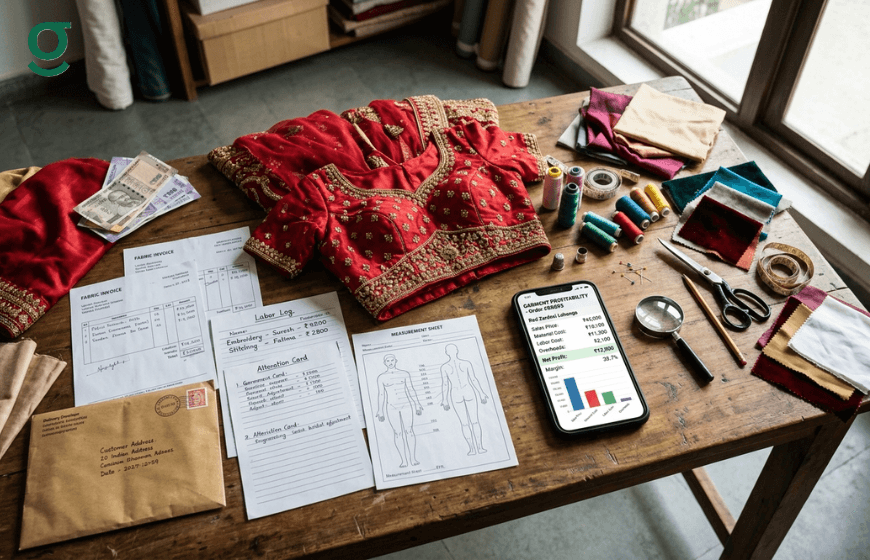
A tailoring application tracks profit per garment by connecting the revenue side of every order: billing amount, advance received and balance collected. It maps this against the cost side: fabric used, stitching time, add-on services and any rework required. The result is a per-order profitability view that most boutiques have never had access to. GrowStitch provides this automatically from data captured during normal order processing. No separate spreadsheet. No manual cost allocation exercise at the end of the month.
Most Indian boutiques know their monthly revenue. Very few know their monthly profit. The gap between the two is filled by fabric wastage, uncollected balances, underbilled add-ons and rework costs that disappear silently into the operation. A tailoring application surfaces each of these leaks by connecting data that was always present but never in one place. Revealing hidden revenue gaps is the first step in improving boutique profitability.

Why Profit Per Garment Is Invisible in Most Boutiques
A boutique owner who bills Rs. 3,200 for a lehenga choli believes the order generated Rs. 3,200. The actual calculation is different. The fabric cost was Rs. 900. The stitching Karigar spent 6 hours on the garment at an implicit hourly cost of Rs. 50. A zip and lining were added but not billed. The advance of Rs. 1,000 was received but the Rs. 2,200 balance was never collected because the customer stopped responding. The order actually produced Rs. 800 in net cash. Not Rs. 3,200.
This is not an unusual scenario. It happens with predictable frequency across boutiques of every size. The leakage occurs at multiple points and none of them are visible in isolation. Fabric cost is in the procurement record. Stitching time is in the Masterji's head. Add-on services are sometimes in the bill and sometimes not. The uncollected balance is in the bill book. Assembling the real picture requires reconciling four separate sources that are rarely in the same room at the same time.
A tailoring application eliminates the reconciliation by capturing all four components in the same order record from the point of booking.
How a Tailoring Application Connects Revenue and Cost Per Order
Fabric Cost Capture
GrowStitch's service catalogue includes fabric rates per metre by material type. When an order is created, the fabric type and quantity used are recorded. The system applies the configured rate to calculate the fabric cost component of that order. Over a month, the boutique has an actual fabric cost per order type rather than an estimate drawn from memory. Avoiding calculation errors on fabric and stitching charges starts with a configured rate catalogue.
Stitching Time Tracking
GrowStitch records timestamps at each production stage. The time spent at the stitching stage is visible per order. For a boutique that compensates Karigars by the piece or by the hour, this data makes the actual stitching cost per order calculable rather than approximate. Over time, the owner can see which garment types consume the most Karigar time relative to the billing amount and adjust pricing accordingly. Stage-wise time data is what transforms production tracking into a profit visibility tool.
Add-On Service Billing
In a manual system, add-on services such as embroidery coordination, lining, express delivery and special finishing are sometimes billed and sometimes forgotten when the boutique is under pressure. GrowStitch's tailoring application requires add-on services to be selected from a pre-configured list when the order is created. The billing is automatic. Nothing is missed under peak season pressure. The most common billing problems in boutiques all trace back to manual add-on tracking.
Pending Balance Visibility
GrowStitch tracks payment status for every order in real time: Paid, Partially Paid or Pending. The total pending balance across all active orders is visible on the owner's dashboard at all times. An order that is billed but not fully collected is flagged until the balance is received. Revenue leakage from uncollected balances is one of the most significant and most fixable profit gaps in a boutique.
![][image1]
Revenue vs Cost Per Order: A Practical Comparison
| Cost Component | Manual Boutique | GrowStitch Tailoring Application |
|---|---|---|
| Fabric cost | Estimated at booking. Rarely tracked accurately per order. | Fabric rate per metre configured in catalogue and applied to every order. |
| Stitching time | Not tracked. Karigar allocation runs on habit and verbal instruction. | Stage timestamps show actual time spent per order at each production stage. |
| Add-on services | Sometimes missed in billing when the boutique is busy. | Add-on rates pulled from catalogue and applied at order creation. Nothing missed. |
| Rework cost | Absorbed silently into fabric and Karigar time. Never attributed to the original order. | Rework orders flagged separately and traceable against the original order. |
| Pending balance | Partially tracked. Some balances go uncollected for months. | Real-time payment status per order. All pending balances surfaced on the owner's dashboard. |
The Profit Per Garment Calculation Framework

With the data GrowStitch captures, a boutique owner can calculate profit per garment type using a straightforward, repeatable framework.
Gross revenue: total billing amount for the order including all services billed.
Fabric cost: fabric rate per metre multiplied by metres used, from the order record.
Stitching cost: hours at the stitching stage multiplied by Karigar rate, from production timestamps.
Add-on costs: any external services added to the order such as embroidery or lining materials.
Net revenue collected: billing amount minus any uncollected balance.
Profit per garment: net revenue collected minus fabric, stitching and add-on costs.
Running this calculation across a month's orders by garment type reveals which products are actually profitable. A boutique running 30 lehengas and 20 blouses a month may discover that blouses generate 60 percent of net profit on 40 percent of orders because the stitching time is shorter and the fabric cost is lower. This insight directly informs which orders to prioritise, which services to reprice and which garment types to promote actively.
Over time, per-garment profitability data becomes a planning tool. Identifying revenue trends by garment type and by month gives the boutique owner data that most competitors are operating without.
What Boutique Management Software Adds to Profit Tracking

Boutique management software like GrowStitch aggregates per-order data into monthly profitability summaries. The owner sees total revenue, total fabric cost, total pending balances and production efficiency in one view. The analytics module shows which months are most profitable, which garment types generate the highest margins and where cost overruns occur most frequently. A single dashboard for orders, payments and production is the infrastructure on which profit visibility is built.
For boutiques considering expansion, whether adding a second Masterji or opening a second location, this profitability data is the business case. The owner is not expanding on feeling. They are expanding on a per-garment profit figure that shows how much additional capacity the business can profitably absorb. Boosting boutique profit starts with measuring the five foundational metrics that a management platform provides.
How a Tailoring Application Changes Pricing Decisions
When a boutique owner can see profit per garment type, pricing decisions become data-driven rather than intuitive. If embroidered blouses consistently produce lower margins than plain ones because the external embroidery vendor cost is not being fully passed through in the bill, the tailoring application makes this visible. The owner adjusts the embroidery coordination charge on the next order. If bridal lehengas are generating strong gross revenue but thin net margins because of high fabric cost and long Karigar hours, the pricing is reviewed before the next season's bookings open.
This kind of proactive pricing review is what separates boutiques that grow profitably from ones that grow in volume but stagnate in profit. The data to make these decisions is already in the business. A tailoring application surfaces it.
Conclusion: Profit Visibility Is a System Decision
A boutique owner who cannot see profit per garment is making pricing and capacity decisions on incomplete information. The costs are already in the business. The revenue is already being billed. The gap is simply a system that connects them in one clear view. GrowStitch's tailoring application fills that gap by capturing fabric cost, stitching time, add-on services and payment status in the same record where the order lives. The calculation is not an end-of-month exercise. It is a live view available every day of the month. Download GrowStitch and see your first garment-level profit view today.
Frequently Asked Questions
1. How does a tailoring application track profit per garment?
A tailoring application tracks profit per garment by connecting the billing amount, fabric cost, stitching time and add-on service charges in a single order record. GrowStitch pulls fabric costs from the configured rate catalogue, production time from stage timestamps and billing data from the invoice module, making per-order profitability visible without manual calculation.
2. What cost components does GrowStitch capture for each order?
GrowStitch captures fabric cost based on material type and metres used, stitching time based on production stage timestamps, add-on services from the order record at creation and any uncollected balance from the payment status tracker. These four components combined with the billed amount are sufficient to calculate net profit per order.
3. Why is profit per garment invisible in most boutiques?
Profit per garment is invisible because the cost components live in different places: fabric cost in procurement notes, stitching time in the Masterji's memory, add-on services sometimes in the bill and sometimes not. Uncollected balances sit in the bill book with no one reconciling them against the order. A tailoring application centralises all four in the order record, making the calculation automatic rather than a manual reconciliation exercise.
4. How does boutique management software help with profit analysis?
Boutique management software aggregates per-order data into monthly profit summaries. The owner compares profitability by garment type, by month and by Karigar. This analysis is not available in a manual system because the underlying data is too fragmented to reconcile without significant manual effort on a regular basis.
5. Can a tailoring application help identify underpriced services?
Yes. When profit per garment is tracked, the owner can see which services consistently produce low or negative margins. If embroidery coordination is billed at Rs. 300 but the actual cost in Karigar time and external vendor charges is Rs. 450, the tailoring application makes this visible. The owner adjusts the pricing before the next order rather than continuing to absorb a known loss.
6. Which garment types are typically most profitable in an Indian boutique?
Profitability varies across boutiques based on pricing, fabric sourcing and Karigar skill mix. A tailoring application reveals the actual margin per garment type based on the boutique's own data. Blouses, salwar suits and ethnic co-ords often show stronger margins than heavy bridal lehengas because the stitching time is shorter relative to the billing amount. Only the boutique's own data confirms this.