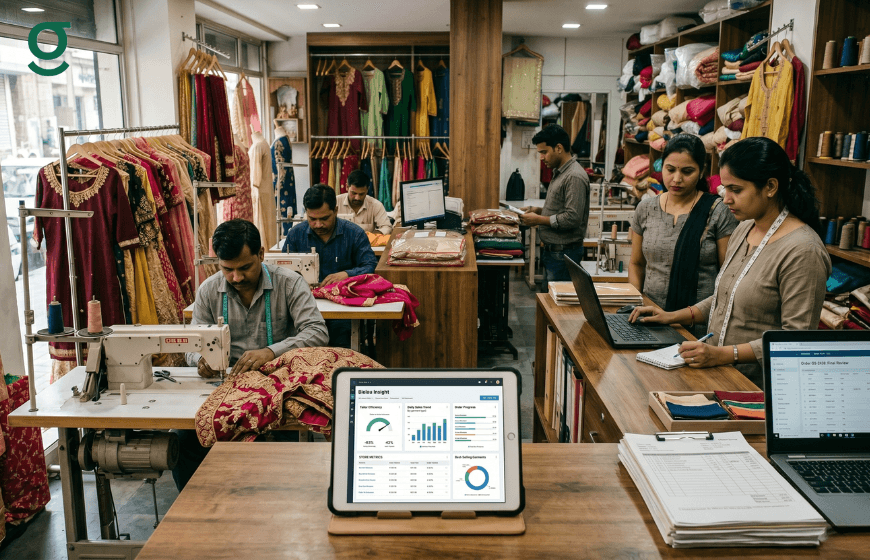
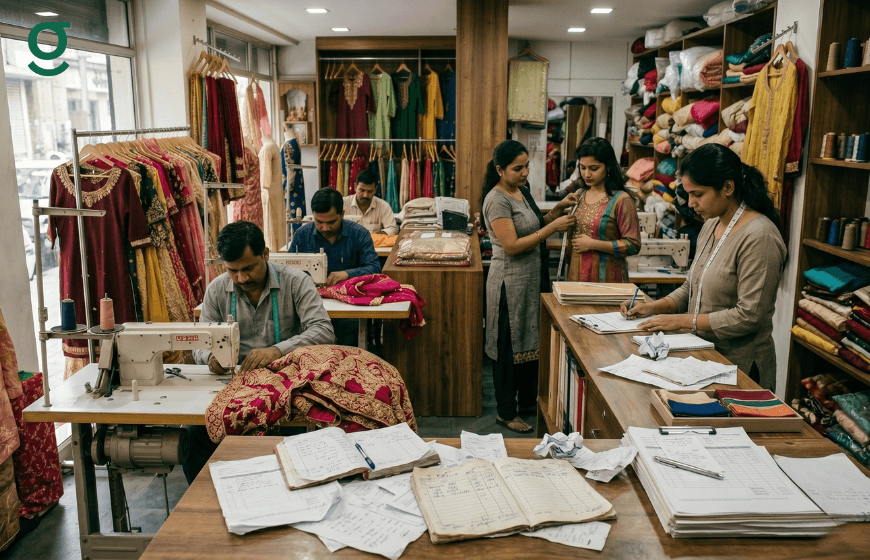
Every tailoring boutique generates data every single day. An order created at the counter is a data point. A production stage updated by the Masterji is a data point. A payment recorded at delivery is a data point. A measurement captured for a repeat customer is a data point. In a boutique running manual systems, all of this data is created and immediately lost: written in a register, noted in a diary, sent via WhatsApp or held only in one person's memory.
Boutique management software captures every one of these data points in a structured digital system and converts them into business intelligence automatically. GrowStitch boutique management software is built around this principle: the daily operational activity of the boutique, without any additional reporting effort from the owner, generates the growth metrics, production insights and market intelligence that inform every strategic decision. For boutiques evaluating the category, how boutique management software measures business growth explains what the intelligence layer looks like in practice.

The Shop-Floor Data That Boutique Management Software Captures
Order data
Every order created in GrowStitch boutique management software adds to the business intelligence layer: the garment type, the customer profile, the order value, the add-ons confirmed, the delivery date and the advance paid. Over a month of 60 orders, this data tells the owner which garment categories are generating the most revenue, what the average order value is and whether the mix of garment types is moving toward higher-margin categories or away from them.
Production data
Every production stage update in GrowStitch boutique management software adds to the operational intelligence layer: how long each garment spends at each stage, which stages create the most delays and which team members have the highest and lowest stage-completion rates. How production insights reveal bottlenecks before they become delivery failures is one of the most operationally valuable outputs of the production data layer in GrowStitch.
Payment data
Every payment recorded in GrowStitch boutique management software adds to the financial intelligence layer: daily collections, outstanding balances, partial payment patterns and end-of-month revenue totals. This data generates the financial dashboard that shows the owner whether the business is collecting what it has earned and where outstanding balances are concentrating.
Customer data
Every customer interaction in GrowStitch boutique management software adds to the customer intelligence layer: the customer's order frequency, their average order value, their most recent visit and whether they are a new or returning customer. Over time, this data identifies the boutique's top-value customers, the customers who have lapsed and the average time between a first and second order.
The Business Intelligence Outputs of GrowStitch Boutique Management Software
Revenue versus target tracking
GrowStitch boutique management software converts daily payment data into a live revenue-versus-target dashboard. The owner sets a monthly revenue target and the dashboard shows real-time progress toward that target throughout the month. Monitoring average order value and monthly targets in GrowStitch explains the specific target-tracking mechanics in the platform.
Production bottleneck analysis
GrowStitch boutique management software converts production stage data into bottleneck intelligence: which stages are consistently slow, which orders are most at risk of missing their delivery date and which team member's assignments are creating the longest queues. This intelligence enables the owner to intervene proactively rather than managing delivery failures after they occur.
Market ranking and benchmarking
GrowStitch boutique management software converts the boutique's order and revenue data into a market ranking within the boutique's pin code and city category. The owner sees not just how the boutique is performing in absolute terms but how it is performing relative to other boutiques in the same local market. This external reference point turns internal performance data into competitive intelligence.
India versus overseas performance split
For boutiques serving both local and overseas customers, GrowStitch boutique management software converts the geographic dimension of order data into separate India and overseas performance metrics. Mastering India versus overseas performance using the GrowStitch intelligence layer gives boutique owners the data needed to make pricing and capacity decisions specific to each market segment.
Why Manual Systems Cannot Convert Shop-Floor Data into Business Intelligence

A physical register records what happened. It does not analyse it. An owner who reviews the register at month-end sees a stack of entries. She can manually count them, add up the totals and compare with last month's count. This process takes hours and produces a number, not intelligence. It tells her the revenue total but not the average order value trend. It tells her how many orders were created but not which garment categories are growing. It tells her what was collected but not what is still outstanding.
Boutique management software removes this gap entirely. Every order created during the day automatically updates the category breakdown, the AOV calculation, the production queue and the revenue target progress. The owner's daily 90-second dashboard review covers the same ground that a manual system requires two hours to produce, and does so with complete accuracy rather than accumulated human error.
For boutique owners who have been running on manual systems and wondering whether the daily shop-floor chaos they manage contains valuable business intelligence, how GrowStitch insights help make smarter decisions demonstrates exactly what that intelligence looks like when it is captured and structured automatically.
The Compounding Value of Business Intelligence Over Time
The intelligence that boutique management software generates becomes more valuable over time. After one month, the owner has baseline data. After three months, she can distinguish seasonal patterns from structural trends. After six months, she has enough production history to predict how long specific garment categories take at different staffing levels. After a year, she has a complete seasonal cycle of data that makes the following year's planning accurate rather than approximate.
GrowStitch boutique management software is designed to be the long-term intelligence platform of the boutique, not just a tool for managing today's orders. Every month of data captured is a month of intelligence that cannot be recovered if the boutique switches back to manual systems. The earlier a boutique starts capturing shop-floor data in a structured digital system, the sooner that data starts generating actionable intelligence.
Conclusion
Boutique management software does not require the owner to do additional work to generate business intelligence. It generates intelligence as a byproduct of the daily operational work the team was already doing: creating orders, updating production stages, recording payments and serving customers. GrowStitch boutique management software captures all of this activity in a structured digital system and converts it into the revenue trends, production insights, customer intelligence and market benchmarking that allow the boutique to be run on data rather than assumptions.
Every boutique generates data every single day. GrowStitch boutique management software makes sure that data is captured, structured and worth something actionable.
Run your boutique like a Pro. Download GrowStitch free: Download GrowStitch
FAQs:
1. How does boutique management software turn shop-floor data into business intelligence?
GrowStitch captures four categories of daily operational data: order data, production stage data, payment data and customer interaction data. Each category feeds a corresponding intelligence output: revenue trends, production bottleneck analysis, financial dashboard and customer value ranking. All of this happens automatically without any additional reporting effort from the owner.
2. What business intelligence outputs does GrowStitch boutique management software provide?
GrowStitch provides revenue versus target tracking, production bottleneck analysis, market ranking in your pin code and city, India versus overseas performance split, average order value trend, repeat customer rate and garment category revenue breakdown. All outputs update automatically from daily operational data.
3. How does market ranking work in GrowStitch boutique management software?
GrowStitch's Growth Insights layer uses the boutique's order and revenue data to calculate its performance rank relative to other boutiques in the same pin code and city category. This external benchmarking converts internal performance data into competitive intelligence, showing the owner whether the boutique is gaining or losing ground relative to local competition.
4. Can boutique management software help identify production bottlenecks?
Yes. GrowStitch's production intelligence layer shows how long each order spends at each production stage, which stages create consistent delays and which orders are most at risk of missing delivery dates. This intelligence enables proactive intervention before delivery failures occur rather than managing complaints after.
5. How long does it take for boutique management software to generate useful business intelligence?
GrowStitch generates baseline data from the first month of use. By month three, the owner can distinguish seasonal patterns from structural trends. By month six, production history is detailed enough to support accurate capacity planning. The intelligence layer becomes increasingly valuable as more operational data flows through the platform.
6. Is the business intelligence in GrowStitch available to all team members?
No. GrowStitch's role-based permissions restrict the business intelligence dashboard, revenue data and market ranking to the admin level. Counter staff and production team members see only the operational information relevant to their daily tasks. Sensitive business intelligence is protected and visible only to the owner and designated managers.