
Tailoring software generates a monthly business health report automatically by aggregating all order, billing, payment and production data accumulated during the month into a structured summary that covers five areas: total revenue earned, total pending balance uncollected, average order value, production efficiency and top-performing garment categories. The owner does not compile this report manually. The platform generates it from the data the boutique has produced during normal operations. GrowStitch produces this business health view continuously, with the monthly summary available on the first day of the following month.
Most Indian boutique owners end the month knowing roughly how much revenue they earned. Very few know their average order value, their on-time delivery percentage, their most profitable garment category or their pending balance as a percentage of total billing. These are not exotic analytics. They are the data points that distinguish a boutique running on information from one running on instinct. Tailoring software makes all of them available automatically, without any manual report preparation. GrowStitch Insights gives boutique owners the data-led decision support that manual tracking cannot provide.

The Five Sections of a Monthly Business Health Report
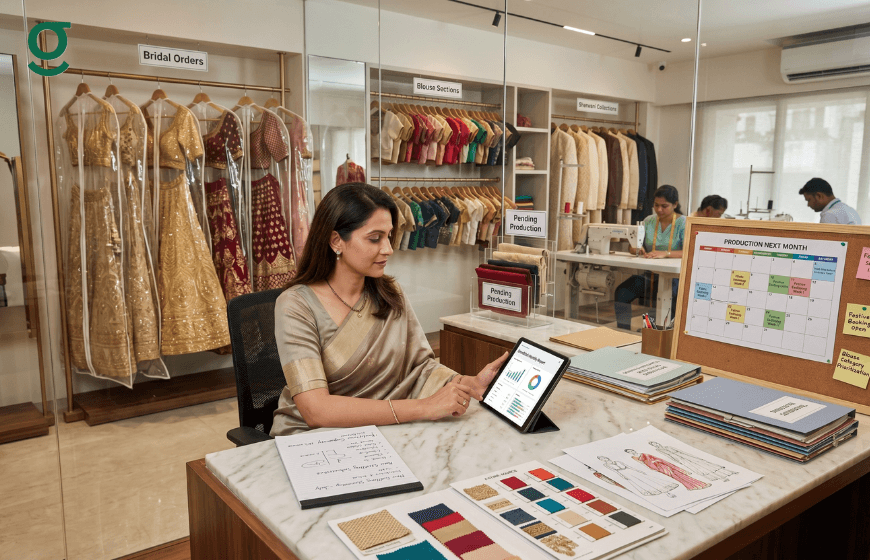
1. Revenue Summary
The revenue section shows total revenue earned during the month, compared against the same month of the previous year and against the monthly target if one is configured. GrowStitch breaks this down by garment category, by customer type (India versus overseas) and by week within the month, showing whether the revenue was distributed evenly or concentrated in specific weeks. Identifying revenue trends across months and categories is the starting point for next-month planning.
2. Pending Balance Report
The pending balance section shows the total outstanding receivables at month end: how much has been billed but not collected. GrowStitch ages this balance, showing how much is less than 7 days old, 7 to 30 days old and more than 30 days old. The aged balance report tells the owner which outstanding amounts need immediate follow-up and which are still within the normal collection window. Revenue gaps in a boutique are most visible when the pending balance is aged and analysed against the billing total.
3. Average Order Value Trend
GrowStitch shows the month's average order value compared against the previous three months and flagged against the configured target AOV if one is set. A declining AOV trend that spans three consecutive months is the early signal of a pricing problem, a shift in the order mix or a systematic failure to bill add-on services. The tailoring software surfaces this trend in the health report without the owner needing to calculate it. Revenue target achievement depends on understanding what is driving the average order value in both directions.
4. Production Efficiency Metrics
The production section of the monthly health report shows three metrics: the percentage of orders delivered on time versus the configured commitment, the average number of days from Cutting to Ready and the alteration rate, defined as the percentage of orders that required alteration after the first trial. A month where the on-time delivery rate dropped below 85 percent is a month that needs a production workflow investigation. Tailoring software surfaces this as a health flag rather than leaving the owner to infer it from customer complaints.
5. Top Garment Categories by Revenue
The category breakdown shows which garment types generated the most revenue during the month: bridal lehenga sets, blouses, sherwanis, salwar suits or any other category the boutique produces. This breakdown reveals which services are driving growth and which are declining. If blouse revenue grew 22 percent month on month while lehenga set revenue declined 8 percent, the boutique may be shifting its customer mix or its pricing. Analysing annual growth patterns by category gives the boutique a strategic view of where its revenue is coming from and where it is going.
How Tailoring Software Generates the Report Automatically
In GrowStitch, the business health report is not a separate reporting process. It is the natural output of the data the boutique creates during normal operations. Every order created, every payment logged, every production stage updated and every billing record generated feeds the analytics layer automatically. At month end, the analytics module aggregates this accumulated data into the five sections described above without any action required from the owner.
The owner opens GrowStitch on the first day of the new month and the previous month's health report is available on the dashboard. She can view it on her phone during the morning commute, share it with her accountant as a PDF or use it as the basis for the next month's planning conversation. The report that would have taken 4 to 6 hours to compile manually from the bill book, the register and the WhatsApp threads is available in zero preparation time.
Using the Tailoring Software Monthly Report for Next-Month Planning

The business health report is most valuable as a planning tool, not just as a review. The revenue summary tells the owner which garment categories to promote in the coming month. The pending balance report tells her which collection calls to make in the first week. The AOV trend tells her whether to revisit the add-on service pricing. The production efficiency metric tells her whether to review the Karigar team's capacity before accepting the next month's bookings. Outperforming local competitors is the result of acting on the data from this month to improve performance in the following month.
GrowStitch Marketplace: Completing the Business Health Picture
A business health report that covers only the revenue side gives an incomplete picture of the boutique's financial health. The material expenditure side, what the boutique spent on threads, buttons, lining, zips and trims during the month, is equally important for understanding profitability. A month with Rs. 1,40,000 in revenue and Rs. 28,000 in material costs is a different business from a month with Rs. 1,40,000 in revenue and Rs. 48,000 in material costs.
GrowStitch Marketplace is a tailoring-material sourcing platform built inside the same app. Every material purchase made through Marketplace is recorded as a business expense in GrowStitch. These expenses appear in the monthly business health report alongside revenue, pending balances and production metrics. The owner sees the complete financial picture: total revenue, total material cost and the resulting gross margin for the month without any manual expense tracking.
For boutiques that have previously tracked material costs in a separate register or not tracked them at all, the Marketplace integration in GrowStitch makes the material expenditure visible for the first time as a monthly total. The business health report becomes a genuine profitability report rather than a revenue-only summary. Tailoring software that connects material costs to billing revenue gives the owner the data to run the boutique as a margin-conscious business rather than a revenue-focused one.
Conclusion: Monthly Reports Are the Boutique's Management Tool
A tailoring software platform that automatically generates monthly business health reports covering revenue, pending balances, average order value, production efficiency and garment category performance gives the boutique owner the same quality of business intelligence that professionally managed businesses have. GrowStitch makes this intelligence available from the first month of use, accumulates it over years of operation and allows the owner to spot trends, act on gaps and plan the next month with data rather than with memory.
The boutique that uses this monthly report consistently does not need to guess whether August was better than July. It does not need to search the bill book to count how many bridal orders were completed. The data is organised, presented and ready to act on. That is the practical difference between running a boutique on a platform and running one on paper.
Run your boutique like a Pro: end every month knowing what happened and start the next one knowing what to do. Download GrowStitch and generate your first monthly business health report today.
Frequently Asked Questions
1. How does tailoring software generate monthly business health reports automatically?
Tailoring software generates monthly business health reports automatically by aggregating all order, billing, payment and production data accumulated during normal operations. In GrowStitch, every order created, payment logged and production stage updated feeds the analytics layer. The monthly health report is the summary of this accumulated data, available on the first day of the following month without any manual preparation.
2. What does a monthly business health report from GrowStitch cover?
A GrowStitch monthly business health report covers five sections: total revenue with month-on-month comparison, total pending balance aged by collection period, average order value trend across the last three months, production efficiency metrics including on-time delivery rate and alteration rate and the top-performing garment categories by revenue. The tailoring application generates all five sections from data already in the system.
3. How long does it take to generate a monthly report in GrowStitch?
The monthly business health report in GrowStitch generates automatically. The owner does not perform any separate reporting step. The report is available on the analytics dashboard at any time and is fully updated for the completed month on the first day of the following month. No manual data compilation, no spreadsheet, no separate accounting entry.
4. How does the monthly report help with next month planning?
The monthly report provides five specific planning inputs: which categories to promote based on the revenue breakdown, which customers to follow up with based on the aged pending balance, whether to review add-on service pricing based on the AOV trend, whether to adjust production capacity based on the efficiency metric and whether any garment category needs a strategy change. Boutique management software that converts past performance into forward-looking decisions is the tool that makes month-on-month improvement systematic.
5. Can the monthly report include material costs from GrowStitch Marketplace?
Yes. Every material purchase made through GrowStitch Marketplace is recorded as a business expense in the platform. These expenses appear alongside revenue in the monthly business health report. The owner sees total revenue, total material cost and the gross margin for the month. This complete financial picture converts the report from a revenue summary into a genuine profitability analysis.
6. How does the business health report compare to what a manual boutique bill book provides?
A boutique management software monthly report provides: revenue by category, pending balance with aging, AOV trend, production efficiency and garment category breakdown, all automatically generated. A manual boutique bill book provides: a record of individual transactions that require the owner to manually sum, sort and categorise to derive any of the above. The bill book records history. The tailoring software business health report analyses it and presents actionable observations.