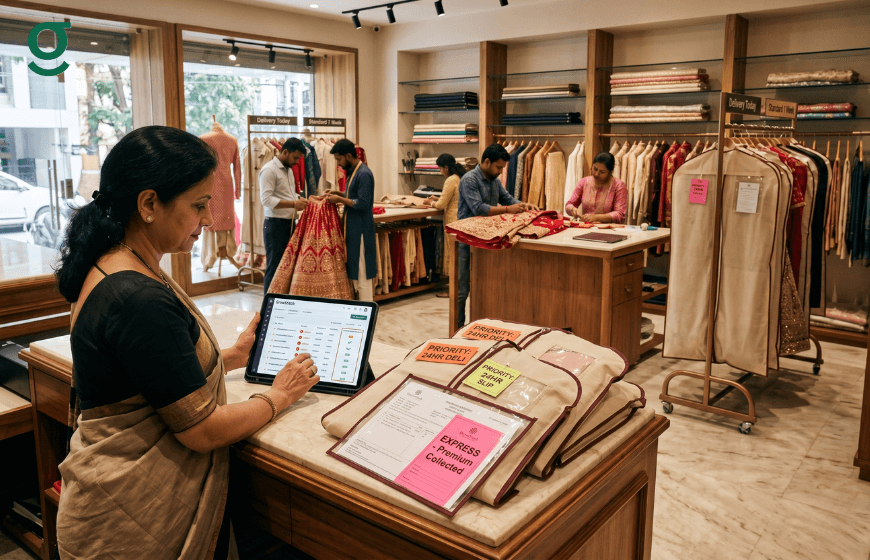
Tailoring software helps Indian boutiques track express delivery premium charges by storing a configurable express delivery rate in the service catalogue, applying it automatically when an order is flagged as urgent and including the charge as a separate line item on the invoice. The customer sees the express charge clearly. The boutique collects it without a manual calculation. The revenue from rush orders is captured systematically rather than left to memory at the billing stage. GrowStitch implements this through its order tagging and service catalogue system, connecting urgency flags to billing automatically.

Every boutique receives rush orders. A customer who needs a blouse for a wedding in three days, a groom's family that forgot to order the sherwani until last week, a corporate client who needs uniforms by Thursday for a Friday event. These situations are common. How the boutique handles the billing for the extra effort involved is what determines whether the rush order is profitable or just stressful. Tailoring software converts the express delivery conversation from a verbal negotiation with an uncertain outcome into a structured, pre-configured billing item that is applied consistently. Revenue leakage from unbilled or under-billed add-on services is one of the most consistently fixable losses in a boutique.
Why Indian Boutiques Undercharge for Express Delivery
An express delivery request puts the boutique owner in an uncomfortable position. The customer is asking for a favour. The urgency is often accompanied by an emotional appeal: it is my daughter's wedding, I have no other option, I will pay extra. The owner agrees to deliver in 72 hours. At the moment, the extra charge feels awkward to specify. The customer goes home with a verbal commitment to pay 'a bit more'. The bit more never gets defined. At billing, the owner charges the standard stitching rate because adding the express charge now feels confrontational.
This pattern happens in boutiques across India every week. The owner provides a premium service, the Masterji works late to complete the order on time, the delivery happens on schedule and the boutique bills only the standard rate. The express delivery effort costs the boutique real money in Karigar overtime, disrupted production scheduling and compressed timeline management. None of that cost is recovered through billing because the express charge was never formalised.
A boutique bill book that only records the standard garment charge has no mechanism to prompt the express charge. The most common billing problems in boutiques trace back to charges that were agreed verbally but never captured in the billing record.
What Tailoring Software Does for Express Delivery Billing
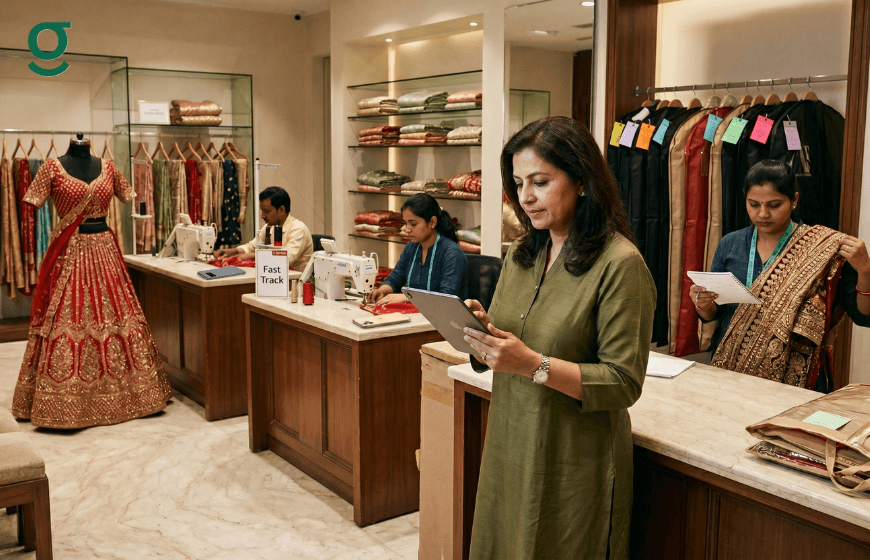
In GrowStitch, the owner configures an express delivery charge in the service catalogue before any rush order is created. The charge can be set as a flat rate per order (Rs. 400 for orders delivered within 72 hours), as a percentage of the total billing amount or as a per-day premium for each day the delivery is brought forward from the standard timeline. Once configured, the charge is applied automatically when the order is flagged as express.
The front-desk staff creates the order, marks it as express and selects the express delivery window. GrowStitch adds the configured charge to the billing total automatically. The invoice shows the garment charge, the express delivery premium and the total. The customer sees exactly what the urgency costs. The conversation about the charge happens at booking when the customer has already decided she needs the rush service, not at delivery when she has already received the garment. Avoiding calculation errors on premium charges requires a configured service rate that applies without manual intervention.
The Tailoring Software Express Order Workflow
Step 1: Customer Flags the Urgency at Booking
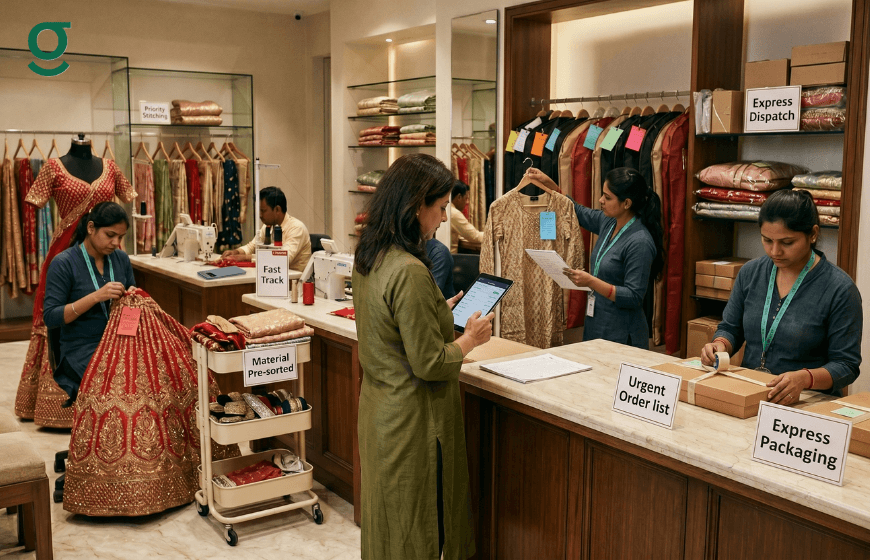
When the customer requests express delivery, the front-desk staff opens GrowStitch and creates the order. The express delivery option is selected from the order type menu. The delivery window is confirmed: 24 hours, 48 hours or 72 hours. The platform shows the express charge applied to the billing total. The staff confirms the total with the customer and records the advance. The customer leaves the counter with a WhatsApp booking confirmation that includes the garment charge, the express premium and the delivery date.
Step 2: Production Is Flagged as Priority
GrowStitch tags express orders differently from standard orders on the production dashboard. The Masterji opens the app and sees the express order at the top of the queue with the delivery deadline clearly visible. There is no ambiguity about which orders are priority. The Masterji allocates Karigar time accordingly. Tracking production stages for express orders separately from standard orders is what prevents an express delivery from slipping into the standard queue.
Step 3: Express Charge Appears on the Invoice
When the order is completed and the invoice is generated, GrowStitch includes the express delivery charge as a line item alongside the garment service charges. The customer pays the full invoice at delivery. The billing staff does not need to remember to add the charge because the platform added it at order creation. Secure payment collection on every order type including express orders is what the platform makes automatic.
Express Delivery as a Revenue Stream, Not an Exception
When express delivery billing is managed manually, every rush order is an exception that requires a separate negotiation. When tailoring software handles it through a configured rate, every rush order is a revenue opportunity with a defined price. The owner knows that every express order adds Rs. 400 to the billing amount. Over a month with 12 express orders, that is Rs. 4,800 in additional revenue that did not exist when the charge was handled verbally.
The Rs. 4,800 is not new pricing. The boutique was doing the express work before. It was simply not billing for the premium consistently. Revenue target achievement in a boutique is built on capturing every billable service at the configured rate, not on increasing volume.
For boutiques that run a billing software for cloth shop that does not support configurable add-on rates, every express order remains a manual exception. For boutiques running GrowStitch, every express order is a configured service with automatic billing and a professional invoice. The shift from a boutique bill book to a digital billing system is what turns exception handling into systematic revenue capture.
GrowStitch Marketplace: Making Express Delivery Promises Deliverable
An express delivery promise is only as strong as the boutique's ability to source materials quickly. When a customer commits to a 48-hour turnaround on a blouse with a specific lining and hook type, the Masterji needs that lining and those hooks available the same day. If the regular local supplier is out of stock, the 48-hour promise becomes a 72-hour apology.
GrowStitch Marketplace is a tailoring-material sourcing platform built inside the same app. Boutique owners can order threads, buttons, zips, hooks, lining fabrics and other materials needed for active orders with next-day delivery, directly from the app without a market visit. When an express order is flagged in the production queue, the owner checks the Marketplace for the required materials and orders them immediately. They arrive the next morning. The production starts on schedule. The 48-hour delivery promise is met.
For boutiques that take express orders regularly, Marketplace is what separates a reliable express service from a well-intentioned one. Tailoring software handles the billing side of express delivery. GrowStitch Marketplace handles the material supply side. Together they make express delivery a service the boutique can deliver consistently, not just occasionally.
Conclusion: Price the Urgency, Deliver on the Promise
An express delivery order is the highest-effort service a boutique provides. It disrupts the standard production queue, requires Karigar overtime and compresses quality checks into a shorter window. Tailoring software like GrowStitch ensures that this effort is matched by a corresponding revenue premium: a configured charge that is applied at booking, visible on the invoice and collected without negotiation. The boutique delivers the urgency the customer needs and receives the revenue the effort deserves. Run your boutique like a Pro: price every rush order at what it costs to deliver. Download GrowStitch and configure your express delivery charge in the service catalogue today.
Frequently Asked Questions
1. How does tailoring software track express delivery premium charges?
Tailoring software tracks express delivery charges by storing a configurable rate in the service catalogue and applying it automatically when an order is flagged as express. In GrowStitch, the front-desk staff selects the express delivery window at order creation. The platform adds the configured charge to the billing total and includes it as a line item on the invoice. The charge is captured at booking, not negotiated at delivery.
2. What is the correct way to price express delivery in a boutique?
Express delivery pricing should reflect the real cost of rush production: Karigar overtime, disrupted queue scheduling and compressed quality checks. A flat rate per order (Rs. 300 to Rs. 600 depending on the delivery window), a percentage of the billing total or a per-day premium for each day brought forward are all valid approaches. The key is configuring the rate in the tailoring software before taking rush orders so it is applied automatically and consistently.
3. Why do boutiques undercharge for express delivery?
Boutiques undercharge for express delivery because the charge is agreed verbally at the moment of urgency and then becomes awkward to formalise at billing. The customer has already received the garment. The owner does not want a dispute. The express premium is absorbed into the standard billing amount. Tailoring software prevents this by applying the configured charge at order creation when the customer is still at the counter and the urgency is the reason she is there.
4. Can GrowStitch apply different express charges for different delivery windows?
Yes. GrowStitch's service catalogue allows the owner to configure separate rates for different delivery windows: a 24-hour delivery premium, a 48-hour premium and a 72-hour premium, each with its own charge. When the front-desk staff selects the delivery window at order creation, the corresponding rate is applied automatically. The tailoring software does not require the staff to know the rates. The platform retrieves and applies the correct one based on the window selected.
5. How does GrowStitch Marketplace support express delivery fulfilment?
GrowStitch Marketplace offers next-day delivery on tailoring materials including threads, buttons, zips, hooks and lining fabrics. When an express order is flagged in the production queue, the owner can order any missing materials from Marketplace immediately. Materials arrive the next morning without a market visit. The express delivery promise is supported by a material supply chain that moves as fast as the promise requires.
6. How does express delivery billing connect to a boutique bill book?
A boutique bill book records only what the staff member writes at billing. If the express charge is not written down, it does not appear on the bill. A digital billing system in GrowStitch applies the express charge at order creation, stores it in the order record and generates it on the invoice automatically. The charge cannot be omitted because it was entered at the time the order was created, not recalled from memory at billing.