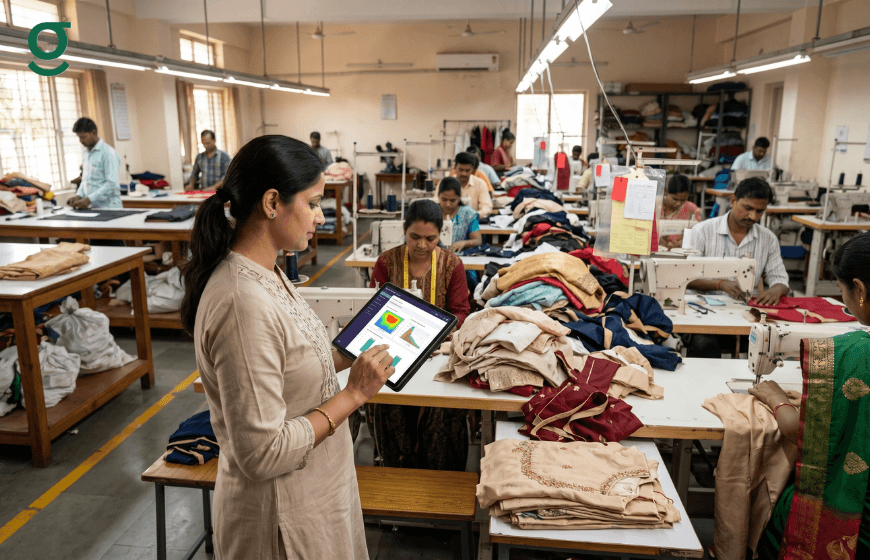
Tailoring software identifies bottlenecks in a stitching unit by tracking the time each order spends at every production stage: Cutting, Stitching, Finishing and Quality Check. When a disproportionate number of orders are accumulating at one stage while others remain empty, the software flags the imbalance. The owner sees the bottleneck before it becomes a delivery failure, not after it already has. GrowStitch tracks production stage timestamps for every active order, giving the owner a real-time view of where the production flow is blocked.
A stitching unit bottleneck is invisible in a manual system until its effect is visible in delivery delays. An owner who manages production through verbal updates and WhatsApp messages from the Masterji learns about the bottleneck when the Masterji reports that orders are piling up at Finishing because there are not enough Karigars for the volume. By that point, 8 to 12 orders are already behind their delivery deadline. Tailoring software surfaces the same signal 5 to 7 days earlier, when the accumulation is just beginning, when there is still time to act. Understanding what tailoring software tracks at the production level is the starting point for bottleneck management.

The Three Production Stages Where Bottlenecks Form
Cutting Stage Bottlenecks
Cutting is the first stage of garment production and the one that determines the schedule for everything downstream. A cutting bottleneck forms when the Karigar who handles cutting is overloaded, when materials are delayed and cutting cannot begin or when the Masterji has not reviewed the job sheet before the Karigar starts. In GrowStitch, the owner can see how many orders are in Cutting at any time. If the Cutting queue is growing while Stitching and Finishing are empty, the cutting Karigar is the constraint and the owner knows it before the backlog reaches Stitching.
Stitching Stage Bottlenecks
Stitching is the most time-intensive stage and the most common bottleneck location. It forms when the boutique has more orders in production than its Karigar team can stitch in the available time, when a specific garment type like a sherwani takes significantly longer per piece than the standard allocation assumes or when a Karigar is absent during a high-volume week. Tailoring software shows the owner the distribution of active orders across all production stages simultaneously. When 60 percent of all active orders are in Stitching, the owner knows the bottleneck is at Stitching before the Masterji reports a delay. Tracking production stages from Cutting to Finishing in real time is how tailoring software surfaces stitching bottlenecks early.
Finishing Stage Bottlenecks
Finishing bottlenecks are the most dangerous because they are the closest to the delivery date. When orders stack up at Finishing because the Karigar team for hemming, button attachment, lining check and packaging is understaffed relative to the Stitching output, the delivery slippage is days away, not weeks. A Finishing bottleneck in a boutique with 40 active orders in week three of November is a delivery crisis. GrowStitch flags orders that have been in Finishing for more than a configured number of days with a delivery deadline approaching, giving the owner the exact list of at-risk orders.
How Tailoring Software Surfaces Bottlenecks Before They Cause Delays

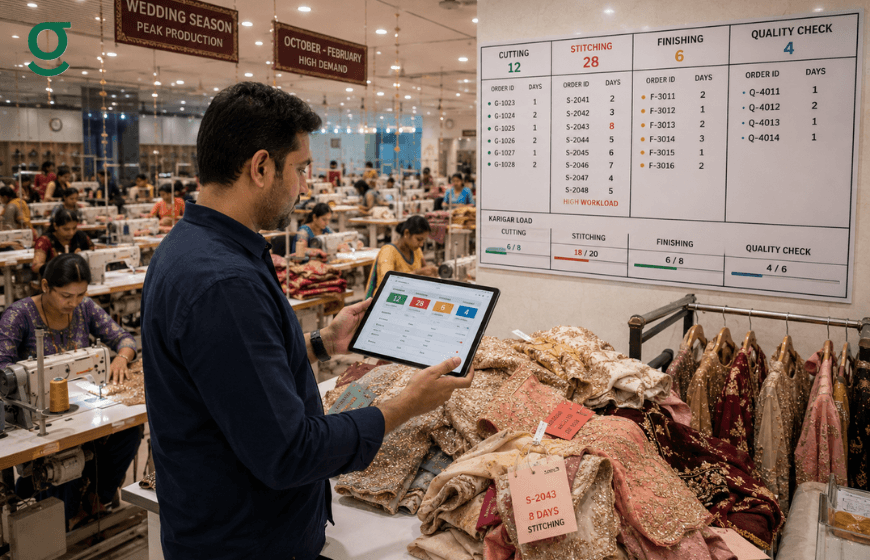
In GrowStitch, the owner opens the production dashboard and sees the stage distribution across all active orders: 12 in Cutting, 28 in Stitching, 6 in Finishing, 4 in Quality Check. The stitching concentration is immediately visible. By comparing this distribution against the Karigar headcount available at each stage, the owner can see whether the current Stitching workload is absorbable within the available delivery deadlines or whether the Stitching queue needs to be redistributed.
The software also shows the time each order has spent at its current stage. An order that has been in Stitching for 8 days when the production standard is 4 days is flagged. The owner investigates: is the garment complex, is the Karigar struggling, is material missing? Each of these causes has a different response. The tailoring software surfaces the flag. The owner determines the cause and acts. Eliminating late deliveries requires catching production accumulations before they breach the delivery window.
Using Tailoring Software to Identify the Karigar Bottleneck
GrowStitch tracks which staff member last updated each order's production stage and when. The owner can filter the production dashboard by Karigar to see each team member's active order count and stage distribution. If Karigar A has 14 orders in Stitching and Karigar B has 4, the imbalance is visible. The owner reallocates 5 orders from Karigar A to Karigar B or brings in additional capacity before the Karigar A queue creates delivery failures. Assigning daily tasks and tracking Karigar workloads through the tailoring application creates the accountability that prevents individual bottlenecks from becoming workshop-wide delays.
Bottlenecks During Festive and Wedding Season
Bottleneck risk is highest during October to February when a boutique's active order count may be 3 to 4 times the off-season level. The same number of Karigars is being asked to process 3 times the volume. The production flow that works at 25 orders breaks at 70 orders unless the bottleneck points are actively managed. Tailoring software that shows stage distribution and individual Karigar load makes it possible to run a 70-order production floor with the same owner oversight that previously covered 25 orders. Handling high-volume festive season orders without slowing production requires production visibility at each stage, not just at the final delivery point.
GrowStitch Marketplace: Eliminate the Materials Bottleneck
Production bottlenecks are not always a Karigar capacity problem. One of the most common and least discussed bottlenecks is a materials shortage: a matching thread is out of stock at the regular supplier, a specific button size is unavailable, a lining fabric cannot be sourced in the right colour in time. When a material is missing, the garment stops at whatever production stage it reached when the shortage was discovered. A lehenga that is 80 percent complete sits in Finishing for 3 extra days waiting for a Rs. 15 trim that could not be sourced.
GrowStitch Marketplace is a tailoring-material sourcing platform built inside the same app. Boutique owners can order the specific threads, buttons, zips, lining fabrics, hooks and trims needed for active orders with next-day delivery directly from the app. When the Masterji identifies a material shortage, the owner places a Marketplace order from the same screen where the production bottleneck is visible. The materials arrive at the boutique the next day. The production bottleneck caused by the missing item is eliminated without a market visit.
For boutiques that track bottlenecks through tailoring software and source materials through GrowStitch Marketplace, the two most common causes of production delay are both managed within the same platform.
This single-platform approach significantly changes the speed of response to any production problem. In a fragmented system, detecting a material shortage takes one action on the production tool, sourcing the material takes a second action on a separate supplier channel and confirming delivery takes a third check. In GrowStitch, all three happen from the same screen. The owner sees the bottleneck flag, places the Marketplace order and monitors the incoming delivery timeline without switching applications at any point. Response time shrinks from hours to minutes.
Conclusion: Bottlenecks Are Visible Problems, Not Hidden Invisible Ones
A stitching unit bottleneck is only invisible to a boutique running on a manual system. In tailoring software like GrowStitch, it is a clearly visible accumulation at one production stage that the owner can see, investigate and address before it becomes a delivery failure. The production dashboard, the stage duration tracking and the Karigar load view together give the owner a complete bottleneck detection system that requires no additional staff and no daily physical walkthrough of the workshop. Run your boutique like a Pro: see every block in your production flow before it becomes a broken delivery promise. Download GrowStitch and see your stitching unit's first real-time production dashboard today.
Frequently Asked Questions
1. How does tailoring software identify production bottlenecks?
Tailoring software identifies production bottlenecks by tracking the time each order spends at each production stage and showing the stage distribution across all active orders simultaneously. In GrowStitch, when a disproportionate number of orders accumulate at Stitching or Finishing, the owner sees the imbalance on the production dashboard. Orders that have been at the same stage longer than the configured production standard are flagged individually.
2. Which production stages are most prone to bottlenecks in a boutique?
Stitching is the most common bottleneck stage because it is the most time-intensive part of garment production. Finishing is the most dangerous bottleneck because it is closest to the delivery date. Cutting bottlenecks create cascading delays downstream because no order can progress until the cut is complete. Tailoring software provides visibility into all three stages simultaneously.
3. How does GrowStitch help reallocate Karigar workloads?
GrowStitch allows the owner to filter the production dashboard by Karigar, showing each team member's active order count and stage distribution. When one Karigar is overloaded and another has capacity, the owner can reassign specific orders to balance the load. The tailoring application records the reassignment and the receiving Karigar's dashboard updates immediately to show the newly assigned orders.
4. Can tailoring software detect material-related production bottlenecks?
GrowStitch's production stage tracking flags orders that have been at the same stage for longer than the configured standard. A material shortage that is holding a garment at Finishing will show as a stage duration anomaly. The tailor app surfaces the flag. The owner investigates the cause. If the cause is a missing material, a GrowStitch Marketplace order can be placed from the same app to resolve the shortage with next-day delivery.
5. How does bottleneck detection change during peak season?
During peak season, the volume of active orders increases dramatically while Karigar capacity stays constant. Bottlenecks form faster and compound more quickly. Tailoring software becomes more critical during peak season because the owner cannot monitor the production floor by physical presence alone. The real-time stage distribution view in GrowStitch covers the entire workshop simultaneously without the owner being physically present.
6. What is the connection between tailoring software and on-time delivery performance?
Tailoring software improves on-time delivery performance by detecting production stage accumulations before they breach delivery deadlines. In GrowStitch, the owner sees orders approaching their delivery deadline while still in Stitching. This early visibility gives the owner 4 to 7 days to act: redistribute Karigar load, extend a delivery date or inform the customer of a delay. Without the software, the same signal arrives when the delivery date has already passed.