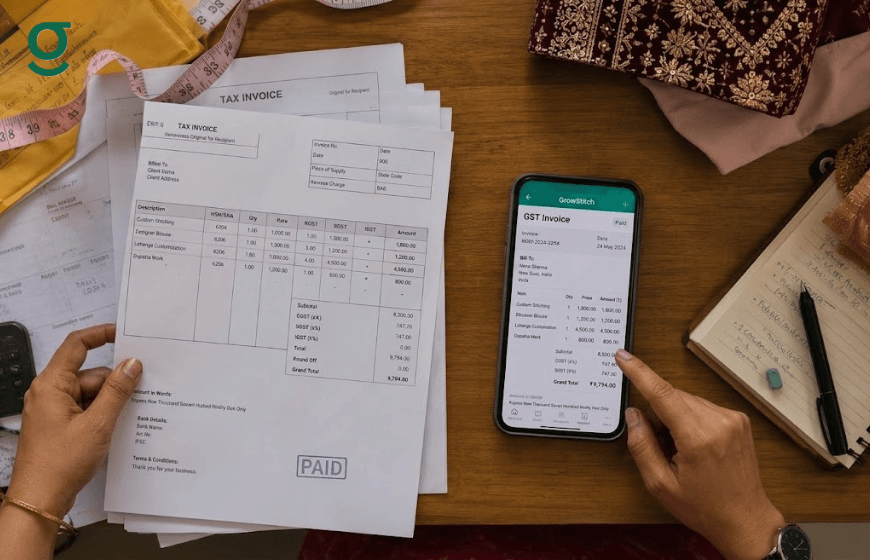
Tailoring software makes GST-compliant invoicing effortless by auto-generating accurate invoices directly from order data: fabric charges, stitching rates, add-on services, advance payments and the applicable GST rate are all calculated and applied without manual entry. For Indian boutiques operating under GST, this removes one of the most time-consuming and error-prone back-office tasks from the owner's plate.
GrowStitch is built for Indian boutique billing workflows. Every order booked in the platform generates a GST-ready invoice at the point of delivery without a separate billing step. Billing problems in boutiques are well-documented and most trace back to manual processes. This guide explains exactly where those problems originate and how automated invoicing through GrowStitch resolves each one.
Why GST Billing Is Harder for Boutiques Than for Retail Shops
A retail shop sells a fixed product at a fixed price. The GST calculation is straightforward. A boutique charges for a combination of fabric, labour, finishing, embellishments and sometimes express delivery. All of this lands in a single invoice and each component may attract a different GST rate. A blouse with Swarovski work is priced differently from a plain cotton kurta. Charging both accurately under the correct HSN code requires knowledge that a manual bill book system does not enforce.
The result is that many boutiques either apply a flat approximation or skip GST documentation entirely for smaller orders. Both approaches create compliance exposure. The reason billing software for boutiques must be built differently from retail tools is precisely this: boutique billing is multi-component and service-oriented, not product-based.

Where Manual Billing Creates Problems in a Boutique

Calculation Errors on Complex Orders
A bridal lehenga order might include fabric charges, blouse stitching, lehenga stitching, lining, embroidery coordination and express delivery. Totalling six line items by hand under time pressure at the counter produces errors. The customer is either overcharged and disputes it or undercharged and the boutique absorbs the loss. Neither outcome is acceptable when order values run to tens of thousands of rupees.
Advance Payment Confusion
Most boutiques take an advance at booking and collect the balance at delivery. In a manual system, the advance is written in the bill book and the final bill is calculated separately at delivery. The deduction is manual. If the bill book page is misread or the advance was noted in a different register, the customer is asked to pay the wrong amount. Partial payment tracking is one of the most consistent cash flow problems in manual boutiques.
Lost or Duplicate Bills
Physical bill books get damaged, misplaced or confused with each other. A customer who asks for a duplicate bill at a later date creates a problem because the original cannot be found. A dispute over whether a payment was made becomes unresolvable without a paper trail. Digital invoicing eliminates this class of problem entirely.
No Real-Time Payment Visibility
In a manual system, the owner knows total revenue only when they sit down and tally the bill book. Outstanding balances require manually reviewing every open entry. There is no quick answer to the question of how much money is pending across all active orders. This real-time visibility is what tailoring software restores to boutique owners.
How Tailoring Software Automates GST-Compliant Invoicing
GrowStitch removes manual entry from every stage of the billing workflow. The tailoring software connects order data, service pricing and GST rates into a billing engine that produces accurate invoices automatically.
Service Rate Catalogue
Before the first order is created, the boutique configures its service pricing in GrowStitch: stitching rate per garment type, fabric charge per metre, add-on services and their prices. These rates are set once and applied consistently to every invoice. Managing complex fabric rates and stitching prices through this catalogue eliminates the inconsistency that happens when staff quote from memory.
Auto-Generated Invoice from Order Data
When an order moves to Ready, GrowStitch generates the invoice automatically. The garment type determines which service rates apply. The fabric used and its metre count pull from the order record. Any add-ons booked at the time of ordering are included. The advance paid is deducted. The GST is applied at the correct rate. The invoice is ready before the customer arrives for pickup.
Digital Invoice Delivery
The completed invoice is sent to the customer via WhatsApp directly from the app. The customer has a digital copy immediately. If they ask for a duplicate three months later, the invoice is retrieved in seconds from the order history. This is part of why modern boutiques choose secure digital billing over paper-based systems.
Real-Time Balance Dashboard
Every order in GrowStitch has a payment status: Paid, Partially Paid or Pending. The owner opens the dashboard and sees the total pending balance across all active orders at a glance. Collections follow-ups are based on a real list, not a memory exercise. Boutique bill book versus digital invoicing is a clear comparison on this dimension.
Manual Billing vs GrowStitch Tailoring Software: Side by Side
| Invoice Element | Manual Bill Book | GrowStitch Tailoring Software |
|---|---|---|
| Fabric charges | Calculated by hand, often approximated. | Pulled from the fabric rate catalogue set in the app. |
| Stitching charges | Quoted verbally, written in shorthand. | Service rates defined per garment type; applied automatically. |
| GST calculation | Calculated manually or skipped. | Applied at the correct rate automatically on every invoice. |
| Advance deduction | Manually subtracted from bill total, prone to error. | Advance recorded at booking; deducted automatically on final bill. |
| Balance tracking | Written in a separate column or remembered. | Real-time balance visible on every order: Paid, Partial, Pending. |
| Invoice sharing | Physical copy only; customer cannot get a duplicate easily. | Digital invoice sent via WhatsApp instantly. Retrievable any time. |
What GST Compliance Actually Requires for Boutiques
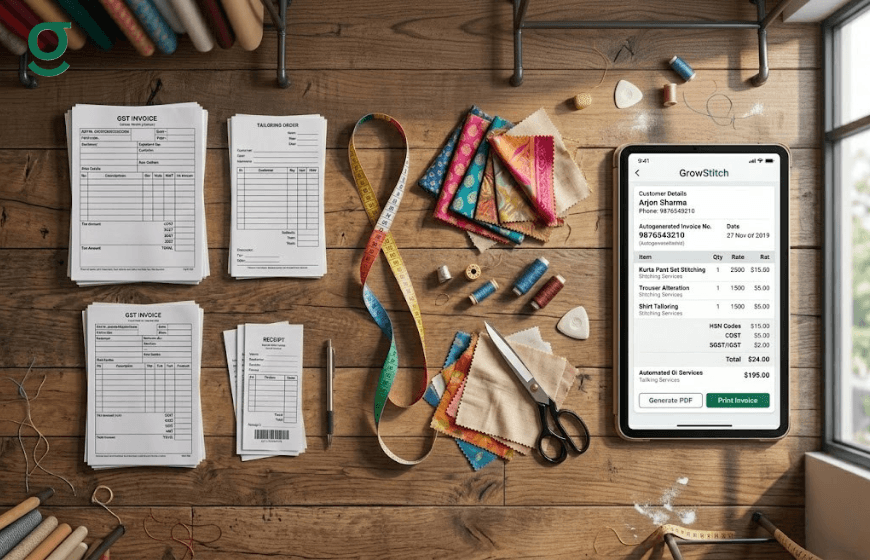
Under Indian GST rules, tailoring services fall under SAC code 9988 with a 5 percent GST rate on job work for textile garments. Fabric sold separately may carry a different rate depending on the type. Boutiques that supply both fabric and stitching service as a composite supply need to apply the correct rate to the combined transaction. Manual billing systems cannot enforce this consistency. GrowStitch's billing engine handles the rate application automatically once the service types are configured.
For boutiques that issue invoices to corporate clients or bulk buyers, GST registration and GSTIN on invoices is a compliance requirement. GrowStitch supports GSTIN configuration so every invoice carries the correct registration details without the owner manually adding them to each bill.
Conclusion: Accurate Billing Is Not Optional When Orders Run to Thousands of Rupees
A bridal lehenga order worth Rs. 35,000 with a manual bill is a liability. A billing error on that order creates a dispute that costs time, trust and sometimes the customer relationship. Tailoring software that auto-generates GST-compliant invoices from order data removes that risk entirely. GrowStitch handles the billing so the owner handles the business. Download GrowStitch and issue your first GST-compliant invoice today.
Frequently Asked Questions
1. How does tailoring software handle GST invoicing?
Tailoring software like GrowStitch auto-generates GST-compliant invoices directly from order data. Fabric charges, stitching rates, add-ons, advance deductions and the applicable GST rate are all applied automatically when an order moves to Ready. The invoice is ready before the customer arrives and can be sent via WhatsApp instantly.
2. What GST rate applies to boutique tailoring services in India?
Tailoring services in India fall under SAC code 9988 with a 5 percent GST rate on job work for textile garments. Boutiques that supply fabric as part of the service may need to apply the composite supply rate depending on the transaction structure. GrowStitch's billing configuration supports the correct rate application once the service types are set up.
3. Can a tailor app generate duplicate invoices for customers?
Yes. A tailor app like GrowStitch stores every invoice against the order permanently. If a customer requests a duplicate invoice months after the delivery, the original is retrieved from order history in seconds and resent via WhatsApp. Paper bill books cannot match this.
4. How does tailoring software handle advance payments in billing?
In GrowStitch, the advance paid at booking is recorded against the order at the point of collection. When the final invoice is generated, the advance is automatically deducted from the total. The balance due is displayed clearly. There is no manual subtraction and no risk of the advance being forgotten or applied to the wrong order.
5. Does GrowStitch support GSTIN on invoices?
Yes. Boutiques with GST registration can configure their GSTIN in GrowStitch. The GSTIN appears on every invoice automatically without the owner adding it manually to each bill. For boutiques issuing invoices to corporate or bulk clients, this ensures every document is compliance-ready.
6. What happens if a billing rate changes mid-season?
In GrowStitch, service rates are managed through the store catalogue. When a rate changes, the new rate is updated once in the catalogue and applies to all new orders from that point forward. Existing orders retain their original rates. There is no need to manually update rates on individual bills or risk inconsistency across the team.