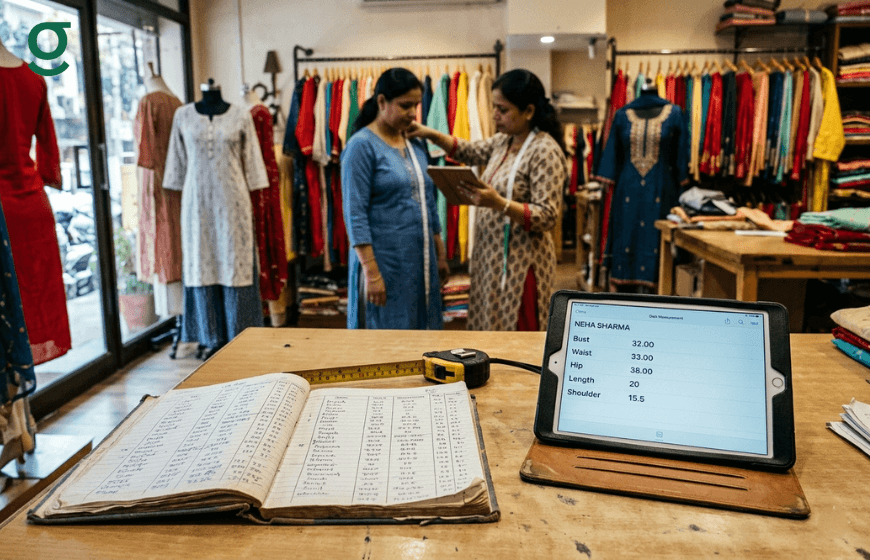
A tailor measurement book is the record at the heart of every boutique. It captures the body measurements that determine whether a blouse fits perfectly or goes back for costly rework. For decades, this was a physical notebook filled with handwritten entries: Gola, Kamar, Sleeve, Nali, noted down in the Masterji's shorthand across dozens of pages. In 2026, that physical record is the single biggest operational vulnerability in most boutique businesses.
GrowStitch replaces the physical tailor measurement book with a secure, searchable digital system that stores every customer's complete measurement profile organised by garment type and accessible from any device. For boutiques evaluating the shift, this guide on what tailoring software does explains the broader platform context that a digital measurement system sits within.
This guide covers why the physical tailor measurement book fails modern boutique operations, what the digital alternative looks like in GrowStitch and how the shift directly improves fit quality, repeat order speed and customer loyalty.
What a Tailor Measurement Book Is and Why It Matters
A tailor measurement book is the physical or digital record that stores a customer's body measurements linked to a specific garment type. A well-maintained measurement record captures not just numbers but context: the customer's fit preference, adjustments made in previous orders and notes like 'add 1 inch to sleeve' or 'loose fit at waist'. This record is the foundation of every repeat order and every quality garment the boutique produces.
The quality of the tailor measurement book directly determines the quality of every fit. A blouse that goes back for alteration three times is not a tailoring skill problem. It is a measurement record problem. Studies of rework patterns in busy boutiques consistently show that the majority of rework costs trace back to measurement errors rather than stitching quality.
5 Problems With a Physical Tailor Measurement Book
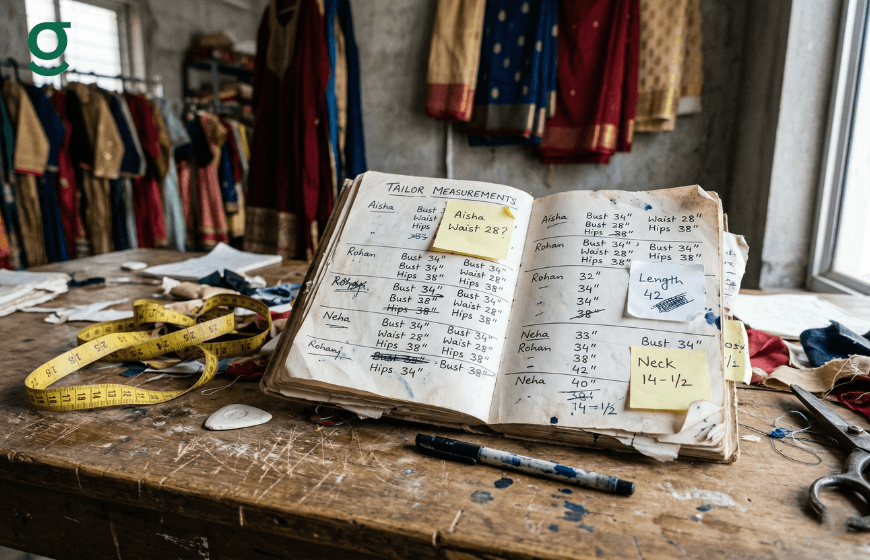
1. The handwriting problem
Every boutique has experienced this: a measurement that could be 36 or 38, a Gola written as 32 but cut as 33, a Sleeve note nobody can decipher two weeks after the order. Handwriting in a physical record introduces ambiguity between the counter and the cutting table. GrowStitch eliminates this entirely by requiring typed digital entries, making every field 100 percent legible regardless of who recorded it or when.
2. The missing measurement problem
A customer walks in during a peak hour rush. The counter staff takes the obvious measurements and forgets Armhole Depth for the blouse or Gown Length for the lehenga. A physical notebook has no mandatory field structure. GrowStitch enforces completeness through garment-specific templates, preventing the incomplete records that cause fitting errors and rework downstream in production.
3. The lost record problem
A boutique measurement book from three years ago is buried under newer books or damaged by water. Protecting customer measurement history is one of the most critical and most overlooked responsibilities of a boutique owner. GrowStitch stores all data in the cloud. Records from three years ago are as accessible as records from yesterday.
4. The multi-staff consistency problem
When three different counter staff members use their own measurement methods and terminology, the physical record becomes inconsistent. One writes Shoulder in centimetres, another in inches. GrowStitch standardises terminology and units across the team, building a consistent boutique measurement book that any authorised staff member can read and use correctly.
5. The repeat order friction problem
A customer calls for a repeat order. The counter staff searches through the physical register, finds the old entry and manually copies measurements to the new order form. GrowStitch removes all of this friction. Storing and retrieving measurements for repeat customers takes under 30 seconds from any device.
What a Digital Tailor Measurement Book Looks Like in GrowStitch
GrowStitch provides a digital tailor measurement book organised by customer profile and garment type. Each customer profile functions as a dedicated measurement record: it stores every measurement taken, every order placed, every fitting note and every alteration made across the entire customer relationship.
When a new order is created, the staff selects the garment type from the catalogue. The system loads the relevant template for that garment: a blouse template includes Bust, Waist, Hip, Shoulder, Sleeve, Neck, Armhole and Back Length as standard fields. The staff fills the template during the order session. Measurements are stored against the customer's profile and are immediately available for the Masterji's digital Job Sheet, without any secondary transcription required.
This is what makes GrowStitch fundamentally different from a generic note-taking app used as a makeshift record system. The fields are garment-specific, the data is linked directly to the order and the tailor measurements app generates a digital Job Sheet automatically from the same data, eliminating the transcription step where most fitting errors originate.
How a Digital System Improves Repeat Order Quality

Repeat customers are the revenue foundation of any boutique. What they trust is that your measurement record has their data accurately stored and that whoever is at the counter on their next visit will use those measurements correctly. GrowStitch makes this trust systematic rather than relying on one Masterji's memory or one readable notebook.
When a repeat customer visits, GrowStitch shows her last recorded measurements alongside her order history. The counter staff confirms whether anything has changed, updates any fields that have shifted and the new order is created from verified data. No re-measuring from scratch unless the customer requests it.
This workflow is one of the key reasons measuring and improving customer retention is much easier with a digital measurement system than with a physical one. GrowStitch gives you the data on repeat order frequency and customer history that a physical boutique measurement book can never provide.
Custom Templates and Garment-Specific Fields in GrowStitch
Every boutique has its own measurement system. GrowStitch allows boutique owners and admins to customise measurement templates to match their specific workflow. The Modern Masterji's Toolkit guide covers exactly how to configure GrowStitch for a boutique's specific garment categories and measurement terminology.
You can add custom fields, rename standard fields to match the terminology your team uses on the shop floor and reorder fields to match the natural flow of your measurement session. If your Masterji specialises in bridal lehengas and needs additional fields not in the standard template, you add them. The digital record in GrowStitch adapts to your boutique's actual workflow.
Conclusion
A physical tailor measurement book has served boutiques for generations. In 2026, it is the weakest link in the operational chain of any boutique that wants to grow beyond what one Masterji can remember and manage. GrowStitch replaces it with a digital boutique measurement book that is legible, structured, searchable and permanently protected in the cloud.
Your measurement record should be an asset that builds customer loyalty over time and protects the quality of every garment produced. GrowStitch makes it exactly that, from the very first order created on the platform.
Run your boutique like a Pro. Download GrowStitch free: Download GrowStitch
FAQs: Tailor Measurement Book and Going Digital
1. What is a tailor measurement book?
A tailor measurement book is the record that stores a customer's body measurements linked to specific garment types. It includes fields like Bust, Waist, Hip, Sleeve and garment-specific fields like Armhole for blouses or Kamar for lehengas. GrowStitch provides a digital boutique measurement book that is structured, searchable and permanently stored in the cloud.
2. Why should a boutique switch from a physical to a digital measurement record?
A physical tailor measurement book introduces five structural risks: illegible handwriting, missing fields, lost records, staff inconsistency and repeat order friction. GrowStitch's digital system eliminates all five through typed entries, garment-specific mandatory templates, cloud storage, standardised terminology and one-tap repeat order access.
3. How does GrowStitch's digital measurement system work?
When an order is created in GrowStitch, the staff selects the garment type and the system loads the relevant template. Measurements are entered directly into the template, stored against the customer's profile and used to generate a digital Job Sheet for the production team. Repeat orders surface saved measurements automatically for quick confirmation and update.
4. Can I customise the measurement templates in GrowStitch?
Yes. GrowStitch allows admins to add custom fields, rename existing fields and reorder them to match the boutique's measurement workflow. If your Masterji uses specific terminology like Nali, Gola or Kamar, those terms can replace default labels in the tailor measurements app, ensuring the system reflects how your team actually works.
5. Does GrowStitch work as a boutique measurement book for repeat customers?
Yes. Every customer's measurement history is stored in their GrowStitch profile. For repeat orders, the staff pulls up the profile, confirms whether measurements have changed and applies saved data to the new order. Customers appreciate not being re-measured every visit, and boutiques benefit from the speed and accuracy this digital record provides.
6. Is a digital measurement record more secure than a physical notebook?
Significantly more secure. A physical tailor measurement book can be lost, damaged or misread. GrowStitch stores all data in the cloud. Records from past orders are permanently accessible and legible, regardless of what happens to the physical device. No flood, fire or staff departure can remove your boutique's measurement history.