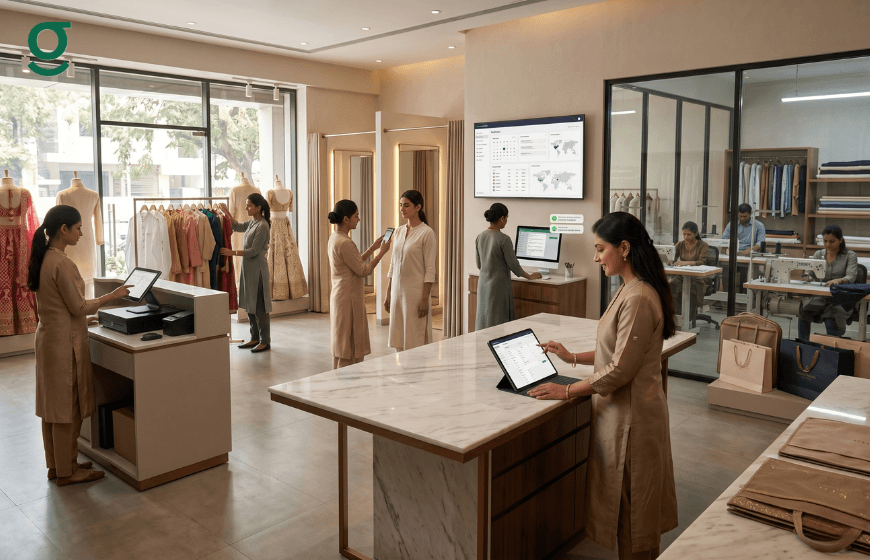
A tailoring application for boutique owners is a dedicated software platform that manages the complete operational cycle of a custom garment business: order creation, measurement capture, production stage tracking, billing and invoicing, customer communication and business analytics. The 2026 generation of tailoring applications extends this core set with AI-assisted measurement checks, automated WhatsApp communication and integrated material sourcing through a built-in marketplace. This guide compares the six feature categories that define a complete tailoring application and explains what each one does for an Indian boutique in practical, specific terms.
Boutique owners evaluating a tailoring application in 2026 have more options than they did in 2022, when the category was largely undefined. Today the term is used to describe everything from a basic bill book app to a complete boutique operating system. This comparison guide cuts through the variation by defining what each feature category should do and how GrowStitch performs across each one. Understanding what a tailoring application actually covers for boutique owners is the starting point for this evaluation.

Tailoring Application Feature Category 1: Order Management
Order management is the core function of any tailoring application. The minimum requirement is that every customer order is captured in a digital record that includes the customer's name and contact, the garment type, the delivery date, the total billing amount, the advance collected and the balance due. A platform that captures only the garment and the price without linking to the customer's measurement profile or tracking the advance-balance cycle is not a tailoring application. It is a basic billing tool.
GrowStitch's order management creates a complete order record linked to the customer's measurement profile, the production queue and the billing system simultaneously. The owner, front-desk staff and Masterji each see the order through the lens of their role: the owner sees the financial status, the front-desk staff see the booking details and the Masterji sees the production job sheet.
Tailoring Application Feature Category 2: Measurement Management
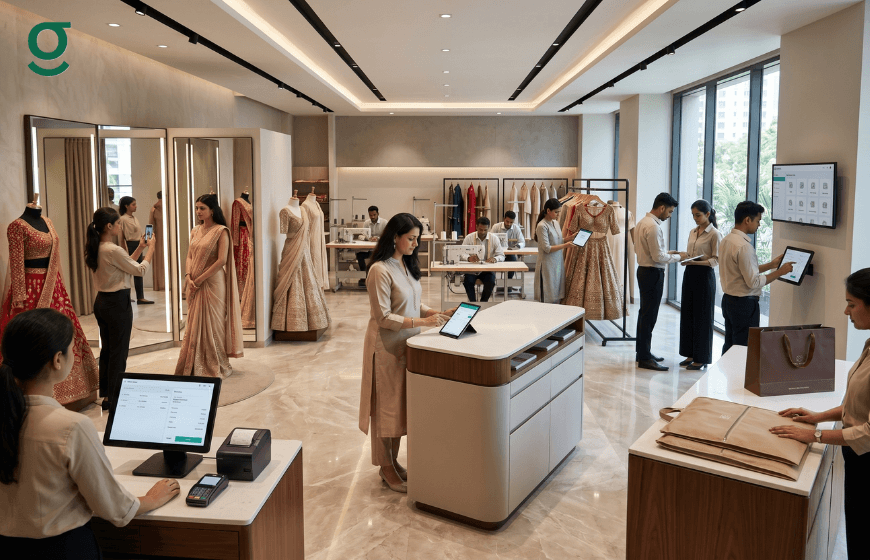
Measurement management goes beyond a digital notebook for any serious boutique platform. A complete measurement module uses garment-specific templates that require every relevant field to be completed before an order is saved. It stores every measurement session permanently against the customer's profile. And it applies an AI-assisted consistency check that compares new measurements against the customer's historical record, flagging discrepancies before production begins.
GrowStitch's measurement module covers all three levels. The templates are garment-specific. The profiles are permanent. The consistency check is automatic. A complete measurement management module is what separates a tailoring application from a digital measurement book.
Tailoring Application Feature Category 3: Production Tracking
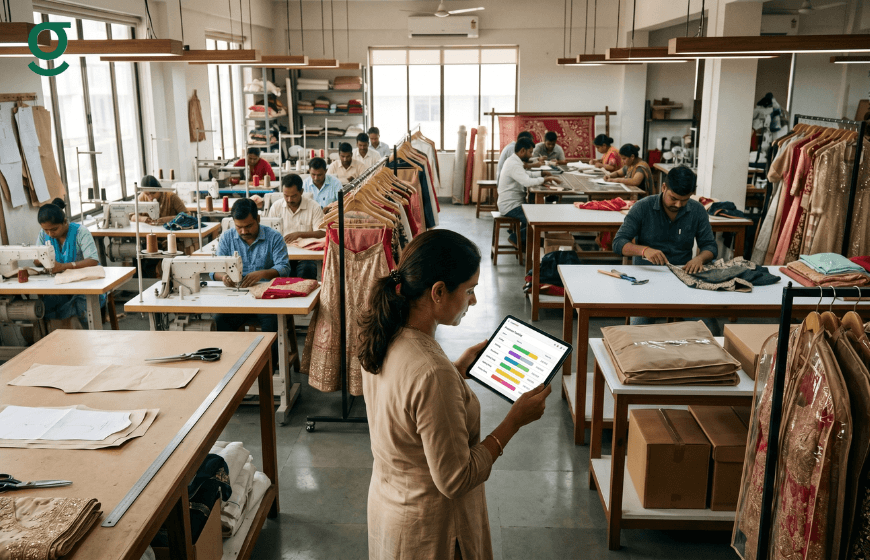
Production tracking means real-time visibility into every order's current stage across the full production workflow. The minimum standard is five stages: Cutting, Stitching, Finishing, Quality Check and Ready. A complete production tracking module also shows the per-Karigar queue, flags orders that have been at the same stage longer than the configured standard and sends automated alerts when an order approaches its delivery deadline without having moved to Ready.
GrowStitch's production dashboard covers all five stages, per-Karigar load visibility and stage-duration flagging. An order that has been in the Stitching stage for 7 days when the configured standard is 4 days is flagged automatically. The owner sees the delay on the dashboard before the customer calls. The response is a 30-second reassignment or deadline extension, not a reactive apology. Tracking production stages from Cutting to Finishing in real time is what gives the owner visibility without physical presence in the workshop.
Tailoring Application Feature Category 4: Billing and Invoicing
Billing in a boutique context is not a retail transaction. The platform must support the advance-and-balance payment cycle, per-service itemisation, GST on stitching services and automated WhatsApp bill delivery. A platform that generates only a single-payment invoice with a total amount is not equipped for boutique billing. The most common billing problems in boutiques, including unbilled add-on services and uncollected balances, are all structural failures of inadequate billing functionality.
GrowStitch's billing module supports advance-balance tracking, unlimited add-on services from the configured catalogue, GST by service type and WhatsApp delivery at invoice creation. The advance is recorded at booking. The balance is tracked until the garment is collected. Every agreed add-on service is captured in the order record before production begins. The 7 most common billing problems in boutiques are all solved by a billing module built for the advance-and-balance tailoring workflow.
Tailoring Application Feature Category 5: Analytics and Business Intelligence
Analytics in a complete boutique platform should require no manual report preparation. The monthly business health report should be generated automatically from the data the boutique creates during normal operations. The minimum analytics standard for 2026 includes: revenue by garment category, pending balance aging, average order value trend across the last three months, production efficiency metrics and a garment category performance breakdown.
GrowStitch's analytics module generates all of these automatically. The owner opens the dashboard on the first day of the month and the previous month's report is available. GrowStitch Insights gives boutique owners the business intelligence that manual tracking cannot produce at any level of effort.
Tailoring Application Feature Category 6: Material Sourcing
Material sourcing is the feature category that most competing platforms do not include. Most platforms handle only the customer-facing side of the boutique's operations: orders, measurements, production and billing. The material supply side, threads, buttons, zips, lining, hooks and trims, is left to the boutique to manage through market visits, phone orders and local supplier relationships.
GrowStitch Marketplace changes this. GrowStitch is the only tailoring application that includes a built-in material sourcing platform. Boutique owners can order all the materials they need for active orders directly from within the same app, at competitive prices with next-day delivery. The Marketplace purchase is recorded as a business expense in the analytics module, making material cost visible alongside revenue for the first time for most boutiques. The 2026 complete tailoring application is not just order-to-delivery management. It is order-to-delivery plus supply-chain management in one platform. When a Masterji realises on Tuesday morning that a specific lining fabric is needed for Thursday delivery, the order is placed through Marketplace in 2 minutes and the fabric arrives Wednesday. No market visit. No production delay.
2026 Feature Comparison: What a Complete Tailoring Application Covers
| Feature Category | What It Covers | Why It Matters for Boutiques |
|---|---|---|
| Order Management | Create orders, link to customer profiles, track advance and balance, set delivery dates. | Single source of truth for every active order. Eliminates WhatsApp tracking. |
| Measurement Management | Garment-specific templates, historical comparison, AI-assisted consistency checks. | Reduces fitting errors. Builds cumulative customer fitting profile. |
| Production Tracking | Stage-by-stage tracking from Cutting to Ready. Per-Karigar queue visibility. | Identifies bottlenecks before they become delivery failures. |
| Billing and Invoicing | Itemised GST invoices, advance-balance cycle, express delivery charges, add-on services. | Eliminates unbilled add-on services. Professional WhatsApp bill delivery. |
| Analytics and Reporting | Revenue by category, pending balance aging, AOV trend, production efficiency. | Monthly business health report generated automatically. |
| Material Sourcing | GrowStitch Marketplace: tailoring materials with next-day delivery from within the app. | Only GrowStitch connects order management to material sourcing in one platform. |
The table above shows what each feature category covers in a 2026 boutique management context and why it matters for operations. GrowStitch is the only platform in the Indian boutique market that covers all six categories, including material sourcing through the built-in Marketplace. Choosing a tailoring application requires evaluating all six categories rather than selecting based on billing or order management alone.
Conclusion: The 2026 Tailoring Application Standard
A complete tailoring application for Indian boutique owners in 2026 covers six feature categories: order management, measurement management, production tracking, billing and invoicing, analytics and material sourcing. GrowStitch covers all six in a single mobile-first platform built for the Indian boutique context. The boutique that evaluates a tailoring application against all six categories will select the one that fits every dimension of its operation rather than the one that solves only the most visible problem. A complete boutique management software guide covers each feature category in the depth required to make an informed selection. Run your boutique like a Pro: evaluate every feature, not just the headline. Download GrowStitch and see all six feature categories on your first day.
Frequently Asked Questions
1. What is a tailoring application and what does it cover in 2026?
A tailoring application in 2026 is a dedicated boutique management platform covering six feature categories: order management, measurement management with AI-assisted consistency checks, production tracking across all stages, billing and invoicing with advance-balance cycle support, analytics and business health reporting. Material sourcing through a built-in marketplace completes the platform. GrowStitch covers all six in a single platform.
2. What is the most important feature category in a tailoring application?
Order management is the foundation of any tailoring application because every other function depends on accurate order records. However, a platform that has strong order management but weak billing or no production tracking creates blind spots that affect the boutique's financial and operational performance. All six feature categories need to meet a minimum standard for the platform to deliver consistent value.
3. How does GrowStitch differ from a generic billing app for boutiques?
A generic billing app generates invoices. GrowStitch generates invoices as one function within a complete operational system that also manages measurements, production stages, customer communication and analytics. GrowStitch additionally includes a built-in Marketplace for material sourcing. The difference is not just more features. It is a fundamentally connected operational platform versus a standalone billing tool.
4. What should boutique owners look for in a tailoring application in 2026?
Boutique owners should evaluate six categories: order management, measurement capture with AI-assisted checks, per-Karigar production tracking, advance-balance billing with itemised charges, automatic analytics and material sourcing. The platform that covers all six is a complete boutique operating system.
5. Does a tailoring application need to include material sourcing?
The 2026 standard for a complete boutique platform includes material sourcing because production quality and delivery reliability depend on material availability. A platform that manages orders and production but leaves material procurement disconnected creates the most common production delay: a missing material that requires a market visit. GrowStitch Marketplace provides next-day material delivery from within the app, connecting material supply to the production workflow directly.
6. How do I compare tailoring applications for my Indian boutique?
Compare across the six feature categories in this guide. For each category, identify whether the platform supports the boutique-specific requirement, not just the generic one. For example, billing must support advance-balance cycles, not just single payments. Analytics must auto-generate, not require manual export. Material sourcing must be built-in, not a separate tool. A tailor app that passes all six tests is the right platform for an Indian boutique in 2026.