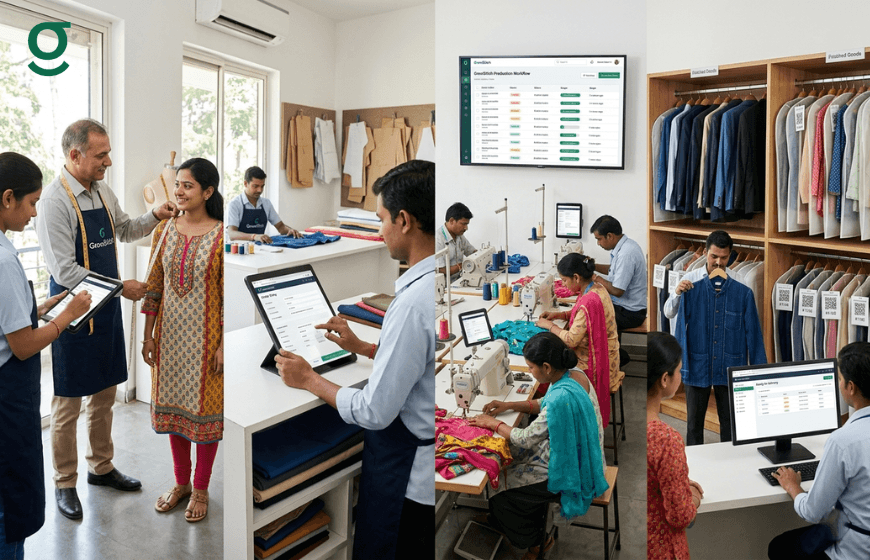
Tailoring software and a generic billing app can look similar from the outside. Both generate invoices. Both record payments. Both are available on a mobile phone. But the way they handle the actual operational workflow of a tailoring business is fundamentally different. The signs you are ready for professional tailoring software are often more obvious in hindsight than they are when you are still using a generic billing app.
GrowStitch is tailoring software built specifically for Indian boutiques. This comparison explains, feature by feature, where tailoring software delivers what a boutique actually needs and where a generic billing app stops short. For boutiques that have not yet evaluated what purpose-built tailoring software actually does, this comparison is the clearest starting point for that evaluation.
What a Generic Billing App Is Designed to Do
A generic billing app is designed for standard retail or service businesses. It records a sale, generates an invoice, accepts a payment and produces a receipt. It handles simple transactions where the product exists at the time of sale and the customer pays and leaves. For a shop selling readymade garments, a barber or a general store, a generic billing app is a reasonable fit.
For a tailoring business, a generic billing app handles approximately 30 percent of what the business actually requires. Why Indian boutiques need tailoring software built for local workflows covers in detail why the local tailoring context, from payment cycles to garment categories to measurement terminology, makes generic tools a poor fit regardless of their feature count.

6 Key Differences Between Tailoring Software and a Generic Billing App
1. Order management: custom garment lifecycle vs single transaction
A generic billing app records a transaction. Tailoring software manages an order lifecycle spanning weeks. When a customer orders a lehenga, the order exists across multiple production stages before the customer pays the balance. GrowStitch tailoring software tracks that order from creation through Cutting, Stitching, Finishing, Quality Check and Ready for Delivery. A generic billing app has no concept of an order that spans weeks and production stages.
2. Measurement management: structured digital profiles vs no capability
GrowStitch stores every customer's measurements, fitting notes and order history in a searchable digital record. A generic billing app has no measurement management capability. The boutique is left maintaining a separate physical measurement book alongside the billing app, which creates exactly the dual-system problem that tailoring software is designed to eliminate.
3. Production tracking: stage-wise visibility vs no capability
GrowStitch tailoring software tracks every garment through Cutting, Stitching, Finishing and Quality Check with real-time stage updates from any device. A generic billing app cannot track production. Moving away from WhatsApp and manual diaries for production coordination is the clearest sign that a boutique needs tailoring software rather than a billing app.
4. Payment cycle: advance-partial-balance tracking vs simple payment record
GrowStitch tracks the three-stage payment cycle per order and sends automatic WhatsApp receipts at every payment. A generic billing app records a single payment against a bill with no concept of the advance-partial-balance cycle tied to a garment still being produced.
5. Customer communication: automated WhatsApp receipts vs manual
GrowStitch automatically sends order confirmations on WhatsApp at booking and a payment receipt every time a payment is recorded. This communication happens without any manual effort from the counter staff. A generic billing app may allow you to export an invoice as a PDF and send it manually. The difference in operational burden across 60 active orders per month is significant.
6. Business intelligence: market benchmarking vs basic sales data
GrowStitch tailoring software provides a business insights dashboard showing revenue, average order value, target versus actual performance, India versus overseas performance and your boutique's ranking in your pin code. A generic billing app shows basic sales data: total revenue and a list of invoices. There is no market benchmarking and no production analytics.
How GrowStitch Tailoring Software Handles the Full Tailoring Workflow
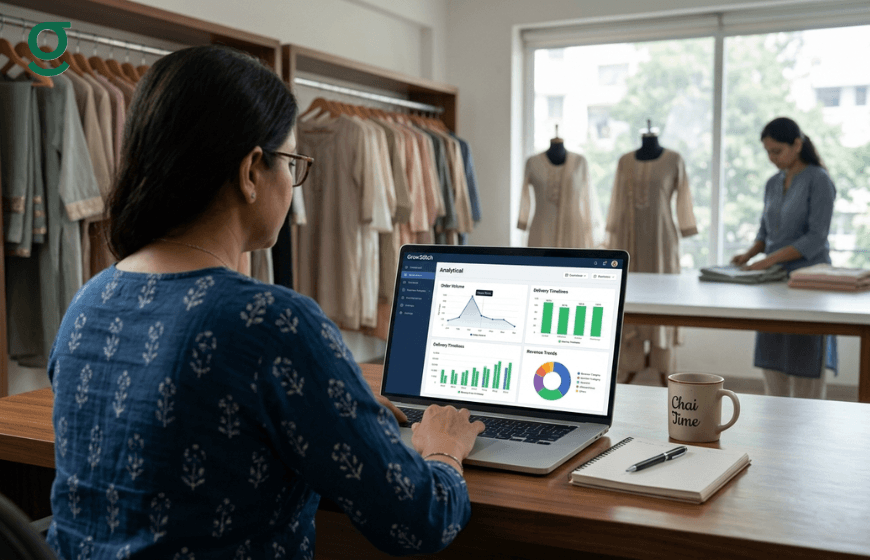
GrowStitch tailoring software is designed around the complete workflow of an Indian boutique. Revenue leakage in boutiques on generic billing apps is a documented operational reality: add-ons that are not billed, partial payments that are not tracked and outstanding balances that are never collected are all symptoms of a billing system that does not understand the tailoring order lifecycle.
GrowStitch tailoring software makes the entire workflow digital, connected and visible from one screen. A generic billing app participates in exactly one of these steps: the initial invoice. Everything else, from the measurement record to the Job Sheet to the production stage to the payment reminder, happens outside the generic billing app and inside a combination of physical diaries, WhatsApp groups and the owner's memory.
The Real Cost of Using a Generic Billing App in a Tailoring Boutique
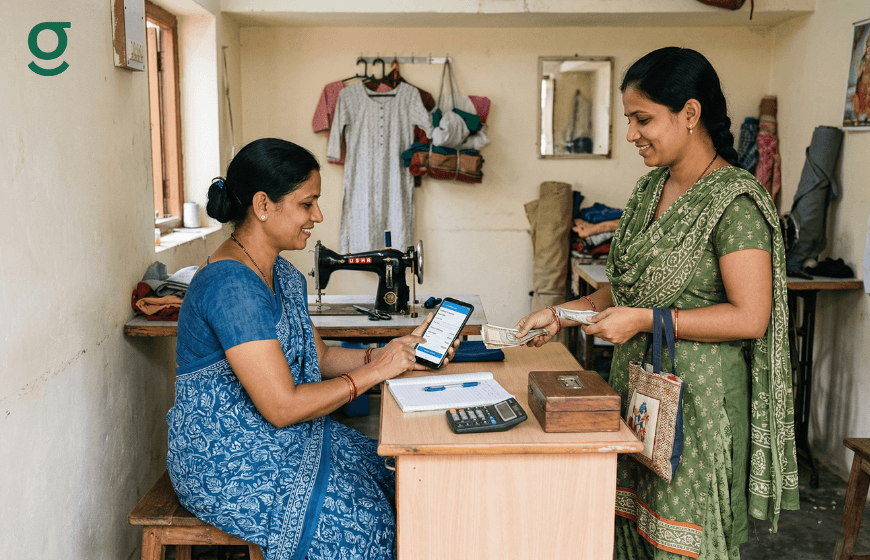
When a boutique chooses a generic billing app, it pays the subscription cost and then adds the hidden costs of all the workarounds required. Late delivery penalties and their operational root causes are one of the most significant hidden costs of managing production through WhatsApp and memory rather than tailoring software with built-in stage tracking.
The practical outcome for most boutiques on generic billing apps is managing the business across four or five disconnected systems. GrowStitch tailoring software consolidates all of these into one platform. The comparison is not between two types of boutique software. It is between one coherent system and a patchwork of five partial solutions each requiring its own maintenance.
When a Generic Billing App Is the Right Choice
A generic billing app is genuinely the right choice for a boutique that primarily does ready-to-wear retail alongside minor alterations, has no repeat measurement customers, processes fewer than 15 orders per month and has a single counter staff member. At this scale and workflow, the tailoring-specific features of GrowStitch provide more capability than the business currently needs or will use. This is an important and honest distinction and it matters: the best tool is the one that fits the business, not the one with the most features.
For any boutique doing custom stitching, managing repeat customers with stored measurements, running production through a Masterji and Karigar team and processing more than 20 orders per month, tailoring software is not a premium option. It is the minimum viable tool for running the business professionally and at scale.
Conclusion
Tailoring software and a generic billing app are tools built for different business models. A generic billing app is built for retail. GrowStitch tailoring software is built for tailoring: custom orders, stored measurements, production stage tracking, advance-partial-balance payment cycles and business intelligence that tells you how your boutique compares with others in your city.
For Indian boutiques doing custom work for customers who expect a perfect fit, a reliable delivery date and truly professional service throughout the process, tailoring software is the only tool that actually fits the job completely. GrowStitch is that tool. Download it today, run your very first order through the platform and see in one session what the real operational difference between a generic billing app and purpose-built tailoring software looks like in daily boutique operations.
Run your boutique like a Pro. Download GrowStitch free: Download GrowStitch
FAQs: Tailoring Software vs Generic Billing App
1. What is the main difference between tailoring software and a generic billing app?
A generic billing app records sales and generates invoices for simple retail transactions. Tailoring software like GrowStitch manages the complete tailoring order lifecycle: custom order creation with measurements, stage-wise production tracking, advance-partial-balance payment cycles, digital Job Sheets and business intelligence dashboards. These are different capabilities for a different business model.
2. Can a generic billing app manage tailoring production stages?
No. A generic billing app has no production tracking capability. Boutiques using one revert to WhatsApp messages and verbal check-ins. GrowStitch tracks every order through Cutting, Stitching, Finishing, Quality Check and Ready for Delivery with real-time stage updates from any device.
3. How does GrowStitch tailoring software handle the advance-balance payment cycle?
GrowStitch records the advance at booking, tracks any partial mid-cycle payments and shows the exact balance outstanding at delivery. An automatic WhatsApp receipt goes to the customer at every payment. This three-stage payment cycle is built into the GrowStitch platform from the ground up.
4. Does tailoring software cost more than a generic billing app?
GrowStitch is subscription-based with boutique-appropriate pricing. The relevant comparison is total operational cost: GrowStitch versus a generic billing app plus a physical measurement book plus WhatsApp coordination plus manual reconciliation plus revenue lost to billing errors. The purpose-built platform is consistently the lower total cost for any boutique doing custom work at volume.
5. What boutique software features does GrowStitch have that generic apps do not?
GrowStitch includes garment-specific measurement templates, digital Job Sheet generation, stage-wise production tracking, advance-partial-balance payment cycle management, automated WhatsApp customer communication and a business intelligence dashboard with local market benchmarking.