
Managing a boutique involves balancing creativity with complex logistics. From the moment a customer chooses a fabric to the final trial, the production process requires precise coordination. Relying on manual methods often leads to confusion and delays. Integrating a smart boutique app transforms this chaotic workflow into a streamlined, digital system, ensuring efficiency and higher customer satisfaction.
Inefficiencies of Traditional Boutique Workflows
Traditional boutique management often relies on handwritten notes, carbon-copy bill books, and verbal instructions. While familiar, these methods create significant operational risks in a growing business.
- Fragmented Information: Customer measurements reside in one book, fabric details on a slip, and payment status in a separate ledger. This separation makes it difficult to get a complete view of an order.
- Production Blind Spots: Without a digital system, a store owner cannot verify the status of an order whether it is in cutting or stitching without physically interrupting the karigar.
- Dependency on Individuals: If the master cutter is absent, the knowledge of pending orders and specific design instructions often pauses with them.
- Communication Delays: Conveying design changes or status updates to customers requires manual phone calls, consuming valuable time.
A boutique app addresses these issues by consolidating all data into a single, accessible platform, removing the reliance on memory and paper.
Defining a Smart Boutique App Beyond Basic Billing
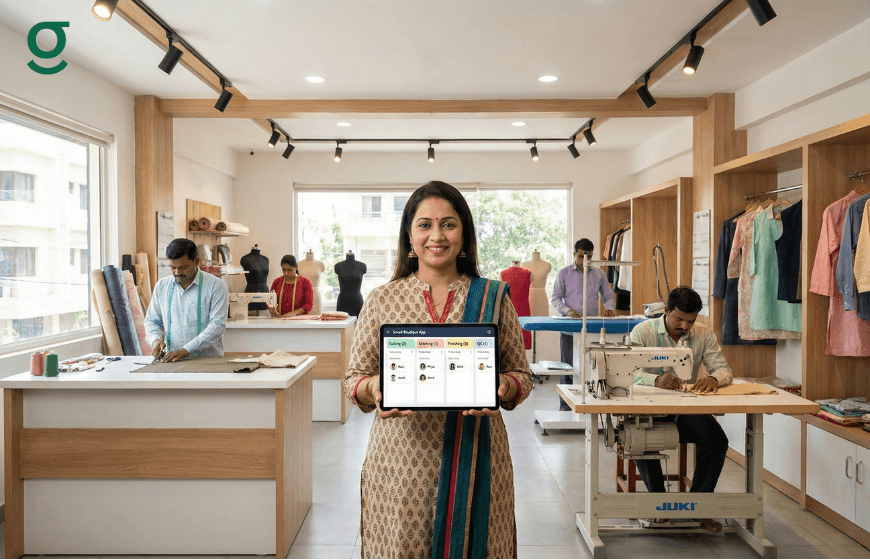
Many software options market themselves as boutique solutions but offer only basic invoicing. A truly smart boutique app functions as a comprehensive operating system for the business.
To qualify as "smart," the application includes features specifically designed for the tailoring lifecycle:
- Production Insight: The capability to track a garment's journey through specific stages like "Cutting," "Stitching," and "Finishing."
- Role-Based Access: Distinct interfaces for different staff members, ensuring masters and tailors see only the tasks relevant to them.
- Integrated Media: Support for notes and images to capture design nuances that text cannot convey.
- Automated Updates: The ability to trigger updates via WhatsApp directly from the workflow, keeping customers informed without manual effort.
Step 1: Centralizing Orders with Voice Notes and Reference Images
Data accuracy at the point of order entry determines the success of the production line. Handwritten descriptions are often misread or lack necessary detail, leading to production errors.
A robust boutique app improves accuracy through:
- Digital Measurement Storage: Saving customer measurements permanently ensures consistency for future orders and speeds up the booking process.
- Voice Notes: Recording specific instructions such as "deep back neck" or "add tassels"ensures the tailoring team hears the exact requirement.
- Reference Images: Attaching photos of the fabric and the desired design style directly to the digital order card prevents confusion and mismatched fabrics.
Step 2: Customizing Production Stages for Unique Workflows
Every boutique follows a unique production rhythm. Some specialize in heavy bridal wear requiring embroidery and handwork, while others focus on quick alterations.
A flexible tailoring software allows for the customization of production stages to match reality:
- Workflow Configuration: Users can define stages such as "Dyeing," "Embroidery," "Cutting," and "Stitching."
- Stage Skipping: For simpler orders, the system allows bypassing unnecessary steps, moving an order directly from "Booking" to "Stitching" or "Finishing."
- Real-Time Visualization: The dashboard provides a snapshot of the entire production floor, showing exactly how many orders are pending at each specific stage.
Step 3: Assigning Staff Roles to Eliminate Bottlenecks
Bottlenecks in production often go unnoticed until a deadline is missed. Assigning tasks digitally creates accountability and reveals where the workflow is stalling.
Using the team management features of the app:
- Role Assignment: Specific orders or stages are assigned to specific staff members. The "Cutting" stage is tagged to the Master, while "Stitching" is assigned to a specific tailor.
- Workload Visibility: The admin can view the number of active tasks assigned to each staff member. If one tailor has ten pending blouses and another has two, the work can be redistributed immediately.
- Accountability: Digital logs record who completed each stage, making it easy to identify high performers and those needing additional training.
Step 4: Automating Customer Communication on WhatsApp

Manual follow-ups and answering "Is my dress ready?" calls consume a significant portion of a boutique owner's day. Automation handles this routine communication efficiently.
A smart boutique app integrates directly with WhatsApp to:
- Send Order Confirmations: Customers receive an instant message with order details and the promised delivery date upon booking.
- Share Invoices: Digital bills are sent immediately, reducing paper waste and ensuring the customer has a record.
- Update Status: The system can notify customers when their order moves to "Ready for Trial" or "Completed," ensuring they visit the store only when the garment is actually ready.
Conclusion
Transitioning to a smart boutique app like GrowStitch is a strategic upgrade from manual chaos to digital clarity. By centralizing order details, customizing production workflows, assigning clear staff roles, and automating communication, boutique owners can significantly reduce errors and delays. This operational efficiency not only lowers stress but also builds a professional reputation that retains customers and drives growth.
And if you move now, the first 1,000 users get exclusive early-bird access, download the app today and stay ahead while others struggle to catch up
Frequently Asked Questions
1. Is a boutique app difficult for staff with limited technical skills?
Most smart boutique apps are designed with a mobile-first approach, utilizing simple icons and voice notes to ensure that staff who are comfortable with smartphones can use them easily without extensive training.
2. Can the app handle different types of garments?
Yes. The software allows for the creation of custom workflows and measurement profiles, making it suitable for everything from blouses and kurtas to men's suits and sherwanis.
3. Does the app work for boutiques with multiple branches?
Advanced tailoring software supports multi-store management, allowing the owner to track production, sales, and staff performance across different locations from a single admin login.
4. How does the app help with fabric management?
By attaching images of the fabric to the digital order, the app ensures that the cutting team always matches the right cloth to the right design, preventing costly mix-ups.
5. Is it possible to track payments alongside production?
Yes. The app links the production status with the payment status, ensuring that the final delivery is only made once the pending balance has been cleared.
6. Can I use the app if I outsource my stitching?
Yes. You can create user profiles for your external manufacturing units or freelance tailors, allowing you to assign orders and track their progress just as you would with an in-house team.