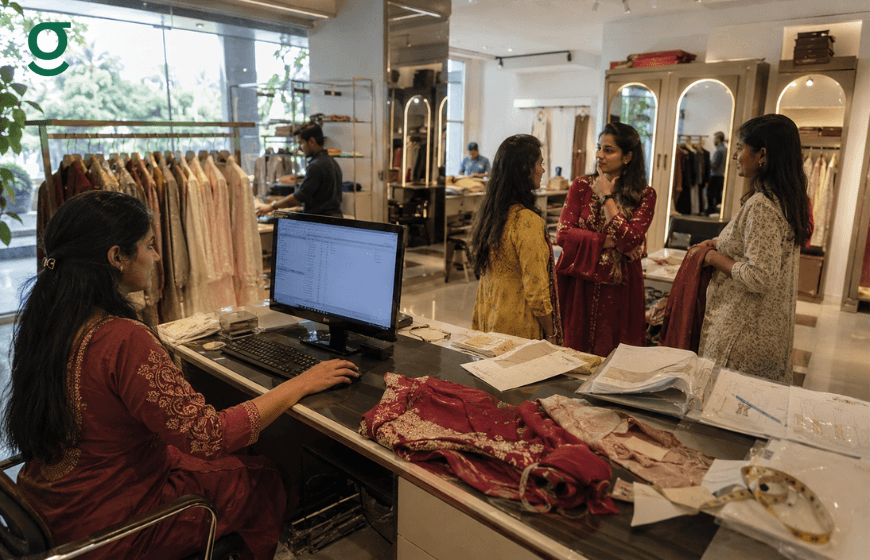
Apparel billing software is a billing and invoicing system designed for the clothing and fashion retail sector. It is built around product-based transactions: a customer selects a finished garment, the system records the item, calculates the price, applies GST and generates a receipt. For ready-to-wear shops, fabric retailers and standard garment stores, apparel billing software is a reasonable fit.
For custom tailoring businesses, Indian boutiques and Karigar-led stitching units, apparel billing software is structurally wrong. The problem is not a missing feature that can be added with a plugin. The problem is architectural. Apparel billing software is built to record the sale of an existing product. Custom tailoring is built around creating a product that does not yet exist, from a specific person's body measurements, through a multi-stage production process, funded by a payment structure that spans weeks. The two workflows are fundamentally incompatible.

What Apparel Billing Software Is Actually Designed to Do
Standard apparel billing software manages a product catalogue. It tracks SKUs, handles barcode scanning, applies discounts, calculates GST on finished goods and generates point-of-sale receipts. Large garment chains, fabric shops and ready-to-wear retail stores use this category of software effectively. The billing logic is transactional: customer selects item, price is applied, payment received, receipt generated.
Some apparel billing software adds inventory management, low-stock alerts and sales reporting. These features are useful for retail garment businesses. They have no relevance for a boutique managing custom orders where there is no pre-stocked inventory and every garment is made to measure.
Why billing software for cloth shops must be built differently from standard retail tools: Why Billing Software for Cloth Shop Operations Must Be Built Differently.
Why Apparel Billing Software Fails Custom Tailoring Businesses
No Client Measurement Storage
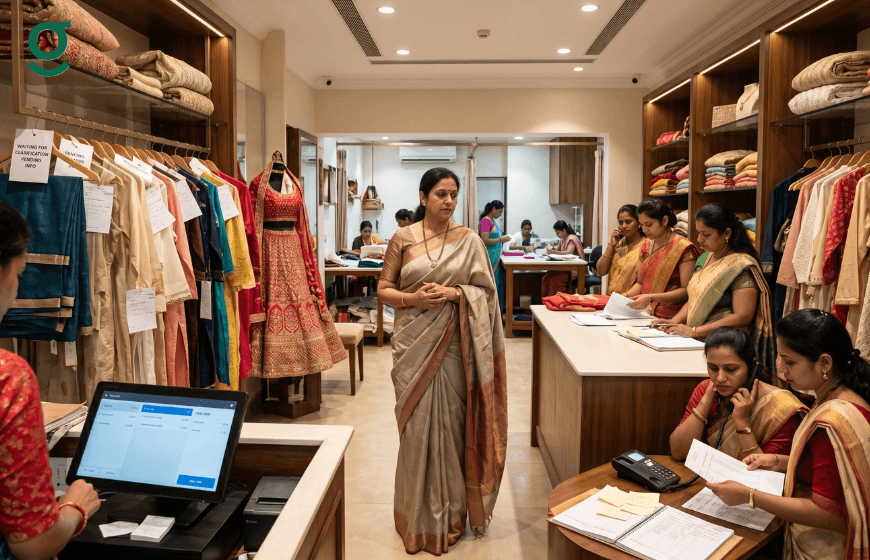
Apparel billing software has no concept of client body measurements. Every custom tailoring order begins with a measurement appointment. The garment is built to a specific person's body. The billing system that records this order must link the invoice to the measurement card and the garment specification. Standard apparel billing software cannot do this. It records a transaction, not a custom production order.
No Advance and Partial Payment Tracking
Custom tailoring in India typically runs on a two-stage or three-stage payment model. The client pays an advance at booking and the balance at delivery. For high-value bridal orders, a mid-order payment may be collected when the fabric is purchased. Apparel billing software is designed for full payment at the point of sale. It has no mechanism for tracking advance amounts, recording partial payments or showing the balance outstanding across a multi-week production period.
Partial payment tracking is one of the most critical functions any tailoring business needs in its billing system: Tracking Partial Payments: The Hidden Cash Flow Leak in Your Boutique Bill Book.
No Production Stage Tracking
Between booking and delivery, a custom garment passes through cutting, stitching, fitting, embroidery and finishing. The billing system in a tailoring business must connect the invoice to the production stage. The owner should be able to see at a glance which stage each order is at and whether any order is at risk of missing its delivery date. Apparel billing software sees only the financial transaction. It cannot tell you that the Jodhpuri suit is at the embroidery stage or that the bridal lehenga needs its final fitting scheduled.
No Garment-Specific Customisation Fields
Every custom garment has specifications that determine both what is produced and what it costs. Fabric type, lining choice, neckline design, sleeve style, embroidery pattern and finishing instructions are all relevant to the order. In some cases, they affect the price. Apparel billing software has no fields for garment specifications. The boutique ends up maintaining parallel notes to capture what the billing software cannot, creating the exact fragmentation the software was supposed to eliminate.
No Staff or Karigar Task Assignment
In a tailoring unit, production is distributed. The cutter handles the fabric, the Karigar manages stitching and a separate specialist handles embroidery. Apparel billing software does not assign production tasks to staff members. It records the sale and nothing more. The Masterji must manage all task allocation separately through verbal instruction or WhatsApp, creating accountability gaps that lead to production delays.
Incorrect GST Treatment for Tailoring Services
Indian boutiques operate under GST regulations that treat tailoring services differently from retail product sales. The GST rate applicable to custom stitching services differs from the rate on ready-made garments. Apparel billing software designed for retail applies the product GST logic and does not accommodate the service-based billing structure of custom tailoring correctly.
The Real Business Cost of Using Apparel Billing Software for Custom Tailoring
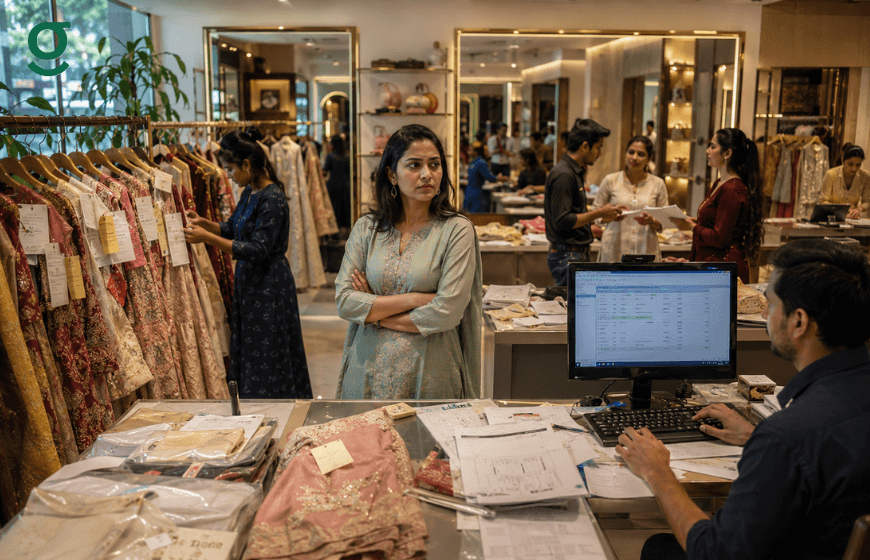
Boutiques that use generic apparel billing software to manage custom orders operate with multiple parallel systems. The billing is recorded in the software. The measurements are in a register. The production status is on a whiteboard or in a WhatsApp group. The payment balance is tracked mentally by the owner or in a separate ledger. Customer communication happens through a third WhatsApp thread.
This fragmentation creates compounding errors. A customer calls to confirm their order status. Someone checks three places before answering. A Karigar begins cutting without seeing the latest measurement update because the measurement data is in a separate register the software cannot access. A balance payment is missed because the bill was never linked to a delivery confirmation. These are not edge cases in boutiques using apparel billing software. They are weekly realities.
Understand the full cost of operating with disconnected systems: Stop Using Excel: 5 Signs You Are Ready for Professional Tailoring Software.
What Custom Tailoring Businesses Actually Need Instead
A custom tailoring business needs tailoring software, not apparel billing software. The distinction is structural and critical. Tailoring software is built around the full order lifecycle: from measurement intake and garment specification through production stages to billing, payment collection and delivery confirmation. Every function is connected in one system.
GrowStitch is built specifically for this workflow. It is not apparel billing software adapted for tailoring. Measurements are stored against customer profiles. Garment specifications are attached to each order. Production stages are tracked from cutting through finishing. Billing is connected to partial payment management. Staff task assignment ensures the right Karigar handles the right stage at the right time.
What tailoring software is and what it actually manages for a boutique: What Is Tailoring Software: A Complete Guide for Boutique Owners.
Apparel Billing Software vs GrowStitch Tailoring Software
Measurement storage: GrowStitch stores client measurements against the order record. Apparel billing software has no measurement capability. Advance and partial payment tracking: GrowStitch tracks every advance and balance in real time. Apparel billing software records only point-of-sale transactions. Production stage visibility: GrowStitch shows the production stage for every active order. Apparel billing software does not track production. Garment specifications: GrowStitch captures fabric, design and construction details per order. Apparel billing software has no custom specification fields. Staff task assignment: GrowStitch assigns production tasks to specific Karigars. Apparel billing software records only the sale.
Conclusion: Choosing the Right Billing Software for a Boutique in India
The evaluation criteria for billing software for a cloth shop or boutique in India must go beyond GST compliance and receipt generation. The right platform must connect billing to measurements, production tracking, partial payment management and staff accountability. No apparel billing software on the market meets all five criteria for a custom tailoring workflow.
How to evaluate billing software for cloth shop operations specifically: Why Billing Software for Cloth Shop Operations Must Be Built Differently.
GrowStitch was built in India for Indian boutiques. The payment models, the garment categories, the measurement formats and the GST treatment are all calibrated for Indian tailoring workflows. It is the alternative to apparel billing software that actually fits the way custom tailoring businesses operate.
Ready to run your boutique like a Pro? Download GrowStitch today: Download GrowStitch
Frequently Asked Questions
What is apparel billing software?
Apparel billing software is a billing and invoicing system built for product-based clothing retail. It manages SKU-based inventory, point-of-sale transactions and GST on finished garments. It is not designed for custom tailoring workflows that involve client measurements, advance payments, production stage tracking and garment-specific specifications.
Why does apparel billing software fail for custom tailoring businesses?
Apparel billing software fails for custom tailoring because it records transactions, not custom order lifecycles. It has no mechanism for client measurement storage, advance payment tracking, production stage management, garment specification capture or staff task assignment. Custom tailoring requires all of these capabilities connected in one system.
What is the difference between apparel billing software and tailoring software?
Apparel billing software handles retail product transactions. Tailoring software manages the full custom order lifecycle from measurement to delivery. Tailoring software connects billing to measurements, production stages, partial payments and staff assignments. Apparel billing software covers only the financial transaction at the point of sale.
Is GrowStitch a type of apparel billing software?
No. GrowStitch is tailoring software, not apparel billing software. It manages the full custom order lifecycle including client measurements, garment specifications, production stage tracking, partial payment management, billing and delivery confirmation. It is built specifically for boutiques and custom stitching businesses, not general retail.
What billing software works best for an Indian boutique?
The best billing software for an Indian boutique doing custom stitching is tailoring software that connects billing to measurements, production tracking and payment management. GrowStitch handles advance payments, partial settlements, GST-compliant invoicing and order-linked billing in a single platform built specifically for Indian boutique workflows.
Can I use apparel billing software with separate measurement and production tools?
You can but the fragmentation between systems creates compounding errors. Measurements in one place, billing in another, production status in a third and payment tracking in a fourth means every handoff is a risk. GrowStitch replaces this fragmented setup with one connected tailoring software platform where all functions are integrated from the start.