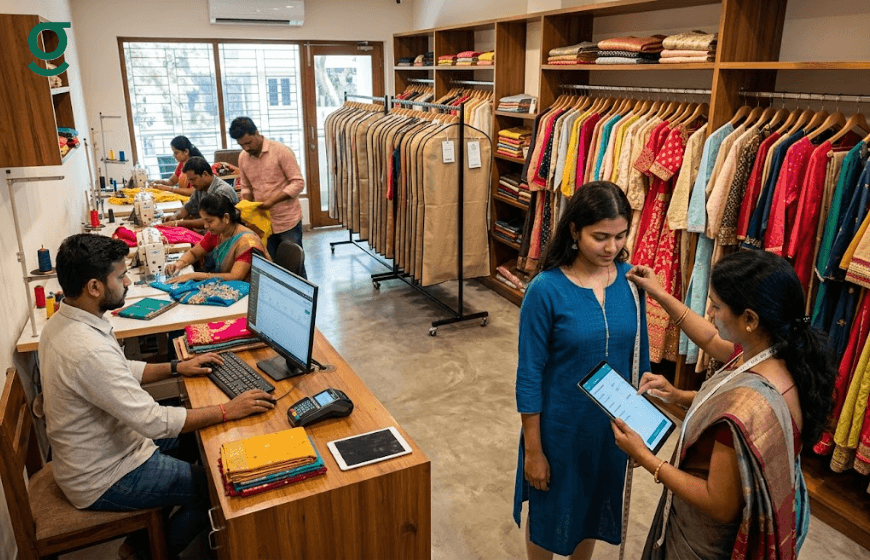
Digital tailor management software is a purpose-built platform that helps boutique owners and tailoring businesses manage every operational function in one digital system: order booking, customer measurements, production tracking, staff coordination, billing and payment collection. It replaces the combination of physical diaries, WhatsApp groups, manual bill books and separate billing apps that most Indian boutiques currently rely on.
GrowStitch is built specifically as this kind of management platform for Indian boutiques, master tailors and designer studios. The platform covers the full business workflow from the moment a customer walks in to the moment the final payment is settled. If you are familiar with tailoring software as a broader category, this guide covers that foundation. This guide focuses specifically on what the digital management layer means and why it matters for boutiques operating in India today.

Why the Word 'Digital' Changes Everything for Tailor Businesses
Most tailoring businesses in India are not unmanaged. They are managed through physical means: the diary at the front counter, the measurement book the Masterji carries, the WhatsApp group with the Karigar team and the handwritten bill book. These systems work at low volume. They break under pressure.
The shift to digital tailor management software is not about replacing the Masterji's skill. It is about giving the owner, the front-desk staff and the workshop team a shared digital record that everyone reads from the same source. When a customer calls to ask about their order, the answer is on the screen in two seconds. When a Karigar finishes the stitching stage, the production record updates instantly. When a payment comes in, the balance adjusts in real time. This is the gap that a dedicated boutique system closes that diaries and WhatsApp cannot.
What Digital Tailor Management Software Actually Does
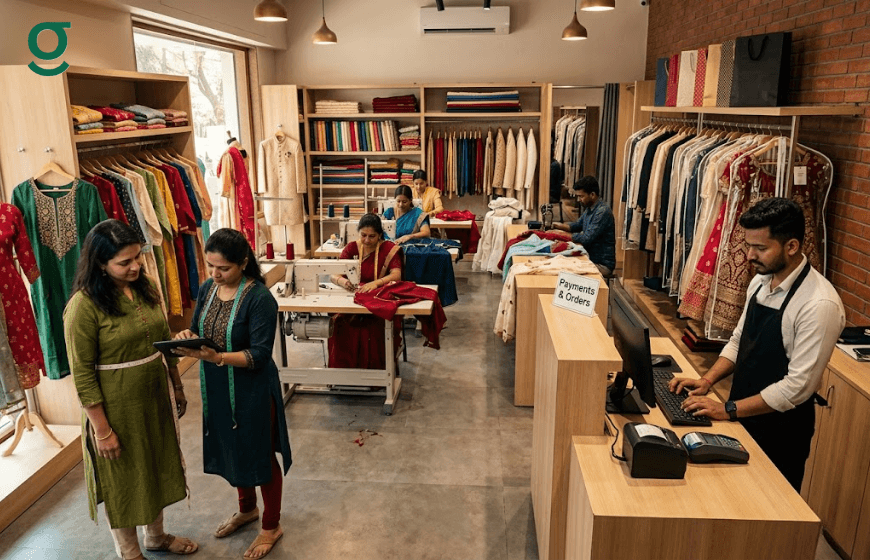
The term covers six core functions that every tailoring business needs to manage. In a purpose-built platform like GrowStitch, all six run in a single mobile-first application.
1. Order Management
Every order is created digitally at the point of booking. Customer name, fabric details, garment type, design notes, trial date and delivery deadline are all captured in a structured form. Each order gets a unique ID and is linked to the customer profile. No information travels by word of mouth. This is what a tailor app does at the order level.
2. Customer Measurement Storage
Measurements are stored in digital templates specific to each garment type: blouse, lehenga choli, Anarkali, Sherwani, Jodhpuri suit. Every measurement captured is saved to the customer profile permanently. Repeat customers' measurements pull into new orders automatically. The Masterji works from the same data the counter captured, with no re-entry and no transcription error.
3. Production Tracking
Every garment in the workshop moves through defined stages: Cutting, Stitching, Finishing, Quality Check and Ready. Each stage update is logged by the staff member who moved the order forward. The owner sees a live dashboard of every active order and its current stage. Bottlenecks surface before they become delays. Running boutique operations through this automated production layer is what removes the daily chaos.
4. Staff and Role Management
A purpose-built management platform assigns role-specific access to each team member. The front-desk staff sees order booking and billing. The Masterji sees production and measurement screens. The owner sees the full dashboard including revenue, pending orders and staff activity. Sensitive financial data is never visible to workshop staff.
5. Billing and GST Invoicing
Once an order moves to Ready, the invoice is auto-generated from the order data. Fabric charges, stitching rates, add-on services and advance payments are all calculated and applied. The output is a GST-compliant invoice that can be shared digitally. Manual bill books, calculation errors and lost payment slips become obsolete.
6. Analytics and Business Visibility
A digital system records every transaction. Over time this becomes a performance database: monthly order volumes, average order value, top-selling garment types, pending payment totals and production throughput by Karigar. The owner makes decisions from data instead of memory.
Who Needs Digital Tailor Management Software
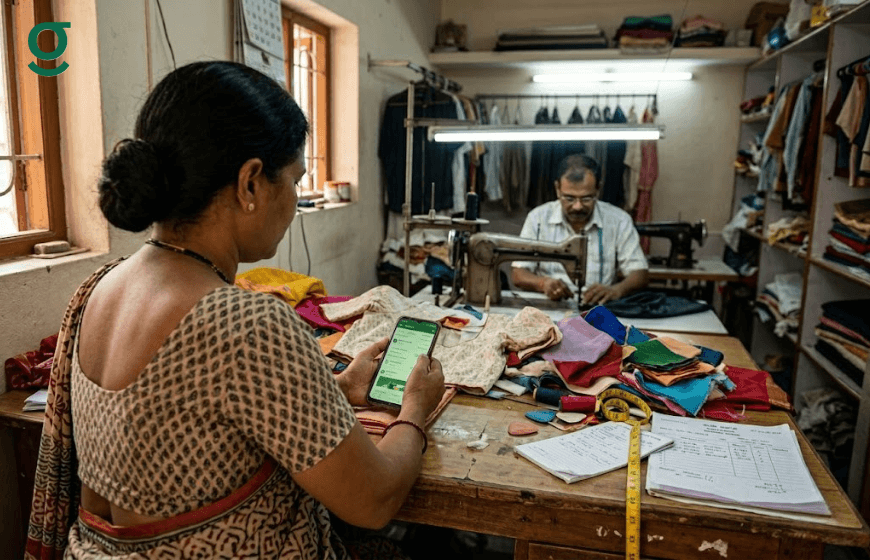
The short answer: any tailoring business that is managing more than 20 to 25 active orders at a time and finding that manual systems create more problems than they solve. In practice, the need is strongest for four types of operations.
Independent boutique owners who manage counter staff, a Masterji and Karigars and need a single system that connects all three.
Designer studios handling bridal and occasion wear where per-order value is high and a single mistake is expensive.
Multi-staff tailoring units where production is spread across multiple Karigars and the owner cannot physically supervise every stage.
Boutiques with repeat customers who want measurement history, order history and loyalty data in one place rather than across multiple notebooks.
How Digital Tailor Management Software Differs from Generic Apps
Generic billing apps, retail POS systems and spreadsheet tools are built for businesses that sell finished goods. They do not have fields for measurements, production stages, trial management or Karigar assignments. A system built specifically for boutiques captures the workflow exactly as it happens on the shop floor. The difference is not cosmetic. It is structural.
A generic billing app closes a sale. A digital tailor management system opens an order, tracks it through five production stages, manages two or three customer interactions, generates a compliant invoice and closes the loop on payment. No switching between tools required.
If you are evaluating what category of software fits your boutique, this guide on boutique management software covers the full decision framework. For a comparison of the related terms in this space, the boutique management system software guide covers what each term means in practice.
Key Features to Look for in Digital Tailor Management Software
Not every platform in this category delivers the full functionality. When evaluating options, the test is whether the platform handles all six functions natively in one app without requiring integrations. Specific features that separate purpose-built platforms from generic tools:
Garment-type measurement templates with mandatory fields so incomplete data cannot move forward.
Stage-wise production tracking with timestamps and staff attribution at each stage.
Automated customer communication via WhatsApp when order status changes.
GST-compliant auto-billing that generates from order data without manual entry.
Role-based access controls so each team member sees only what their function requires.
Analytics dashboard with order volume, revenue and production data by time period.
GrowStitch as Digital Tailor Management Software for Indian Boutiques
GrowStitch is built specifically for the Indian boutique and tailoring market. The platform handles every function described in this guide in a single mobile-first application. It understands the context of Indian boutique operations: the Masterji-Karigar workshop structure, the seasonal demand spikes around Diwali and wedding season, the mix of bridal and regular wear and the need for GST compliance in billing. For boutiques choosing between different options, this evaluation guide covers what to look for.
The brand positioning says it clearly: Run your boutique like a Pro. Digital tailor management software is the operational infrastructure that makes that possible.
Conclusion: Digital Management Is Not a Luxury. It Is the Next Step
Every boutique that has grown past a certain order volume has hit the same wall: the diary cannot keep up, the WhatsApp group is a mess and the Masterji is the only person who knows where anything stands. Digital tailor management software replaces that fragile system with one that is legible, searchable and current to the minute. GrowStitch is that system, built for Indian boutiques. Download GrowStitch and run your boutique on a digital foundation from day one.
Frequently Asked Questions
1. What is digital tailor management software?
Digital tailor management software is a platform that manages the complete boutique workflow digitally: order booking, customer measurements, production stage tracking, staff coordination, GST billing and payment collection. It replaces physical diaries, separate measurement books and manual bill books with a single connected system. GrowStitch is an example built specifically for Indian boutiques.
2. How does this type of platform differ from a regular billing app?
A billing app handles one function: generating invoices. A full management platform handles the entire order lifecycle from booking through production to delivery and payment closure. It includes measurement storage, workshop tracking, customer communication and business analytics that a standalone billing app does not provide.
3. Do small boutiques need a dedicated digital management system?
Yes. A boutique with 20 to 30 active orders is already managing more information than a paper system handles accurately. Digital tailor management software reduces errors in measurement transfer, eliminates lost payment records and gives the owner visibility over the full order status without physically checking each stage. The time saved per week typically exceeds five to eight hours for a boutique of this size.
4. Does it work for a multi-Karigar workshop?
Yes. Role-based access means each Karigar sees only the production tasks relevant to their stage. The owner sees the full dashboard. Stage-wise tracking with timestamps shows exactly which Karigar handled each stage of every order. This accountability layer is only possible with a digital system.
5. Is GrowStitch available on mobile?
Yes. GrowStitch is designed mobile-first. The owner, front-desk staff and Masterji all access the platform on their mobile devices. Orders are created, measurements captured, production stages updated and invoices sent directly from the app. No desktop setup or complex installation is required.
6. How long does it take to set up a digital management system for a boutique?
Most boutiques using GrowStitch are fully operational within a day. The store setup covers service pricing, fabric rates and garment types. Staff are assigned roles and access. Customer and order data begins building from the first booking. There is no data migration required to start. Existing orders can be entered manually if needed.
7. What is the difference between tailoring software and digital tailor management software?
The terms are closely related. Tailoring software refers to the category broadly. Digital tailor management software emphasises the management layer specifically: the coordination of people, orders and information across the workshop and counter. GrowStitch delivers both: the software infrastructure and the management capability built on top of it.