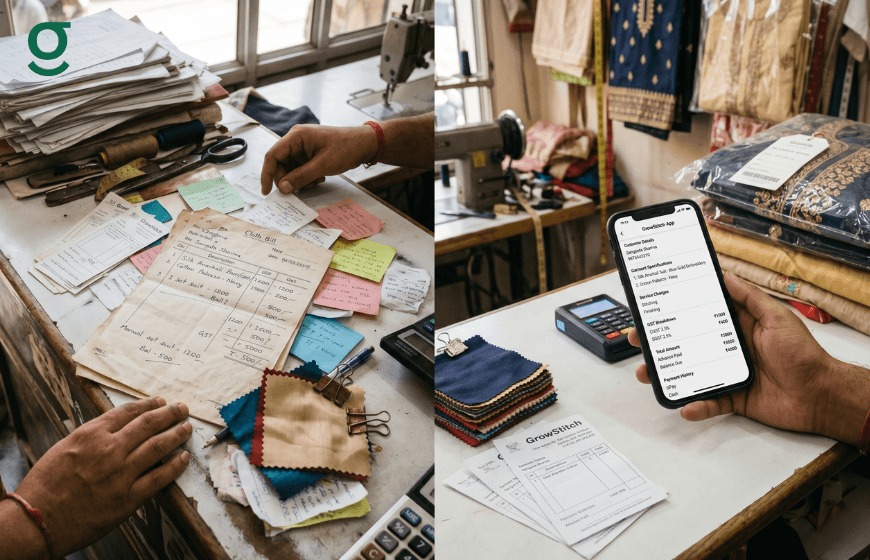
A Clothes Bill Format is a billing template created in Microsoft Word that Indian tailors use to generate invoices for custom stitching orders. It typically lists garment details, fabric charges, stitching fees and the payment status. Many Masterjis begin their billing journey with a Clothes Bill Format because Word is free, familiar and available on most phones and laptops.
The problem begins when order volume grows. A Clothes Bill Format is a static document. It does not calculate, it does not track payment history, it does not link to the customer's next order and it cannot tell you how much money is pending across all active orders at any given moment. This guide walks through what a proper clothes bill format must include, where Word falls short and how GrowStitch replaces the Word-based cloth bill with a live digital billing system built for Indian tailoring.

What Should a Clothes Bill Format Include?
A Clothes Bill Format for an Indian tailor should cover the following fields as a minimum. Boutique name and logo at the top. Customer name and contact number. Order date and expected delivery date. An itemised list of garments, each showing the garment type, fabric used, stitching charge, embroidery or add-on charge, and any alteration charges. Total amount charged, advance received and balance due. GST applied where applicable. A payment receipt section confirming the transaction.
Many tailors who search for a Clothes Bill Format want a template that covers these fields in a clean layout. Dozens of free templates are available online. The challenge is not finding a Clothes Bill Format . The challenge is that even the best Word-based cloth bill stops working the moment the boutique moves beyond basic, single-payment orders.
For a deeper understanding of how billing formats compare to full digital invoicing: Boutique Bill Book Format vs Digital Invoicing: What Actually Saves You Time.
Why Indian Tailors Search for a Clothes Bill Format
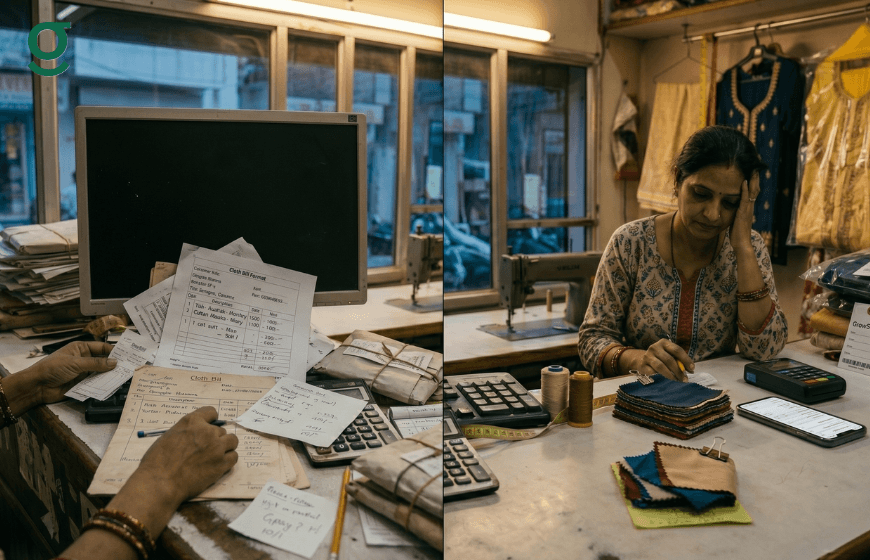
The search for a Clothes Bill Format is driven by three factors: cost, familiarity and speed. Word is free. Most Masterjis already know how to use it. Creating a simple table with boutique name and order details takes under ten minutes. For a boutique running five to eight orders a month, this approach is functional.
Beyond that volume, the limitations of a Word-based clothes bill format become visible fast. You are managing multiple files. File names become inconsistent. Finding last month's bill for a customer who has returned requires opening multiple documents. Calculating total pending dues across all customers is impossible without reviewing every single file. A clothes bill in Word is a snapshot. It tells you nothing about what is happening across your business right now.
See the billing problems that all Word-based and manual cloth bill approaches create: 7 Billing Problems That Tailoring Software Solves for Indian Boutique Owners.
The Specific Problems With a Clothes Bill Format
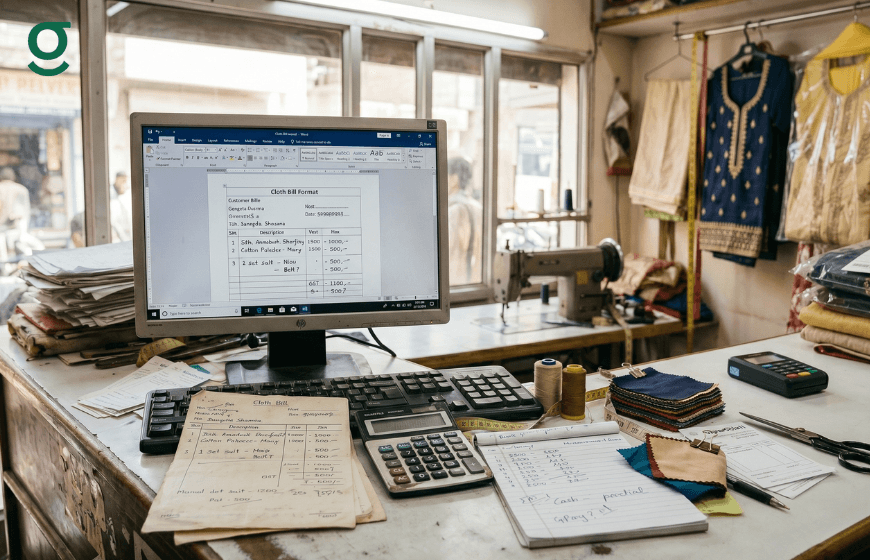
Manual Calculations Create Errors
A Clothes Bill Format uses no formulas unless the tailor has manually set up a table with basic sums. When a charge changes, the Masterji updates one cell but often forgets to update the total. GST is calculated separately. Discounts are adjusted by hand. Every manual step is an opportunity for a calculation error that leads to a billing dispute with the customer.
No Running Balance Across Orders
The most significant gap in a Word-based cloth bill is the absence of a running ledger. A customer places three orders in a month. Each has its own Word file. The customer has paid partial amounts on each. Finding the total outstanding balance requires opening all three files and adding the numbers manually. GrowStitch does this automatically in real time.
No Customer History Linkage
A Clothes Bill Format exists as an isolated document. It has no memory of the customer's previous orders, measurement preferences or payment behaviour. When a repeat customer calls to ask about a previous order, the Masterji has to search through a folder of files. The Clothes Bill Format was never designed to be a customer management system.
No Professional Digital Receipt
Customers receiving a photo of a printed Word document on WhatsApp do not feel they are dealing with a professional boutique. A clean digital receipt with the boutique's branding, the order reference number, the garment breakdown and the GST figure is a trust signal. A clothes bill in Word, photographed and shared on WhatsApp, is not.
How GrowStitch Replaces the Clothes Bill Format
GrowStitch provides a structured digital billing system designed specifically for tailoring businesses. When a new order is created, the billing fields appear as part of the order creation flow. The Masterji fills in the garment type, fabric rate, stitching charge, embroidery add-on and GST category. The system calculates the total, applies GST automatically and generates a professional digital receipt.
When the customer pays an advance, it is logged against the order immediately. The balance due updates in real time. When the final payment comes in at delivery, the bill is closed. The entire clothes bill is digital, accurate and connected to the order record. There is no separate Word file to manage, no manual calculation and no risk of a missing receipt.
Learn how tailoring software handles partial payments and cash flow tracking: Tracking Partial Payments: The Hidden Cash Flow Leak in Your Boutique Bill Book.
Clothes Bill Format vs GrowStitch Digital Billing
Automatic GST calculation: GrowStitch calculates this. A Word-base
The clothes bill format requires manual entry every time. Running payment balance: GrowStitch shows the live balance outstanding across all orders. Word has no running total between files. Customer history: GrowStitch links every clothes bill to the customer's profile. Word stores each bill as a separate, disconnected file. Professional receipt: GrowStitch generates a clean digital receipt instantly. Word produces a document that must be printed or photographed and shared. Speed at counter: GrowStitch generates a clothes bill in under two minutes. Word requires opening, editing, saving and sharing each file individually.
What a Professional Cloth Bill Looks Like in 2026
A cloth bill in 2026 should be generated digitally at the point of order creation, updated automatically as payments come in, sent to the customer as a clean digital receipt and stored permanently against their order record. It should include GST, the full garment breakdown, the payment history and the balance remaining.
A Clothes Bill Format can meet none of these requirements. GrowStitch meets all of them by design because it was built for exactly this workflow.
What a tailor app actually does beyond billing: What Does a Tailor App Actually Do: A Feature Guide for Boutique Owners.
Making the Switch from a Word-Based Clothes Bill to Digital
Switching from a Clothes Bill Format to GrowStitch does not require migrating old records. Start by creating your next new order inside GrowStitch. The billing flow guides the Masterji through every required field. The first time the process runs smoothly, the advantage is immediately obvious. There is no Word file to open, no table to format and no calculation to check.
Within a week, the Masterji is generating digital cloth bills faster and more accurately than the Word-based process allowed. Within a month, the boutique has a searchable payment history, real-time outstanding balance visibility and professional receipts going to every customer.
When you are ready to move beyond manual tools: Stop Using Excel: 5 Signs You Are Ready for Professional Tailoring Software.
Conclusion:Data-Driven Growth and Market Benchmarking
Beyond the immediate benefit of replacing a manual clothes bill format, moving to a digital platform like GrowStitch opens the door to Business and Growth Insights. While a paper bill tells you what one customer spent, GrowStitch tells you how your boutique is performing compared to others in your city. You can track your Average Order Value (AOV) and see if you are ranking among the top boutiques in your area for specific categories like bridal or daily wear.
This market intelligence allows you to make data-backed growth decisions. For instance, if you notice your overseas revenue is growing faster than your domestic revenue, you can shift your marketing focus accordingly. A manual billing system keeps you focused on the past; GrowStitch keeps you focused on the future of your business.
Ready to run your boutique like a Pro? Download GrowStitch today: Download GrowStitch
Frequently Asked Questions
What is a Clothes Bill Format for Indian tailors?
A Clothes Bill Format is a Microsoft Word template used by tailors to create invoices for custom stitching orders. It includes fields for customer name, garment type, fabric charges, stitching fees, GST and payment received. It is a starting point for billing but does not support running balances, payment history or automatic calculations.
Is a Clothes Bill Format enough for a growing boutique?
A Clothes Bill Format is sufficient for boutiques handling fewer than ten orders a month. As order volume grows, managing separate Word files for each clothes bill becomes unmanageable. Payment tracking, customer history and GST calculations all require manual effort. A digital billing system like GrowStitch handles all of this automatically.
What is the difference between a cloth bill and a clothes bill format?
A cloth bill is the invoice issued for a specific tailoring order. A clothes bill format is the template or layout used to create that invoice. In GrowStitch, the clothes bill format is built into the order creation flow and generates automatically without any manual template management.
Can GrowStitch replace my Word-based cloth bill completely?
Yes. GrowStitch replaces the Clothes Bill Format entirely. It generates digital cloth bills automatically at order creation, tracks advances and balances in real time, calculates GST and sends professional receipts to customers. There is no Word file to manage and no manual calculation required.
Why do Indian tailors still use Clothes Bill Format in 2026?
Indian tailors continue using Clothes Bill Format because of familiarity and low initial effort. Word is free and already installed on most devices. The switch to digital billing requires a small learning curve. However, the time saved and errors eliminated by a dedicated cloth billing system like GrowStitch far outweigh the short adjustment period.
What makes GrowStitch better than a free Clothes Bill Format ?
GrowStitch is purpose-built for tailoring billing and handles everything a Clothes Bill Format cannot: automatic GST calculation, running payment balances, customer order history, professional digital receipts and real-time outstanding dues visibility. It replaces the static Word template with a live, connected billing system built for boutique workflows.