
Apparel billing software designed for the garment industry handles inventory, stock management and retail sales transactions. It tracks SKUs, manages fabric stock, records sales from existing inventory and generates GST-compliant invoices. For a readymade garment shop, a fabric store or an apparel wholesaler, this is exactly the right tool. For a tailoring boutique, it is the wrong tool entirely.
The reason generic apparel billing software fails tailoring businesses is structural, not cosmetic. It is built around a retail model where the product exists at the time of sale. Tailoring is a custom manufacturing model where the product is created after the sale is agreed. GrowStitch is tailoring software built specifically for the custom manufacturing reality of Indian boutiques. Why Indian boutiques need tailoring software built for local workflows explains the specific ways generic apparel tools fail on the shop floor.
What Generic Apparel Billing Software Is Built to Do
Generic apparel billing software manages inventory-based retail. Its core capabilities are: maintaining a product catalogue with SKUs and stock levels, recording sales from existing stock, generating GST-compliant invoices for completed transactions and tracking remaining inventory. These capabilities serve a retail business well because the product exists before the customer walks in.
The entire architecture of generic apparel billing software assumes that what is being sold already exists. There is no concept of a garment that will be created over the next three weeks based on the customer's specific measurements, fabric choice and design preferences.
Why Generic Apparel Billing Software Cannot Handle Tailoring Operations
No measurement management
A tailoring order begins with body measurements: Bust, Waist, Hip, Shoulder, Sleeve, Armhole, Kamar, Gola and dozens of other fields depending on the garment type. Generic apparel billing software has no measurement management capability. The boutique is left maintaining a separate physical measurement book alongside the billing tool, which creates exactly the dual-system problem that tailoring software is designed to eliminate.
No production stage tracking
A tailoring order passes through multiple production stages before it is ready for delivery: Cutting, Stitching, Hemming, Finishing and Quality Check. Tracking production stages from Cutting to Finishing in GrowStitch tailoring software gives the boutique real-time visibility that generic apparel billing tools cannot provide.
No advance-and-balance payment cycle
A tailoring order involves a two-stage payment process: advance at booking and balance at delivery. Generic billing tools process a single payment at the point of sale. GrowStitch tailoring software tracks the complete tailoring payment cycle per order. The billing problems that tailoring software solves are precisely the ones that generic tools cannot address because they are structurally tailoring-specific.
No Job Sheet generation
When a tailoring order is confirmed, the Masterji needs a production document containing the customer's measurements, fabric notes, design instructions, reference images and delivery date. Generic billing software generates an invoice, not a Job Sheet. The production information has to be communicated separately, typically verbally or via WhatsApp, which introduces the transcription errors and information loss that cause rework.
No business intelligence for tailoring operations
GrowStitch tailoring software provides a business intelligence dashboard showing revenue versus target, average order value, repeat customer rate, India versus overseas performance and market ranking in your pin code. Generic apparel billing software shows inventory movement and sales totals, which tell a tailoring boutique almost nothing about how the business is actually performing.
What Happens to Boutiques That Use Generic Apparel Billing Software
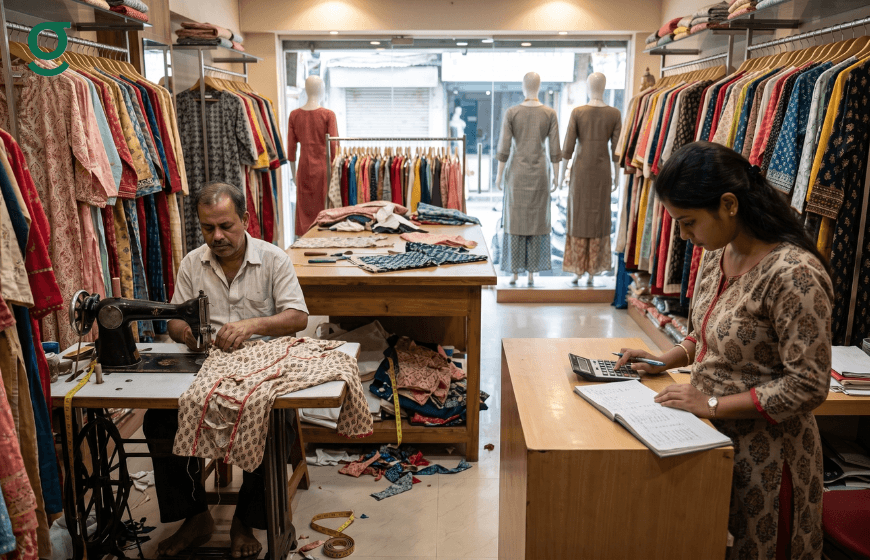
A boutique that uses generic billing tools to manage tailoring operations ends up running two parallel systems: the billing software for invoices and something else, a physical register, WhatsApp or a spreadsheet, for measurements, production tracking and payment follow-up. The billing software solves 20 to 30 percent of the operational problem and the rest gets improvised.
This hybrid approach costs more in daily friction than a purpose-built tailoring software subscription. The signs a boutique is ready for professional tailoring software typically include exactly this pattern of managing multiple disconnected tools alongside a generic billing solution.
The Real Cost of Using Generic Software in a Tailoring Business
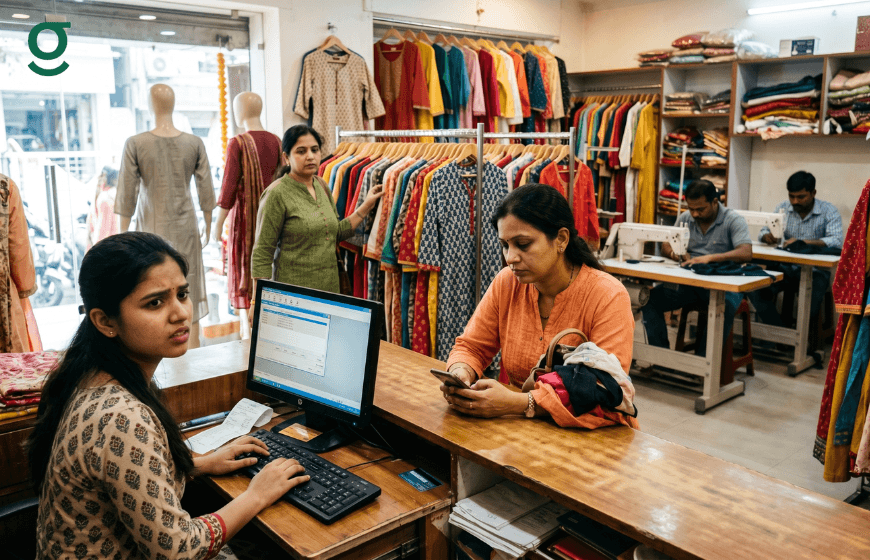
The direct cost of a generic billing tool subscription is visible on the monthly statement. The indirect cost of using it in a tailoring business is invisible but significantly larger. Every hour the owner spends searching through a physical measurement book for a returning customer's dimensions, every rework event caused by a measurement that never made it from the counter to the cutting table and every balance that went uncollected because there was no system tracking it: these are the operational costs that accrue daily in a boutique that uses generic software for a workflow it was never built to support.
GrowStitch tailoring software replaces the generic tool and eliminates the indirect costs simultaneously. Boutiques that make the switch consistently report that the operational friction they had normalised as just how tailoring works largely disappears within the first month.
What to Use Instead: GrowStitch Tailoring Software
GrowStitch is tailoring software built from the ground up for the custom manufacturing workflow of Indian boutiques. Every feature reflects the actual daily operations of a boutique: garment-specific measurement templates, digital Job Sheet generation, stage-wise production tracking, advance-and-balance payment management and a business intelligence dashboard with local market benchmarking. How to choose boutique management software provides a practical evaluation checklist for any boutique currently using generic tools or no dedicated system at all.
For a boutique transitioning from generic software to GrowStitch, the first week reveals the capabilities that the old system was missing: measurements stored against customer profiles, Job Sheets generated automatically, production stages tracked in real time and payment balances visible across all active orders simultaneously. The second week reveals the time savings: the counter staff is no longer flipping through a physical measurement book for repeat customers, the Masterji is no longer receiving verbal production instructions that get misremembered and the owner is no longer spending 45 minutes every evening tallying the day's payments from a handwritten register. The third week confirms the quality improvement: rework starts to fall because the Job Sheet eliminates the transcription step where most measurement errors were occurring. By the end of the first month, the boutique is operating with a level of clarity and professionalism that the previous generic billing tool could never have provided, regardless of how many workarounds the team had built around it.
Conclusion
Generic apparel billing software fails tailoring businesses not because it is poorly built but because it is built for the wrong business model. Apparel billing is retail. Tailoring is custom manufacturing. The operational requirements are fundamentally different and a tool built for one cannot adequately serve the other.
GrowStitch tailoring software is built for the tailoring model: measurements, Job Sheets, production tracking, advance-and-balance billing and business intelligence that reflects the reality of running a custom garment operation. For any boutique currently managing tailoring operations with generic billing software, the switch to a purpose-built platform is the most direct path to operational efficiency.
Run your boutique like a Pro. Download GrowStitch free: Download GrowStitch
FAQs:
1. What is apparel billing software?
Apparel billing software is designed for inventory-based garment retail: managing stock, recording sales from existing inventory and generating invoices. It works well for readymade garment shops and fabric stores but is structurally unsuitable for tailoring boutiques where every order is a custom garment created after the sale.
2. Why does generic billing software fail for tailoring businesses?
Generic billing tools have no measurement management, no production stage tracking, no Job Sheet generation and no advance-and-balance payment cycle. These are the four operational requirements that are specific to tailoring and absent from tools built for retail. The result is a boutique managing the missing functions through manual workarounds alongside the billing tool.
3. What should a tailoring boutique use instead of generic billing software?
A tailoring boutique should replace generic apparel billing software with purpose-built tailoring software like GrowStitch that understands the custom manufacturing workflow: measurement templates per garment type, automatic Job Sheet generation, stage-wise production tracking, advance-partial-balance payment management and business intelligence with local market benchmarking.
4. Can GrowStitch replace the billing software a boutique currently uses?
Yes. GrowStitch provides all the billing capabilities of generic apparel billing software plus the tailoring-specific functions that generic tools cannot provide. Order creation, GST-compliant invoicing, payment recording and revenue reporting are all included alongside the measurement, production and analytics features.
5. How long does it take to switch from generic software to GrowStitch?
Counter staff typically learn GrowStitch's order creation and payment workflow within one session. The first week reveals all the capabilities the previous system was missing. Existing customers are migrated gradually as they visit, with no requirement to transfer historical data from the old system.
6. Is GrowStitch tailoring software more expensive than generic billing software?
The relevant comparison is total operational cost, not subscription cost. Generic billing tools plus a physical measurement book plus WhatsApp coordination plus manual reconciliation adds up to more in daily friction and owner time than a GrowStitch subscription. For any boutique with more than 20 active orders per month, tailoring software is consistently the lower total cost.