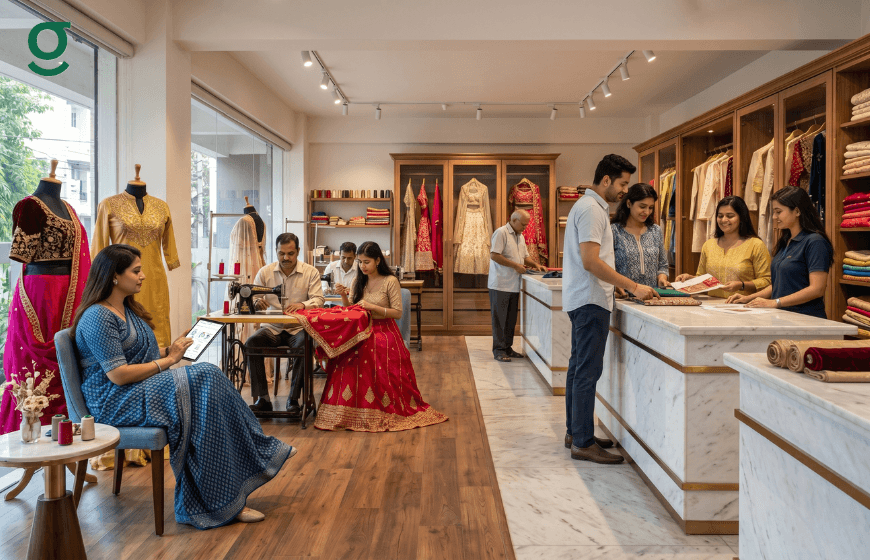
A tailor app helps boutique owners track staff productivity without micromanaging by creating a digital activity trail behind every production update, every order entry and every stage change. The owner sees who updated what, when and for which order, from the analytics dashboard rather than from standing in the workshop asking questions. Productivity becomes visible through data rather than through physical presence. GrowStitch provides this visibility as a built-in function of the production tracking and staff management system.
Micromanagement is the default response to a lack of visibility. An owner who does not know whether the Masterji updated the production stages this morning will walk to the workshop and ask. An owner who does not know which front-desk staff member is processing orders quickly will stand at the counter and monitor. This physical monitoring costs the owner time and signals distrust to the team, which reduces motivation and performance. A tailor app that surfaces the same information through a dashboard eliminates the need for physical monitoring without sacrificing oversight. Moving beyond WhatsApp and diaries is the operational shift that makes data-based oversight possible.

What Staff Productivity Looks Like in a Tailor App
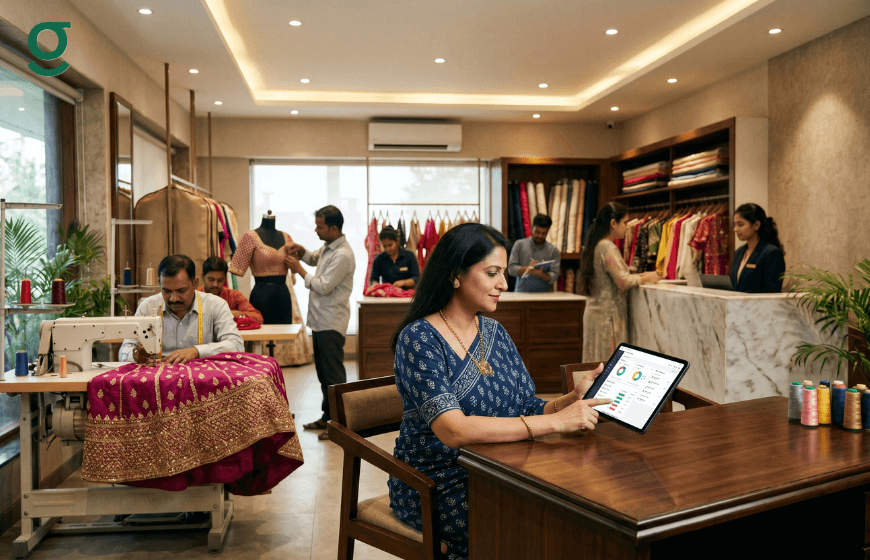
In a boutique running on GrowStitch, productivity is visible through four measurable signals that the tailor app tracks automatically.
1. Production Stage Update Frequency
Masterji's primary productivity metric in a tailor app is the frequency and accuracy of production stage updates. An active Masterji updates the stage of each order as it moves from Cutting to Stitching to Finishing. GrowStitch timestamps every stage update. The owner can see, without calling the workshop, which orders were updated today, which Karigar updated them and what the current stage distribution looks like across the full production queue. A Masterji who has not updated any order since yesterday morning is visible on the dashboard. The owner can investigate before the delay affects a delivery.
2. Order Entry Completeness by Front-Desk Staff
Front-desk staff productivity in GrowStitch is measured by the completeness of the order records they create. An order created with all measurement fields complete, a confirmed trial date and an advance payment logged is a complete order record. An order with missing measurement fields or no advance recorded is an incomplete one. GrowStitch shows the order completion rate by staff members. The owner knows which staff member consistently creates complete records and which regularly leaves fields incomplete, without watching the counter.
3. Task Completion Against Daily Assignments
GrowStitch allows the owner to assign daily tasks to specific team members: complete the Finishing stage on 8 orders today, create the billing invoices for 5 ready orders, update the trial schedule for this week. The team member sees their assigned tasks on their app dashboard. The owner sees the completion status from the management view. Tasks that are not completed by end of day are visible without a single follow-up call. Assigning daily tasks through the tailoring application creates measurable accountability across every team member.
4. Karigar-Level Output Tracking
For boutiques with multiple Karigars, GrowStitch shows each Karigar's production output: how many orders were moved through their assigned stage, how many are currently in their queue and what their average completion time per garment type is. An owner who sees that Karigar A consistently completes 6 to 8 pieces per day while Karigar B completes 3 to 4 is seeing a productivity gap that may indicate a skill difference, a workload imbalance or a process inefficiency. The tailor app surfaces the observation. The owner investigates and responds.
Why Visibility Without Physical Presence Changes the Boutique Culture
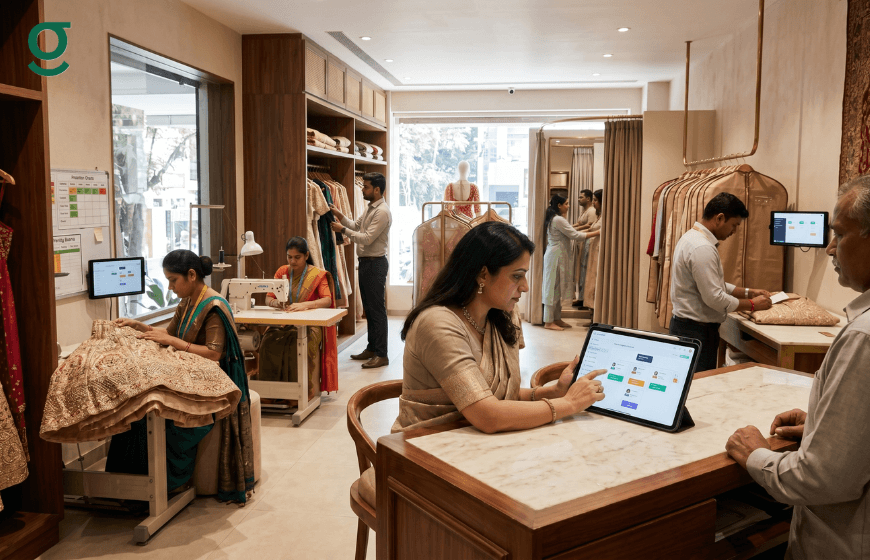
The shift from physical monitoring to data-based oversight changes how the team experiences management. A Masterji who is followed around the workshop and questioned every hour experiences the owner as a source of pressure. A Masterji who updates production stages in the app and knows the owner sees those updates in real time experiences the owner as informed but absent from the workshop floor. The work does not change. The relationship around the work does.
The Masterji who updates stages consistently and accurately is demonstrating performance without being asked about it. The one who does not update is creating a visibility gap that the owner notices without having to visit. In both cases, the performance signal reaches the owner through data rather than through conversation. The management interaction happens when there is something specific to discuss, not as a daily routine of physical checking.
This is what productive accountability without micromanagement looks like in a boutique context. Technology elevates the team's performance accountability without creating the friction of constant monitoring.
How the Tailor App Connects Productivity to Business Outcomes
A tailor app that tracks individual staff productivity connects team performance to business outcomes that the owner can measure. A front-desk staff member with a high order completion rate contributes to fewer production errors and fewer customer disputes. A Masterji with a consistent stage update frequency contributes to lower late delivery rates. A Karigar with a high daily output contributes to a production capacity that enables more orders to be accepted.
GrowStitch's analytics dashboard surfaces these connections. The owner can see that months where the Masterji's update frequency was high correlated with months where the late delivery rate was low. The boutique's operational metrics are the aggregated result of individual team productivity. Boutique management software that connects individual productivity to business performance gives the owner a complete picture.
Setting Up a Productivity-Visible Team in GrowStitch
Configuring the tailor app for staff productivity visibility involves three setup steps. First, the owner assigns each team member a role-based account with the relevant module access. Second, the owner configures daily task assignments for each role. Third, the owner sets the expected stage completion timelines so the app can flag delays against standard rather than against the owner's intuitive expectation.
Once configured, the productivity view is available on the owner's dashboard without any additional effort. The team members work within their module. The data accumulates. The owner reviews the productivity signals every morning as part of the standard dashboard check. No additional meetings. No daily check-in calls. No physical walkthrough of the workshop at the start of each shift. Securely managing team access and performance through the boutique management system is the structural foundation for productive oversight.
GrowStitch Marketplace: Productivity Includes Material Procurement Time
Staff productivity in a boutique is not only measured by production output. It also includes the time spent on material procurement. In boutiques that send a Karigar or a junior staff member to the local market every day or every other day to source threads, buttons, zips and trims, that time is production capacity that has been redirected to shopping. A Karigar who spends 2 hours at the market on Tuesday is a Karigar who produces 2 hours less output on Tuesday.
GrowStitch Marketplace is a tailoring-material sourcing platform built inside the same app. When the owner orders materials through Marketplace from the dashboard, the procurement task is removed from the production team's daily schedule. Materials arrive at the boutique with next-day delivery. The Karigar who would have spent Tuesday morning at the market spends Tuesday morning at the machine. The production output for the day increases without the team working longer hours.
For boutiques that track productivity through a tailor app, removing market visit time from the production team's schedule through Marketplace is one of the fastest ways to improve measurable output per team member per day. The platform tracks what changes. The owner sees it.
Conclusion: Oversight Through Data, Not Presence
A tailor app that surfaces production stage update frequency, order entry completeness, task assignment completion and Karigar-level output gives the boutique owner the information needed to manage performance without standing in the workshop. GrowStitch converts staff accountability from a conversation-dependent activity into a data-visible one. The team works. The data reflects their work. The owner responds to the data rather than to the presence or absence of visible effort. Run your boutique like a Pro: know your team's performance before you ask about it. Download GrowStitch and see your team's productivity dashboard from day one.
Frequently Asked Questions
1. How does a tailor app track staff productivity without micromanaging?
A tailor app tracks staff productivity through a digital activity trail: every production stage update, order entry, task completion and billing action is timestamped and attributed to the staff member who performed it. In GrowStitch, the owner sees this data on the analytics dashboard without visiting the workshop or asking the team. Productivity is visible through data rather than through physical observation.
2. What productivity metrics does GrowStitch track for boutique staff?
GrowStitch tracks four key productivity metrics: the frequency and accuracy of production stage updates by the Masterji, the completeness of order records created by front-desk staff, the completion rate of daily task assignments across all team members and the per-Karigar output volume by garment type. Each metric is visible on the owner's dashboard. The tailor app calculates these automatically from the actions the team takes within the platform.
3. How does the tailor app assign daily tasks to team members?
In GrowStitch, the owner assigns daily tasks to specific team members from the management dashboard. Each team member sees their assigned tasks on their individual tailor app view. The owner sees the completion status from the management view. Tasks not completed by end of day are visible without a follow-up call. The assignment and tracking process requires no additional communication channel beyond the platform itself.
4. Can the tailor app track different productivity metrics for the Masterji versus front-desk staff?
Yes. GrowStitch tracks role-specific productivity metrics for each staff role. For the Masterji, the primary metric is production stage update frequency and order completion per day. For front-desk staff, the metric is order entry completeness and daily booking volume. For billing staff, it is invoice generation and payment logging. The tailoring software provides a role-appropriate productivity view for each team member.
5. How does removing market visits improve staff productivity in a tailor app?
GrowStitch Marketplace delivers tailoring materials to the boutique with next-day delivery. When procurement is handled through Marketplace, Karigars and junior staff who previously made daily or bi-daily market visits redirect that time to production. A 2-hour market visit replaced by a Marketplace order on the app takes less than 5 minutes. The production output per team member increases without any change to working hours.
6. What is the difference between staff productivity tracking in a tailor app versus a manual system?
In a manual system, staff productivity is assessed through the owner's direct observation or through verbal reports from the Masterji. Both are subjective and require the owner's physical presence or active follow-up. In a boutique management software platform like GrowStitch, productivity is an objective data output derived from the team's actions in the app. The data is available at any time, covers any time period and does not require anyone to report it separately.