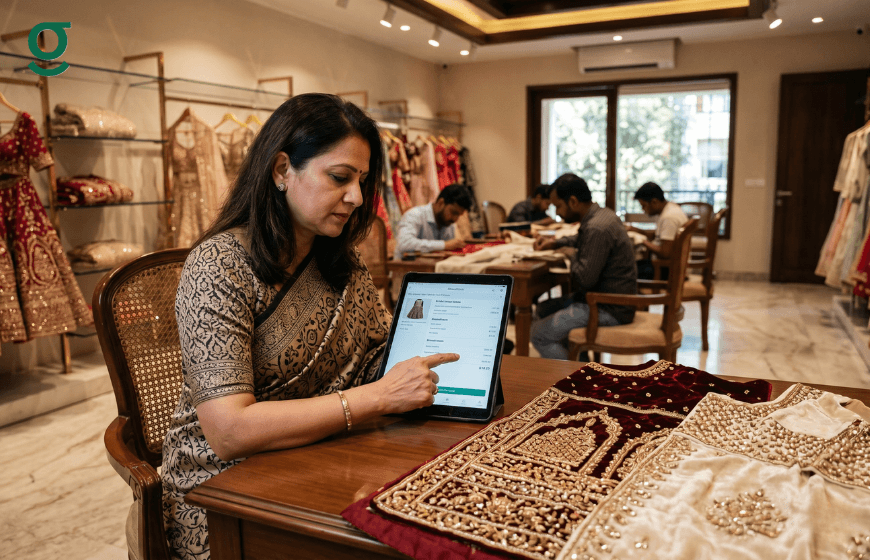
A tailoring application manages festive season advance bookings by recording deposits at the moment of booking, configuring minimum advance amounts by order type, building the booking into the production queue with a confirmed delivery date and giving the owner a live view of how many advance bookings are committed against available production capacity. The boutique owner knows at any point during the booking window exactly how much of the festive season production floor is already committed. GrowStitch enables this advance booking management as part of the standard order workflow.
Festive season advance booking is the period where the boutique's committed revenue for October and November is actually made. Customers who book a lehenga set in August for Navratri are committing to a specific boutique 8 to 10 weeks before they need the garment. This is the highest-conversion moment in the boutique's calendar because the customer's intent is confirmed and the booking advance secures the relationship. A tailoring application that captures this advance, locks in the production timeline and tracks the balance ensures that the revenue committed in August is actually collected in October. Managing bridal and festive orders through a tailoring application is the operational foundation for peak season success.

Why Advance Bookings Without a Tailoring Application Break Down
Advance bookings present a specific and recurring management challenge: the order is created weeks or even months before production begins. In a manual system, an advance booking entered in August lives in the bill book until October. During those 8 to 10 weeks, three things can go wrong. The advance payment can be recorded incorrectly. The booking details can be lost or misread when production begins. The delivery commitment can be forgotten in the chaos of September when new bookings are coming in for other occasions.
The second and often more damaging problem is overbooking. During the August advance booking window, the boutique is taking bookings for garments that will all need to be produced in a 3 to 4 week window in October. Without a production capacity view, the owner cannot know when she has accepted more bookings than the workshop can realistically complete. She discovers the problem in September when the Masterji reports that the production queue is unmanageable. The delivery commitments she made in August cannot be honoured.
Preventing this requires both a live booking record and a connected production capacity view. A tailoring application provides both in the same platform. Handling high-volume festive season orders without slowing production requires seeing the committed capacity before accepting a new booking.
How GrowStitch Tailoring Application Manages Each Advance Booking
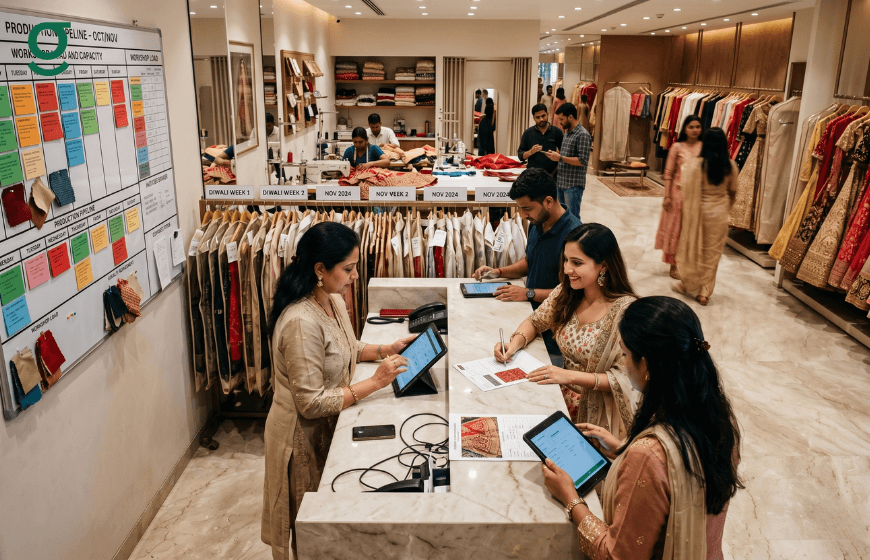
1. Advance Recorded at Booking, Not at Production Start
In GrowStitch, every advance booking creates an order record immediately, with the deposit amount logged at the point of payment. The order includes the garment type, measurement profile, confirmed delivery date and advance received. The customer receives an automated WhatsApp confirmation with all these details. The order is visible in the production queue from day one, even though production may not begin for 6 weeks. The tailoring application does not allow the booking to exist without a recorded advance. If no advance is collected, the record shows a zero advance and the pending balance dashboard flags the order immediately.
2. Configurable Minimum Advance Policy
GrowStitch allows the boutique owner to set a minimum advance percentage by order type. Bridal lehenga sets may require a 50 percent minimum advance. Festive occasion wear may require 30 percent. Simple alteration bookings may require no advance. When the front-desk staff creates a booking, the system prompts for the minimum advance. This policy is enforced automatically without requiring the staff member to remember the rule or apply it consistently.
3. Production Capacity View Against Committed Bookings
The production dashboard in GrowStitch shows the delivery date distribution of all confirmed advance bookings. The owner can see that in the third week of October, 22 orders are scheduled for delivery. She knows her workshop can complete 18 orders per week at normal quality. Three weeks before the October window opens, she knows she has over-committed 4 orders in that week. She has time to extend 4 delivery dates by one week before the customers have been expecting the original date long enough that a change becomes problematic. The tailoring software wedding season playbook demonstrates how this capacity view prevents overbooking before it becomes a crisis.
4. Automated Deposit Follow-Up and Balance Reminders
For advance bookings where the customer paid a partial deposit at booking and is expected to pay the remainder before production begins, GrowStitch sends automated WhatsApp reminders when the deposit balance is due. For bookings with delivery dates in October, the system prompts balance collection in September without the owner manually tracking each advance booking's payment status. Stopping payment chasing during peak season requires a system that follows up on advance balances automatically.
Festive Season Advance Booking as Revenue Planning
The advance booking window for Diwali and wedding season gives the boutique owner the clearest revenue forecast of the year. If the boutique has 35 confirmed advance bookings with an average order value of Rs. 4,200, the committed revenue is Rs. 1,47,000 before a single garment goes into production. This figure is visible in GrowStitch's revenue dashboard from the moment each booking is created. The owner knows in August what October's revenue will look like and can make capacity decisions accordingly: hire an additional Karigar, source materials in advance or limit new bookings to protect quality. Revenue target planning is most reliable when advance booking data is visible weeks before the production window opens.
GrowStitch Marketplace: Pre-Order Materials for Confirmed Advance Bookings

An advance booking commits the boutique to a specific delivery date weeks or months before production begins. The boutique's ability to honour that commitment depends not just on Karigar availability but on material availability. A bridal lehenga booked in August requires specific fabric, matching lining, embroidery thread and trim components that may not be available from local suppliers in October when every boutique in the city is buying the same festive season materials simultaneously.
GrowStitch Marketplace allows boutique owners to pre-order the materials for confirmed advance bookings as soon as the order is created. The lining, thread, zip and trim for an October bridal set can be ordered from Marketplace in August at current prices with delivery scheduled for September when production begins. The boutique is not competing with every other October-delivery boutique for the same materials at the end of September. Materials are secured early at stable prices.
For boutiques managing 30 to 50 advance bookings for festive season, pre-ordering through Marketplace is a production reliability strategy, not just a convenience. The Masterji can begin work on the confirmed schedule without waiting for materials. Eliminating late deliveries starts with having the right materials available when production is scheduled to begin.
The cost stability benefit directly compounds the reliability benefit. Festive season materials, particularly premium lining fabrics, quality threads and decorative trims, see significant price increases in the local market during September and October when every boutique in the city is buying simultaneously. A boutique that pre-orders its advance booking materials in August through GrowStitch Marketplace buys at the stable pre-season price. Every Marketplace purchase is recorded as a business expense in the platform, making material cost for each advance booking visible alongside its billing amount.
Conclusion: Advance Bookings Are a Revenue Opportunity, Not a Management Problem
Festive season advance bookings are the boutique's highest-value revenue moment. A tailoring application like GrowStitch converts this moment from a manual management challenge into a structured, visible and reliable workflow. The advance is recorded, the deposit is tracked, the delivery commitment is visible in the production capacity view and the balance reminders fire automatically. The boutique honours its October commitments because the system managed the August booking accurately. Run your boutique like a Pro: fill the festive season order book with confidence, not hope. Download GrowStitch and open your festive season advance booking workflow today.
Frequently Asked Questions
1. How does a tailoring application manage festive season advance bookings?
A tailoring application manages festive season advance bookings by recording the deposit at the point of booking, configuring minimum advance amounts by order type, placing the booking in the production queue with a confirmed delivery date and showing the owner a live view of committed production capacity. GrowStitch provides all of these functions within the standard order creation workflow.
2. How does GrowStitch prevent overbooking during peak season?
GrowStitch's production dashboard shows the delivery date distribution of all confirmed bookings. The owner can see how many orders are committed for any given week and compare this against available Karigar capacity. When the committed volume for a specific week exceeds realistic capacity, the tailoring application makes this visible in advance so the owner can adjust delivery dates before the problem reaches the production floor.
3. Can a tailoring application track advance deposits separately from balance payments?
Yes. GrowStitch records the advance deposit separately from the balance due. The order record shows the total billing amount, the advance received and the balance outstanding at all times. The pending balance dashboard updates in real time as payments are received. Tailoring software that tracks these separately gives the owner a complete picture of both committed revenue and expected collection timing for every festive season booking.
4. How does advance booking data help with revenue forecasting?
Each confirmed advance booking in GrowStitch contributes to the revenue dashboard from the moment it is created. The owner can see the total committed revenue from all advance bookings at any point during the booking window, giving a reliable revenue forecast for the production month before it begins. This forecast is what makes capacity decisions, material pre-orders and staffing decisions data-based rather than intuitive.
5. How does GrowStitch Marketplace help with advance booking fulfilment?
GrowStitch Marketplace allows boutique owners to pre-order materials for confirmed advance bookings as soon as the order is created. Instead of competing for materials at peak season when all boutiques need the same items, the materials are ordered early at stable prices and delivered before production begins. This pre-ordering through Marketplace is what allows the boutique to honour advance booking delivery commitments reliably.
6. What happens if a customer cancels an advance booking?
When an advance booking is cancelled in GrowStitch, the order is marked as cancelled and the advance amount is flagged as a credit or refund. The order is removed from the production capacity view, freeing that slot for a new booking. The boutique management software maintains a clear record of the cancelled booking and the advance collected, which is important for both financial tracking and any customer refund process the boutique follows.