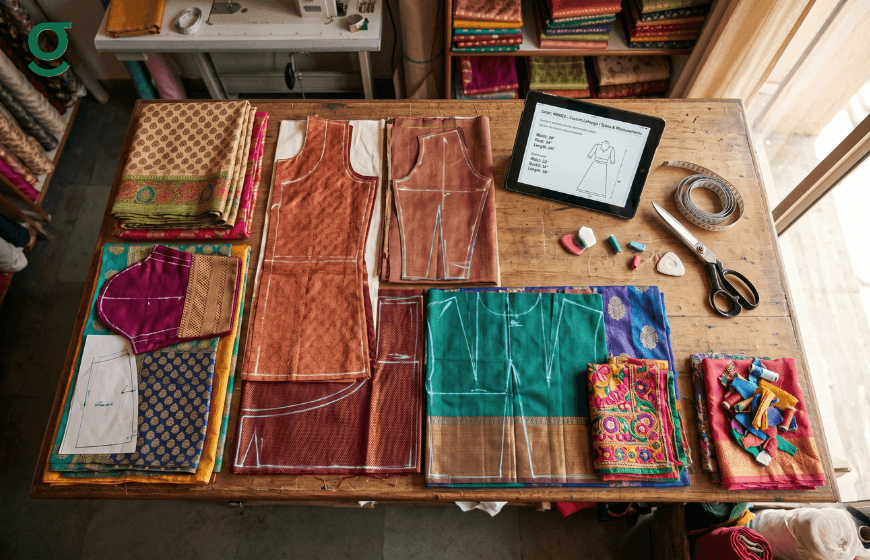
Fabric is the single largest variable cost in a boutique. Every metre wasted on a botched lehenga hem or a wrongly cut kurta body is money written off the day it hits the cutting table. And the frustrating truth is that most fabric wastage in Indian boutiques is preventable. It does not come from bad craftsmanship. It comes from bad information flow.
Tailoring software prevents fabric wastage by ensuring that exact measurements, garment specifications and design instructions reach the Karigar accurately before a single cut is made**.** GrowStitch digitises the handoff between the counter, the Masterji and the cutting table so that verbal instructions and illegible handwriting no longer cost you fabric.
This guide breaks down where wastage originates, how a tailor app closes each gap and what the cumulative cost saving looks like for a boutique running 40 to 60 active orders a month. For context on how a full digital system handles these workflows, see what tailoring software covers end to end.

Where Tailoring Software Targets Fabric Wastage at the Source
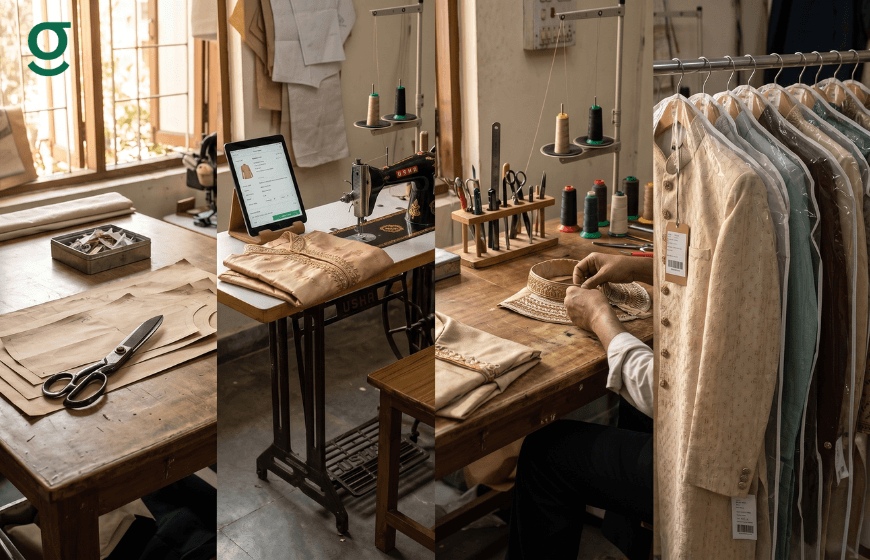
Most boutique owners attribute wastage to fabric quality or staff skill. In practice, three information failures drive the majority of avoidable waste.
1. Measurement Transfer Errors
The measurement is taken correctly at the counter. Then it is written in a physical book. Then it is verbally passed to the Masterji. Then the Masterji writes it on a slip for the cutter. Each transfer is an opportunity for a digit to change. A 38-inch chest becomes 36. A 14-inch blouse length becomes 16. The difference between a correct measurement and a wrong one is often one pen stroke. The cost is half a metre of premium fabric and the time to redo the piece.
2. Verbal Instructions at the Cutting Table
When design instructions travel by word of mouth, the cutter interprets rather than executes. A customer specifies a certain collar cut for a Jodhpuri suit. The Masterji describes it to the Karigar. By the cutting table, the specific detail has blurred. The Karigar adds extra margin to be safe, which wastes fabric. Or worse, cuts to a slightly wrong pattern, which wastes the entire piece. Replacing verbal handoffs with digital job sheets is the most direct fix.
3. Repeat Order Errors
A customer returns for a second lehenga. Staff cannot find the measurement book from her last visit. New measurements are taken in a hurry. The blouse comes out an inch tight at the shoulder because the hurried re-measurement missed the original note about her posture adjustment. The first blouse is scrapped. The second is re-cut from the same fabric roll. Two mistakes, one customer, double the wastage.
How Tailoring Software Closes Each Wastage Gap
GrowStitch addresses each of these three failure points at the source. The platform ensures that by the time fabric reaches the cutting table, the information travelling with it is complete, correct and Karigar-ready. This is also why rework rates drop when boutiques move to a dedicated system.
Digital Measurement Templates
When a customer's measurements are entered into GrowStitch, they go into a structured digital template specific to the garment type. A blouse template has different mandatory fields from an Anarkali template. The tailoring software enforces completeness. No field can be skipped. The Masterji cannot move an order forward with a blank sleeve length. Every measurement captured digitally is also retrievable instantly for any future order. There is no re-measurement, no new slip, no verbal transfer.
Auto-Generated Job Sheets
Once an order is created in GrowStitch, the platform generates a digital job sheet that travels with the garment from the counter to the cutting table to the stitching station. The job sheet contains: exact measurements, fabric roll reference, design notes, any special instructions (e.g. wide hem, extended sleeve, specific collar depth) and the delivery deadline. The Karigar reads from a screen or a printed job sheet. There is no verbal chain. Stage-wise production tracking makes this information accessible at every stage.
Customer Measurement History on Every Order
Every returning customer's full measurement profile, including notes from the last fitting, is attached to the new order automatically. The Masterji sees the original shoulder note for a customer who carries one shoulder lower. The cutter adjusts for it before picking up the scissors. The garment comes out right on the first cut.
Manual Workshop vs GrowStitch: Where Wastage Is Prevented
| Wastage Source | Manual Boutique | GrowStitch Tailoring Software |
|---|---|---|
| Measurement errors | Handwritten notes misread at the cutting table. | Digital measurement templates prevent misreads. All fields mandatory. |
| Repeat rework | Same fitting error on second visit because old notes are not retrieved. | Customer measurement history pulled for every new order automatically. |
| Cutting overage | Cutter adds extra margin because instructions are verbal or unclear. | Job sheet with exact dimensions and tolerances sent to the Karigar. |
| Rush rework fabric | Last-minute correction requires fresh fabric at higher cost. | Stage-wise tracking catches errors at Stitching before Finishing. |
What Fabric Wastage Actually Costs a Boutique Each Month
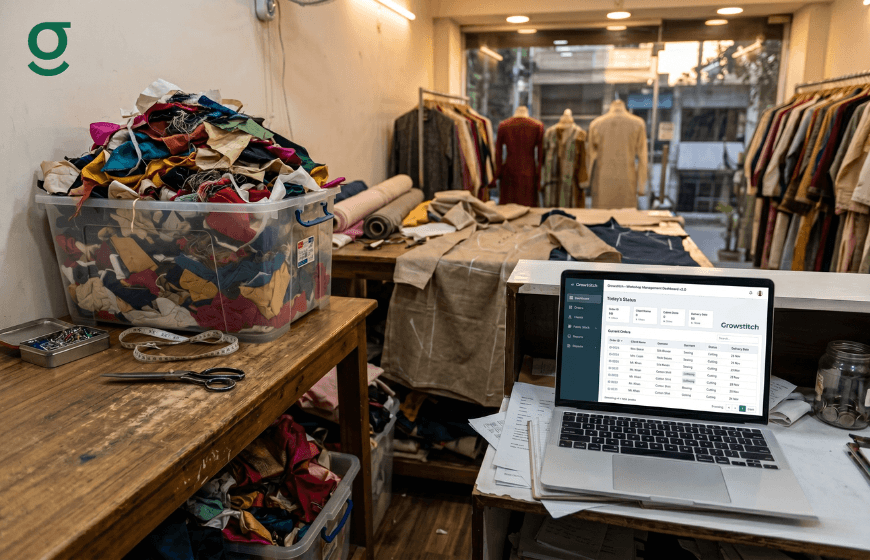
Most boutique owners do not track wastage separately. It disappears into the fabric procurement budget or gets written off as a cost of doing business. A conservative estimate for a boutique handling 50 orders a month tells a different story.
Average fabric cost per garment: Rs. 400 to Rs. 1,200 depending on material.
Wastage rate in a manual boutique: 8 to 12 percent of fabric used.
50 orders a month with average fabric cost of Rs. 600: Rs. 30,000 fabric spend.
Wastage at 10 percent: Rs. 3,000 per month in fabric alone.
Add rework time at 2 to 4 hours per correction: 10 to 20 hours of Karigar time lost monthly.
These are not catastrophic numbers individually. Compounded over 12 months, a boutique is writing off Rs. 36,000 or more in preventable fabric waste, plus the Karigar overtime cost and the customer dissatisfaction from a delayed or re-done garment. Revenue leakage like this is systemic. It requires a system to fix it.
Why Boutique Software Reduces Wastage Across All Garment Types
The same information-flow problem that causes wastage on a lehenga choli also causes it on a men's Sherwani, a ladies' suit or a school uniform order. The garment type changes. The failure mode does not. Boutique software like GrowStitch handles all garment types through a single digital workflow, which means wastage prevention is not limited to one order category.
For boutiques that run bridal orders alongside regular ready-to-stitch items, this is especially valuable. Bridal fabric is expensive. A single re-cut on a heavy Banarasi lehenga can cost Rs. 2,000 to Rs. 5,000 in fabric alone. The job sheet discipline enforced by GrowStitch means bridal orders go through the same zero-verbal-transfer workflow as every other garment.
For boutiques using a tailor app for the first time, the shift is immediately visible. Staff stop relying on memory. The Masterji stops guessing at design intent. The cutter stops adding unnecessary margin. Fabric procurement begins to track actual usage more accurately.
Conclusion: Prevent the Cut Before It Happens
Fabric wastage is an information problem wearing a production disguise. Every cut made on wrong or incomplete information costs money that was entirely avoidable. GrowStitch tailoring software fixes the information handoff at the source: at the counter, at the measurement table and on the job sheet that travels to the Karigar. The result is fewer botched cuts, less rework, lower fabric spend and more accurate production timelines. Stop absorbing wastage as a business cost. Download GrowStitch and start every cut with the right information.
Frequently Asked Questions
1. How does tailoring software prevent fabric wastage?
Tailoring software prevents wastage by digitising the measurement and instruction handoff between the counter, the Masterji and the cutting table. Digital job sheets replace verbal instructions. Mandatory measurement fields prevent incomplete data. Customer history prevents re-measurement errors. Each of these steps removes a common source of cutting and stitching mistakes.
2. What is the biggest cause of fabric wastage in a boutique?
The biggest cause is information loss between the order booking stage and the cutting table. Measurements get copied incorrectly from one medium to another. Design instructions travel verbally and get interpreted loosely. Repeat customer details are not retrieved accurately. A digital system like GrowStitch closes each of these gaps.
3. Can a tailor app help reduce rework and re-cutting?
Yes. A tailor app like GrowStitch attaches all garment instructions, measurements and design notes directly to the order. The Karigar reads from the job sheet instead of relying on verbal briefings. Stage-wise tracking also catches errors at the stitching stage before the finishing stage, so corrections can be made without re-cutting.
4. How much fabric wastage is typical in a manual boutique?
In boutiques operating without a digital system, fabric wastage from measurement errors, cutting overages and rework typically runs between 8 and 12 percent of total fabric used. For a boutique spending Rs. 30,000 a month on fabric, this represents Rs. 2,400 to Rs. 3,600 in monthly avoidable waste.
5. Does GrowStitch store measurement history for repeat customers?
Yes. GrowStitch stores every customer's complete measurement profile including any special notes from previous fittings. When the customer places a new order, the entire profile is attached automatically. The Masterji and cutter work from the same accurate, up-to-date data without needing to re-measure or search through physical books.
6. Does boutique software help with bridal order fabric management?
Yes. Bridal fabric is expensive and precision on the first cut matters more than on standard garments. GrowStitch enforces the same digital job sheet discipline on bridal orders as on all others. Design specifications, measurement notes and fabric roll references are all attached to the order and visible to the Karigar before any fabric is touched.