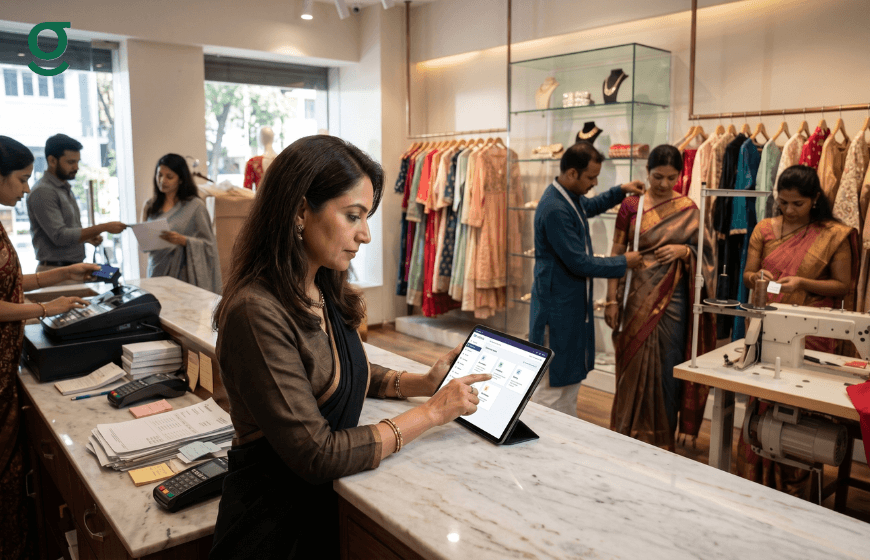
Billing software for cloth shop operations in India must support three capabilities that generic retail billing tools do not provide: the advance-and-balance payment cycle, per-garment service itemisation and GST calculation on tailoring services rather than on product sales. A cloth shop or boutique that attempts to use a standard retail billing tool for custom garment operations will encounter billing gaps, GST complications and customer disputes within the first month of use. GrowStitch is built specifically for cloth shop and boutique billing workflows.
The Indian cloth shop operates on a fundamentally different billing model from a retail store. A retail store sells a product at a fixed price. A cloth shop or boutique accepts an advance, performs custom work over days or weeks and collects the balance at delivery. There is no product in the bill. There is a service, a fabric and a customer-specific specification. Any billing software for cloth shop operations that does not account for this distinction is the wrong tool for the job. Why billing software for cloth shop operations must be built differently from retail billing tools is a question with a specific answer.

The Five Features That Billing Software for Cloth Shop Must Have
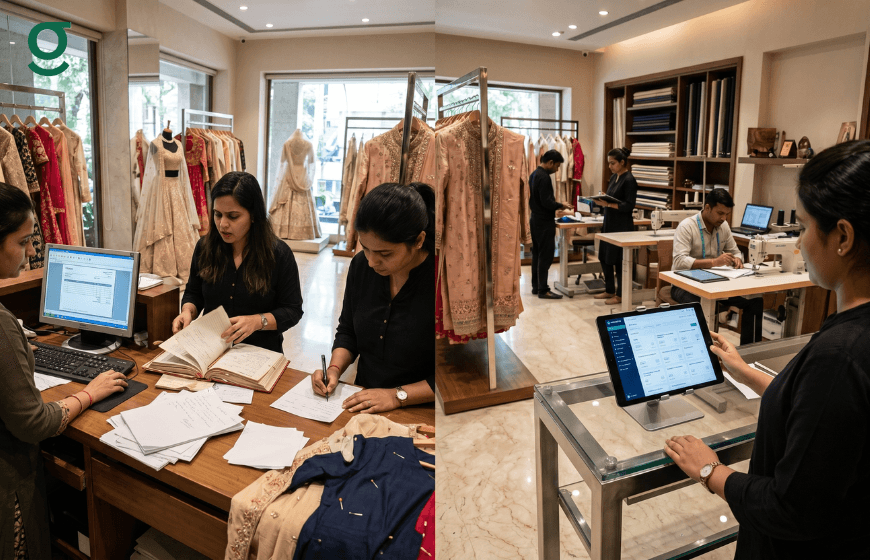
1. Advance and Balance Payment Cycle
A cloth shop takes money in two stages: an advance at booking and the balance at delivery. The advance may be 30 percent, 50 percent or any negotiated amount. The balance is the remainder after the advance is deducted from the total bill. A billing software for a cloth shop that processes only a single payment per order cannot represent this reality. The result is an untracked advance that either becomes a manual reconciliation task at month end or a dispute with the customer who remembers paying more than the bill shows.
GrowStitch records the advance at order creation. The order record shows the total billing amount, the advance received and the outstanding balance in real time. The pending balance dashboard updates automatically as payments are received. Tracking partial payments is the most commonly missed billing function in a cloth shop operation.
2. Per-Garment Service Itemisation
A retail billing tool generates a bill for a product: 'Blue cotton shirt, 1 unit, Rs. 850.' A cloth shop bill needs to show: Lehenga stitching, Rs. 2,200; Blouse stitching, Rs. 800; Lining, Rs. 300; Embroidery coordination, Rs. 600; Express delivery, Rs. 400. Each line item represents a service performed. The customer should be able to read the bill and understand what she paid for. A billing tool that cannot generate service-level line items cannot produce a professional cloth shop invoice.
3. GST on Tailoring Services
The GST rate on tailoring services differs from the GST rate on fabric or on ready-made garments. A cloth shop that uses a generic billing tool configured for retail product GST may apply the wrong rate to tailoring service charges. The result is either a tax compliance gap or an overpayment on every bill. Billing software for cloth shop that is built for the Indian tailoring context has GST configured for service-type charges, not just product sales. Avoiding calculation errors on GST requires a billing system configured for the specific tax category of each service.
4. Customer Measurement History
A cloth shop's billing software should be connected to the customer's measurement record. When the front-desk staff opens a customer's billing screen, they should see the measurement profile alongside the billing history. This connection prevents the situation where the billing record exists in one system and the measurement record exists in a separate diary, creating a risk that orders are billed to the wrong customer or at the wrong price for the agreed specifications.
5. WhatsApp Bill Delivery
Indian boutique customers expect to receive their bills on WhatsApp. A billing tool that generates only a PDF for the owner's records, requiring the owner to manually forward the bill to the customer, adds an avoidable step. A billing software for a cloth shop that sends the bill directly to the customer's WhatsApp from within the platform removes this step. GrowStitch sends the invoice automatically when it is generated, without any additional action from the staff member.
What to Avoid When Choosing Billing Software for Cloth Shop
Three common mistakes boutique owners make when selecting billing software for cloth shop operations.
Using a generic retail POS: Retail point-of-sale systems are built for inventory-based selling. They assume a product SKU, a fixed price and a single payment. None of these assumptions apply to a cloth shop. Why generic apparel billing software fails tailoring businesses is an important distinction to understand before choosing a tool
Using a free bill book app: Free bill book apps generate simple invoices but do not track advances and balances, do not connect to customer measurement records and do not integrate with production workflows. Why a free bill book app is insufficient for a growing boutique comes down to the absence of these connected functions
Using a platform not built for India: Many billing platforms are designed for international markets and apply GST logic, payment cycle assumptions and service catalogue structures that do not match Indian boutique operations. Tailoring software for India built for local workflows is significantly more effective than a global ERP adapted to the Indian context
Comparison: Generic Billing vs GrowStitch for Cloth Shop Operations
The table below summarises the six most critical functional differences between a generic billing tool and GrowStitch as a purpose-built billing software for a cloth shop platform. Each difference represents a specific gap that affects how accurately the boutique bills, how efficiently it collects and how professionally it communicates with customers.
| Feature | Generic Billing Tool | GrowStitch for Cloth Shops |
|---|---|---|
| Advance and balance payment cycle | Not natively supported. Single payment assumed. | Built-in. Advance logged at booking, balance tracked until collection. |
| Per-garment service itemisation | Product SKU-based. No service itemisation. | Service catalogue with per-garment rates. Itemised invoice generated automatically. |
| GST on stitching services | Retail GST configured. Service tax not tailoring-specific. | GST configured per service type. Applied correctly to stitching, lining and add-ons. |
| Customer measurement records | No measurement module. Customer data limited to contact. | Full measurement profile per customer. Linked to every order they place. |
| Production-to-billing connection | No production tracking. Billing is standalone. | Order moves from production to billing in one system. No data transfer required. |
| WhatsApp bill delivery | PDF export only. WhatsApp sharing manual. | Automated WhatsApp bill delivery from within the app. |
GrowStitch Marketplace: Complete Cloth Shop Operations in One Platform
A complete cloth shop operation has two financial dimensions: what the shop earns from customers and what it spends on materials. Most billing software tracks only the earning side. The material spend, threads, zips, buttons, lining, trims and embellishments, is tracked separately in a manual register or not tracked at all.
GrowStitch Marketplace is a tailoring-material sourcing platform built inside the same app as the billing software. Every material purchase made through Marketplace is recorded as a business expense within GrowStitch. The cloth shop owner sees both sides of the financial picture from one platform: billing revenue from the customer side and material costs from the Marketplace side. Profitability per order becomes calculable without a separate accounting exercise.
When evaluating billing software for cloth shop operations, the ability to track both revenue and material costs in the same platform is a feature that separates GrowStitch from standalone billing tools. A tool that handles only billing leaves the material cost dimension untracked. A tool that handles billing and material sourcing gives the owner a complete financial operating picture.
Conclusion: Choose Billing Software Built for Cloth Shop Workflows
Billing software for cloth shop operations in India must be built for the specific realities of custom garment work: advance-and-balance payments, per-garment service itemisation, GST on tailoring services, connected customer measurement records and WhatsApp bill delivery. A generic retail billing tool handles none of these requirements natively. GrowStitch handles all of them as core functions built for the Indian cloth shop context. Run your boutique like a Pro: bill with software that understands your business. Download GrowStitch and configure your cloth shop billing system today.
Frequently Asked Questions
1. What is the most important feature of billing software for cloth shop operations?
Billing software for cloth shop operations must support the advance-and-balance payment cycle. A cloth shop takes an advance at booking and the balance at delivery. A billing tool that processes only a single payment per order cannot represent this cycle and will create billing discrepancies, manual reconciliation work and customer disputes. GrowStitch records both the advance and balance as separate payment events against the same order record.
2. Can I use a generic billing app for my boutique in India?
A generic billing app can generate invoices but will not handle the advance-and-balance cycle, service-level itemisation, the GST rate on tailoring services or the connection between billing and customer measurement records. For a boutique handling 20 or more orders per month, these gaps create billing errors and revenue leakage that a tailoring-specific billing system prevents.
3. How does GrowStitch handle GST for cloth shop billing?
GrowStitch applies GST based on the rates configured in the service catalogue. Each service type, stitching, lining, add-on services, can have its own GST rate configured separately. The billing software for cloth shop applies the correct rate to each service line item and shows the GST breakdown on the invoice. For GST-registered boutiques, the GSTIN is included in the invoice header automatically.
4. What is the difference between a boutique bill book and billing software for cloth shop?
A boutique bill book is a manual record that requires the staff member to write every detail and calculate every total by hand. It does not track advance-and-balance cycles automatically, does not send bills to customers and does not connect to production or measurement records. Billing software for cloth shop like GrowStitch automates all of these functions, eliminating calculation errors and ensuring every charge agreed at booking appears on the final invoice.
5. How does billing software connect to the production workflow in GrowStitch?
In GrowStitch, billing and production are part of the same order record. When an order moves to Ready in the production dashboard, it automatically appears in the billing queue with the full service charges, advance received and balance due. The billing staff does not need to receive the order details from the production team separately. The tailoring software connects both workflows within the same platform.
6. How does GrowStitch Marketplace improve cloth shop financial management?
GrowStitch Marketplace records every material purchase as a business expense within the same platform. The cloth shop owner sees customer billing revenue and material sourcing costs in the same analytics view. This dual visibility makes profitability per order calculable without a separate accounting tool. A billing software that handles only the revenue side leaves the cost side untracked, which means the owner never has a complete picture of actual margin per garment.