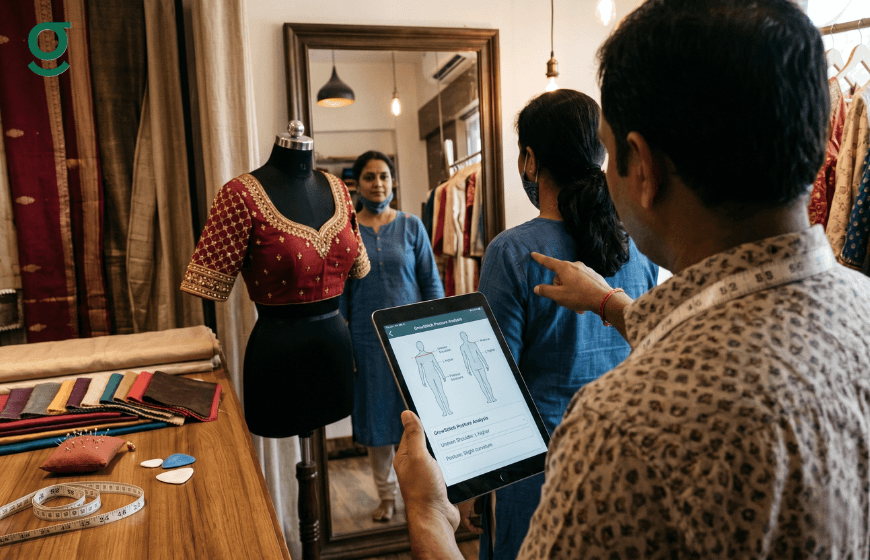
A tailor measurements app captures posture notes by providing a structured notes field alongside each measurement point, allowing the Masterji to record body-specific observations that affect how a garment should be cut and finished. These notes travel with the customer's profile across all orders, so the same posture adjustments are applied every time without needing a fresh assessment. GrowStitch stores these observations permanently in the customer's measurement profile, making posture-informed cutting the default for every order the customer places.
Measurements alone do not make a well-fitting garment. Two customers with identical chest and waist measurements can require completely different cutting instructions because one stands with rounded shoulders and the other with a pronounced forward lean. A tailor measurements app captures both the numbers and the context. This guide explains what posture notes are, which observations matter most and how GrowStitch makes this information available to the Karigar at the point of cutting. Error-free garments start with complete measurement records that go beyond the standard dimensions.

Why Measurements Alone Are Not Enough
A standard measurement record captures chest, waist, hip, sleeve length, shoulder width and inseam. These numbers define the garment's dimensions. What they do not capture is how the customer's body distributes those dimensions. A chest measurement of 38 inches can belong to a customer who holds her shoulders back and carries the measurement evenly. It can equally belong to a customer who rounds forward and carries the measurement differently across the front and the back of the blouse.
The Masterji who took the measurements knows this. He noted it mentally when he worked with the tape measure. The problem is that this observation lives only in his head. When the Karigar at the cutting table works from the measurement sheet, he has the numbers but not the context. The blouse is cut to the measurements. The customer comes for a trial and the back is pulling. A second trial is needed. An alteration is required. The knowledge gap between the Masterji and the Karigar cost the boutique a fitting session.
A tailor measurements app closes this gap by giving the Masterji a clearly structured space to record posture observations at the point of measurement capture. The Karigar reads these notes from the same digital record before cutting begins.
Which Posture Observations a Tailor Measurements App Should Record
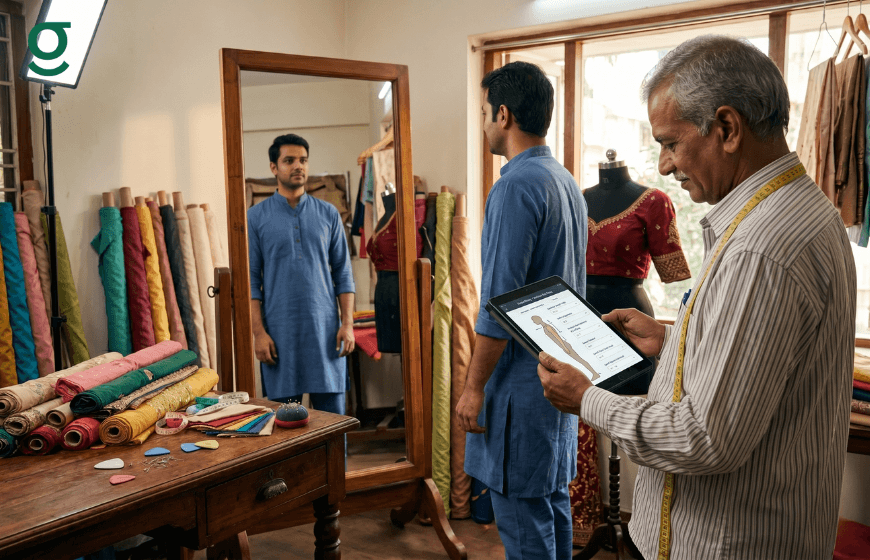
A tailor measurements app supports the recording of multiple posture and body characteristics that affect garment fit. The most consistently useful observations cover the following areas.
Shoulder Posture
Rounded shoulders versus square shoulders affect blouse and jacket fitting at the back. Uneven shoulder height, where one shoulder sits measurably lower than the other, requires an asymmetric shoulder seam. These are observations that a standard measurement does not capture but that determine whether the back sits flat or pulls upward at one side.
Spine Alignment and Back Curvature
A pronounced upper back curve, common in older customers and those who sit at a desk for long hours, requires extra length at the back of a blouse or kameez and a slightly altered armhole. Without this observation, the garment pulls upward at the back when the customer is in her natural posture. Recording this in the tailor measurements app means every future order for this customer automatically includes the relevant back adjustment. Standardised measurement capture includes posture observations as a core component of the fitting record.
Forward Lean
A customer with a natural forward lean carries more of her body volume in front. Blouses and fitted kurtas need additional ease at the front chest and a corresponding reduction at the back. Without this note, the front of the blouse will pull and the back will have excess fabric. This observation is not captured in any standard measurement but it is one of the most common causes of first-trial alterations.
Hip and Seat Distribution
Two customers with the same hip measurement can have very different seat distributions: one carries more volume at the back, another at the sides. For lehengas, skirts and fitted salwar cuts, this observation determines the placement of the flare and the dart work. A note in the measurement profile ensures the Karigar cuts for the actual distribution rather than assuming an average.
Arm Alignment
Arms that hang slightly forward rather than straight at the sides require a sleeve pitch adjustment. Without this note, sleeves on fitted blouses and jackets can bind at the shoulder when the arm is in its natural position. Verifying measurement accuracy includes confirming that posture-related adjustments are recorded, not just the tape measure readings.
How GrowStitch Stores and Surfaces Posture Notes
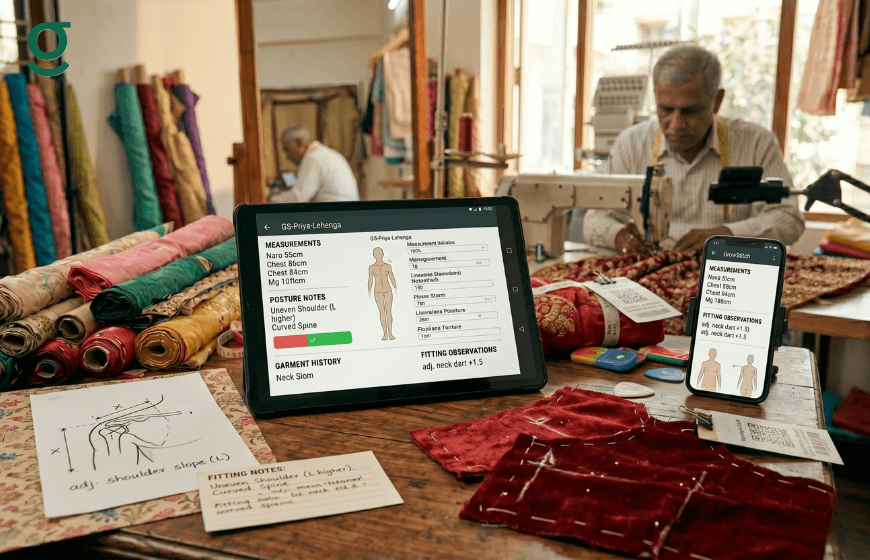
In GrowStitch's tailor measurements app, posture observations are entered as notes in the customer's measurement profile alongside the standard measurement fields. The Masterji types or speaks the observation into the notes field at the time of measurement capture. The note is stored permanently against the customer profile.
When the customer places a new order, the Masterji or Karigar opens the customer's measurement profile in GrowStitch. The measurements and the posture notes are both visible on the same screen. The Karigar does not need to recall the observation from a previous visit. The note is there: rounded shoulders, extra ease needed at front chest, left shoulder 0.5 cm lower than right. The cutting begins with full context.
For boutiques with multiple Karigars handling different garment types, this shared digital record ensures that every Karigar working on any order for the same customer has access to the same posture information. Syncing team measurements ensures that posture notes reach the right Karigar regardless of who took the original measurement.
Posture Notes Across Multiple Orders
The most valuable aspect of posture notes in a tailor measurements app is their permanence. A customer who places her third lehenga order two years after her first does not need to explain her shoulder asymmetry again. The Masterji does not need to remember it. The observation from the first order is in her profile. The third order begins with the same knowledge that informed the first.
Over time, the posture notes become richer. A customer who gains weight between orders may have a new observation added: forward lean has increased, additional ease required at front. These updates are logged alongside the original notes in the measurement profile. Protecting customer measurement history including posture observations is what gives the boutique a permanent quality advantage.
For boutiques that handle a large repeat-customer base, this cumulative posture record is one of the most powerful competitive advantages they can build. A new boutique that takes measurements from scratch cannot match the accuracy of a boutique that has three years of a customer's fitting history in its tailor measurements app.
From Tailor Measurements App to Production: How Notes Reach the Karigar
The value of posture notes is only realised when they reach the Karigar. In a manual system, the Masterji writes the observation on a slip of paper that may or may not travel with the garment to the cutting table. In GrowStitch, the observation is in the digital order record that the Karigar opens on his phone or the workshop screen before he cuts. A centralised measurement database ensures that every observation taken at the counter reaches every Karigar who works on the order.
The result is a direct reduction in first-trial alterations. When the Karigar cuts with posture context, the garment fits better at the first trial. Fewer adjustments are needed. The trial session is shorter and more decisive. The delivery timeline tightens. A tailor measurements app that reduces rework costs does so by capturing better information at the measurement stage, not by cutting faster.
Conclusion: Measurements Plus Posture Notes Equal Better Fit
A tailor measurements app that captures only the numbers is capturing half the fitting information. GrowStitch's measurement profile includes a structured notes field that allows the Masterji to record every posture observation that affects how the garment should be cut. These notes travel with the customer permanently, surface at the start of every order and reach the Karigar before cutting begins. The result is fewer trials, fewer alterations and a reputation for fit accuracy that no manual boutique can match. Download GrowStitch and start building posture-informed measurement profiles for your customers today.
Frequently Asked Questions
1. What posture notes does a tailor measurements app capture?
A tailor measurements app captures posture observations alongside standard measurements. Common notes include shoulder roundness or asymmetry, upper back curvature, forward lean, hip and seat volume distribution and arm alignment. GrowStitch stores these as free-text notes in the customer's measurement profile, making them available to every Karigar who works on any order for that customer.
2. How do posture notes improve garment fit?
Posture notes give the Karigar the body-specific context that standard measurements do not provide. When the Karigar knows that a customer carries more volume at the front chest or has a pronounced back curve, the cutting adjustments are made before the garment is assembled rather than at the trial. This reduces the number of alterations required and improves the accuracy of the first fit.
3. Are posture notes stored permanently in GrowStitch?
Yes. Posture notes entered in GrowStitch's tailor measurements app are stored permanently in the customer's measurement profile. They are visible for every subsequent order the customer places. Notes can be updated when the Masterji observes a change in the customer's posture or body distribution. The full history of observations is retained even when notes are updated.
4. Can posture notes be seen by all Karigars working on an order?
Yes. GrowStitch stores measurement profiles digitally, accessible to any team member with the appropriate access level. When a Karigar opens the order record before cutting, they see both the measurements and the posture notes. This shared access eliminates the information gap between the Masterji who took the measurements and the Karigar who does the cutting.
5. How does a tailoring application use posture notes to reduce alterations?
A tailoring application reduces alterations by ensuring posture-specific cutting instructions are embedded in the order before production begins. When the Karigar cuts with posture context, the garment fits more accurately at the first trial. This directly reduces the number of second trials and post-delivery alterations, saving Karigar time and improving the boutique's delivery reliability.
6. What is the difference between a measurement and a posture note?
A measurement is a quantified dimension: 38-inch chest, 14-inch sleeve. A posture note is a qualitative observation about how the body carries those dimensions: rounded shoulders, pronounced back curve, uneven hip distribution. Both are necessary for accurate garment construction. The measurement defines the size. The posture note defines the shape adjustments needed to fit that size to the specific body.