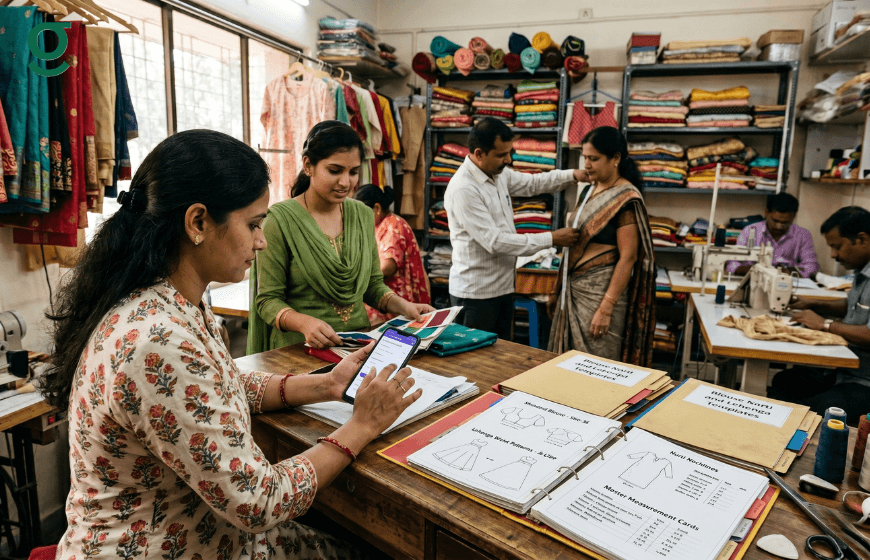
A tailor measurements app uses garment templates to display the exact set of measurement fields required for each garment type the moment an order is created. When a blouse order is opened, the blouse template appears with its specific measurement fields. When a lehenga order is opened, the lehenga template appears. Every required measurement is captured in the right field, in the right order, without the staff member deciding which measurements to take. GrowStitch includes pre-configured garment templates that standardise measurement capture across the boutique's entire order workflow.
Without garment templates, measurement capture in a boutique is inconsistent. One staff member takes nine measurements for a blouse. Another takes seven. One records them in centimetres. Another in inches. One includes sleeve length. Another forgets it. The Karigar at the cutting table receives an incomplete record and either guesses or calls the front desk to ask. A tailor measurements app with structured templates eliminates this inconsistency at the point of capture. Standardised measurement capture is the foundation of error-free garment production.

What a Tailor Measurements App Garment Template Contains
A garment template in a tailor measurements app is a pre-defined set of measurement fields mapped to a specific garment type. When the front-desk staff or Masterji creates a new order for a lehenga, the template automatically presents the fields: waist, hip, length, flare, waist drop and any design-specific measurements the boutique typically captures for that garment. Nothing is left to memory. No field can be skipped without the system flagging it as incomplete.
GrowStitch allows boutiques to configure templates for every garment type they produce: blouses, salwar suits, lehengas, sherwanis, Jodhpuri suits, kurtas, Indo-western and any custom category. Each template is tailored to the actual measurement requirements of that garment type. When a boutique adds a new garment to its catalogue, a new template is created and is available to all staff immediately from the next order. A measurement book for a boutique that uses templates never has incomplete records.
Garment-Specific Templates for Indian Boutique Wear
Blouse Template
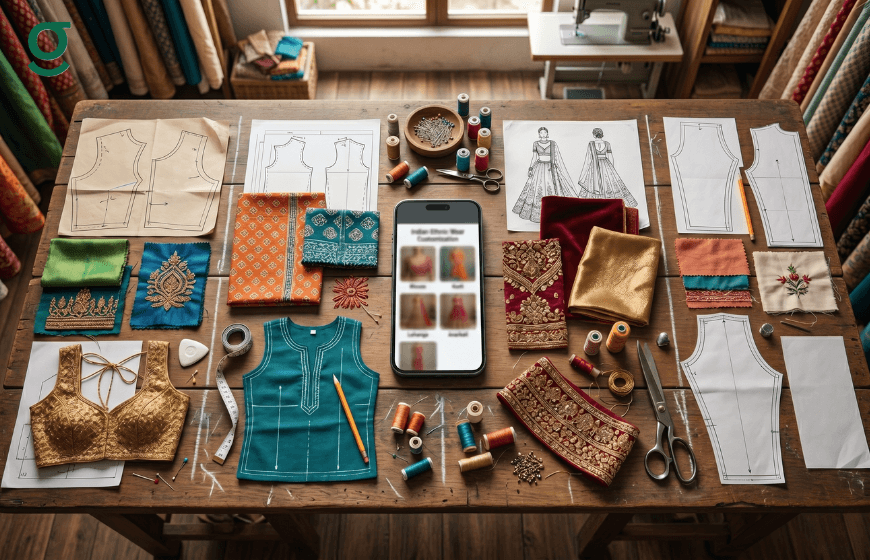
A blouse template typically includes: bust, waist, shoulder width, sleeve length, sleeve width at bicep and wrist, blouse length front and back, neck depth front and back, neck width and armhole measurement. These 10 to 12 fields are specific to a blouse. A template ensures all are captured at the time of order creation. The Masterji does not arrive at the cutting stage and discover that the sleeve width at the wrist was not noted.
Lehenga Template
A lehenga template includes: waist, hip, length, flare circumference, waist drop and any design-specific details such as trail length or panel count. The blouse component has its own fields within the same order. A lehenga is a multi-component garment and a template ensures the measurements for each component are captured as a complete set rather than as whatever the staff member remembered to ask for.
Salwar Suit Template
A salwar suit template covers the kameez and the salwar as a linked pair: chest, waist, hip, kameez length, sleeve details and the salwar measurements including inseam, knee width and ankle width. Without a template, the salwar measurements are frequently underspecified in a manual record, leading to Karigar guesswork at the cutting stage.
Sherwani and Jodhpuri Template
Men's formalwear requires a distinct measurement set: chest, waist, seat, shoulder, sleeve length from collar to wrist, collar size, jacket length and trouser measurements. A tailor measurements app template for a sherwani or Jodhpuri suit ensures the collar size is always captured, which is the measurement most frequently missed in manual records. Error-free measurements for complex garments depend on templates that enforce completeness.
How Templates Speed Up the Order Entry Process
Garment templates accelerate order entry in three ways. First, the staff member does not need to decide which measurements to take: the template defines them completely. Second, the measurement fields appear in a logical sequence that matches how a Masterji typically moves the tape measure around the body, reducing the time spent jumping between body areas and back-tracking. Third, the system flags any incomplete field before the order can be saved, preventing records from being submitted with missing measurements that a Karigar will need to chase later.
In a boutique where the front-desk staff creates 15 to 20 new orders a week, templates save approximately 4 to 6 minutes per order by eliminating the need for the staff member to consult a separate reference sheet or ask a senior colleague which fields are required. Over a month, this represents 60 to 120 minutes of recovered time. Streamlining production using tailor app measurements starts with capturing complete records at the order creation stage.
Tailor Measurements App Templates Across Multiple Karigars
One of the most significant benefits of garment templates in a tailor measurements app is the consistency they enforce across a team. In a boutique where three front-desk staff members capture measurements for new orders and two Karigars receive those records for cutting, the quality of the record should not depend on who created it. A template ensures it does not.
When every staff member follows the same template for the same garment type, the Karigar can trust the record without checking it against a separate reference. The measurement for the wrist width is always in the same field. The sleeve length is always in the same unit. The neck depth is always present. Syncing team measurements through a shared app ensures the cutting record is reliable regardless of who created the order.
For boutiques that are growing and adding new staff, templates are also a training tool. A new front-desk staff member follows the template for their first 20 orders and learns the measurement requirements for each garment type through the structure rather than through a separate training session. A centralised measurement database built on templates is the infrastructure that supports team growth without quality degradation.
How Garment Templates Reduce Karigar Queries and Production Delays
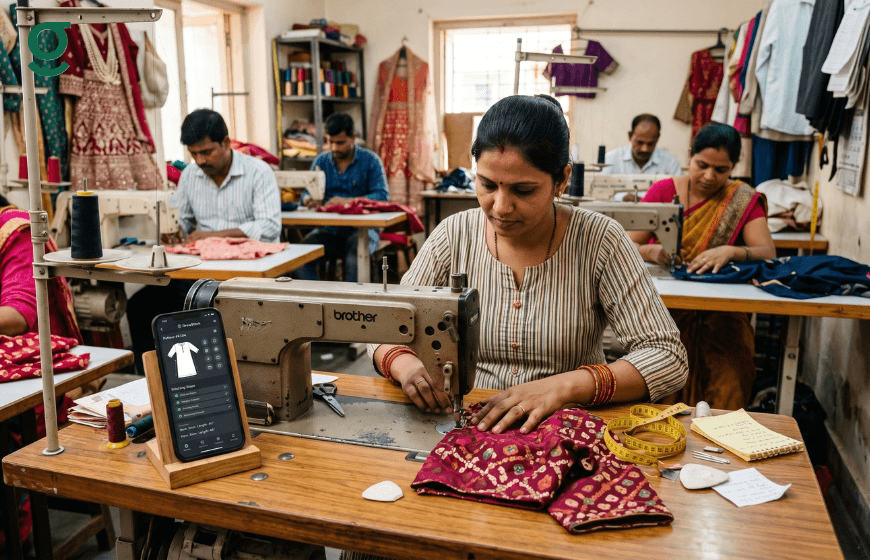
In a boutique without templates, a Karigar who receives an incomplete measurement sheet has two choices: guess or call the front desk to ask. Guessing leads to cutting errors and alterations. Calling the front desk interrupts the production floor, delays the current order and pulls a staff member away from the customer they are serving. Both outcomes cost the boutique time and money.
GrowStitch's template-driven order entry removes this situation entirely. Because the template requires all fields to be completed before the order is saved, the Karigar never receives a measurement sheet with a blank field. The sleeve wrist measurement is always present. The neck depth is always recorded. The hip circumference is always in centimetres, not inches. The Karigar cuts from a complete record and queries to the front desk drop significantly.
For boutiques that track alteration rates by garment type, the reduction in queries and alteration frequency that follows template adoption is measurable. A tailor measurements app that reduces rework costs does so by capturing better information at the measurement stage.
Template Updates: Keeping Measurement Records Current
Garment templates in GrowStitch can be updated as the boutique's product range evolves. When a new garment type is added to the catalogue, a new template is created with the specific measurement fields required. When an existing garment type requires a new field (a boutique that starts offering a specific Indo-western cut with a new measurement point), the template is updated and all future orders for that garment type include the new field. Optimising stock and production decisions depends on measurement data that is always current and complete.
From Template to Production: How the Record Reaches the Karigar
When a customer's order is complete in GrowStitch, the Karigar opens the job sheet on the production dashboard. The job sheet displays all fields from the garment template, populated with the customer's measurements. The Karigar sees the complete measurement record in the same structure as the template, making it immediately readable without cross-referencing a physical book. The reduction in rework costs from complete, template-driven measurement records is one of the most measurable returns from a tailor measurements app.
Conclusion: Templates Are the Starting Point for Consistent Quality
A tailor measurements app without garment templates is a digital notebook. With templates, it is a quality control system. GrowStitch's garment templates enforce complete measurement capture at every order, ensure every staff member captures the same fields in the same format and give every Karigar a reliable, structured record to cut from. The result is fewer incomplete records, fewer Karigar queries, fewer trial alterations and a more consistent quality of finish across every garment the boutique produces. Download GrowStitch and configure your boutique's garment templates today.
Frequently Asked Questions
1. What is a garment template in a tailor measurements app?
A garment template in a tailor measurements app is a pre-defined set of measurement fields for a specific garment type. When a blouse order is created in GrowStitch, the blouse template appears with all the fields required for that garment. When a sherwani is created, the sherwani template appears. Templates ensure complete, consistent measurement capture for every order without depending on the staff member's memory or training.
2. Can GrowStitch templates be customised for different garment types?
Yes. GrowStitch allows boutiques to configure templates for every garment type in their catalogue: blouses, salwar suits, lehengas, sherwanis, kurtas and any custom category. Each tailor measurements app template can include the specific fields required for that garment, with units and field order set to match how the Masterji takes measurements in practice.
3. How do garment templates reduce measurement errors?
Garment templates reduce measurement errors by defining which fields must be completed before an order can be saved. No field can be omitted without a system alert. The staff member follows the template sequence, capturing each measurement in the correct field. The Karigar receives a complete record with no gaps to interpret or fill.
4. Do templates work for boutiques with multiple Karigars?
Yes. Templates are particularly valuable in multi-Karigar boutiques because they standardise the measurement record regardless of which staff member created the order. Every Karigar receives the same structured record with measurements in the same fields and units. The tailor app eliminates the variation in record quality that occurs when different staff members capture measurements without a standard format.
5. How do garment templates speed up order entry?
Templates speed up order entry by displaying the relevant measurement fields automatically when a garment type is selected. The staff member does not need to decide which measurements to take, consult a reference sheet or ask a senior colleague. The sequence follows a logical body-area order, reducing the time taken to capture all fields for a new order.
6. What happens when a boutique adds a new garment type?
When a boutique adds a new garment type to its catalogue, a new template can be created in GrowStitch with the specific measurement fields required. All future orders for that garment type use the new template. Existing orders are not affected. The tailor measurements app updates instantly and the new template is available to all staff members from the moment it is saved.