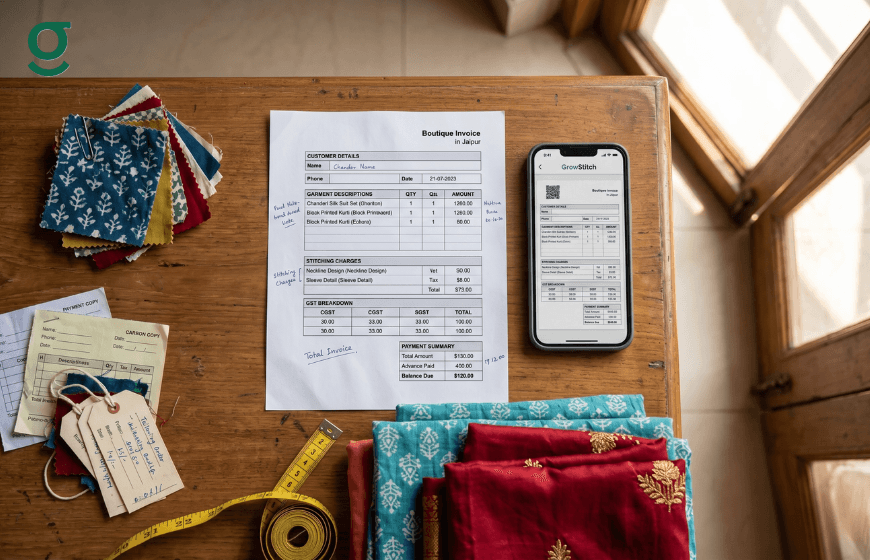
A professional cloth bill format for a boutique includes the customer's name and contact details, the garment type and fabric description, the stitching charges broken down by service, any add-on charges such as embroidery or lining, the advance paid at booking, the balance due and the applicable GST. Each component should be clearly labelled so the customer understands what they are paying for and the boutique has a complete billing record in case of any dispute. GrowStitch generates this format automatically from the order record, without manual entry at the time of billing.
Most Indian boutiques use a handwritten bill that captures only the total amount and the customer's name. This works for simple cash transactions. It fails when a customer disputes a charge, when GST records are needed, when a partial payment has been made and the balance needs to be confirmed or when the boutique wants to present a professional image to a high-value bridal client. A structured cloth bill format solves all four. The shift from a manual bill book format to a structured digital invoice is one of the clearest quality upgrades a boutique can make.

The Seven Components of a Professional Cloth Bill Format
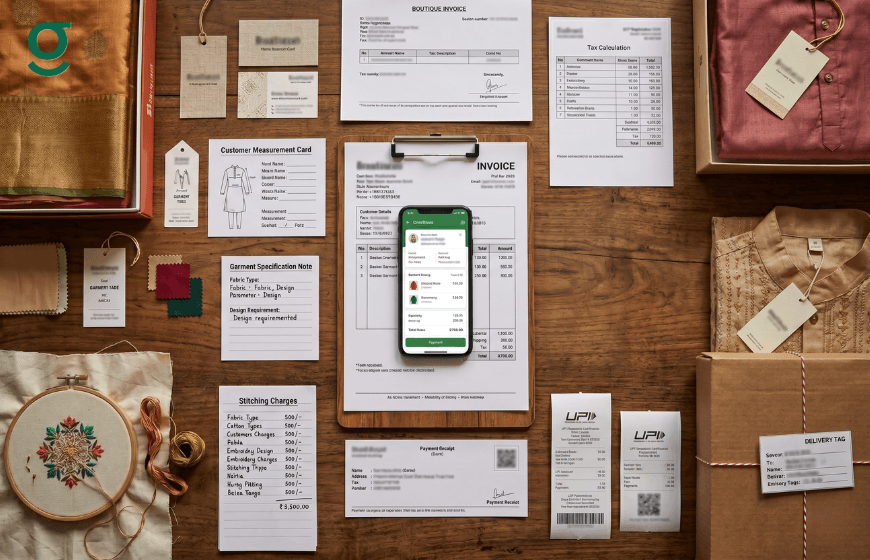
A complete cloth bill format for a boutique covers seven distinct components. Each one serves a specific function in the billing record.
1. Boutique Details
The bill header includes the boutique's name, address, phone number, GST number (if registered) and logo. This information establishes the legal identity of the transaction and gives the customer a point of contact for any queries. Most manual bills from boutiques omit the GST number even when the boutique is registered, which creates a compliance gap.
2. Customer Details
The customer's name, phone number and address should appear on every bill. For a bridal order, the delivery address may differ from the customer's home address. Including the phone number allows the boutique to connect the bill to the customer's profile in GrowStitch, making it part of the customer's permanent order history.
3. Order Details and Garment Description
The garment type, fabric description, colour and any significant design elements should be noted in the bill. This is the component most frequently omitted in manual bills. A bill that says '1 blouse: Rs. 800' is functionally incomplete. A bill that says 'Raw silk blouse, deep neck, short sleeves, embroidered collar: Rs. 800' is a complete garment record. If the customer returns for an alteration six months later, the garment description in the bill is the definitive reference. Without it, the boutique and customer may recall the garment differently. The alteration conversation becomes a negotiation rather than a correction. A boutique ladies tailor bill format that includes garment descriptions reduces all future disputes.
4. Service Charges Itemised
Stitching charge, lining charge, embroidery coordination charge, express delivery charge and any other billable service should be listed separately with their individual amounts. This itemisation prevents the customer from questioning a total they cannot connect to the work done and prevents the boutique from forgetting to bill for a service it provided.
5. Advance Paid and Balance Due
The advance amount received at booking and the balance outstanding must be stated clearly on the final bill. The balance is the figure the counter staff collects at delivery. When it is printed on the bill, the collection conversation is factual: the bill says Rs. 1,800 and the customer sees it. The 7 most common billing problems in boutiques trace directly to missing or unclear advance and balance entries.
6. GST Details
For GST-registered boutiques, the applicable tax rate and GST amount must appear on every bill. Generic cloth bills and many handwritten formats omit this entirely, creating a compliance gap and making it impossible to file accurate GST returns at the end of each quarter. GrowStitch applies GST automatically based on the service rates configured in the platform. Boutique billing software built for cloth shops handles GST differently from generic retail billing tools.
7. Payment Method and Date
The payment method (cash, UPI, card) and the date of each payment should be noted on the bill. For orders with multiple payment stages, an advance at booking and a balance at delivery, this creates a clear and complete transaction history. GrowStitch logs each payment with its method and timestamp automatically, making this component of the bill complete without additional input from the staff member processing the payment.
Manual Cloth Bill Format vs GrowStitch Digital Bill
| Bill Component | Manual Cloth Bill | GrowStitch Digital Bill |
|---|---|---|
| Customer details | Name handwritten. Phone and address often omitted. | Pre-filled from customer profile. Name, phone and address included automatically. |
| Garment description | Brief note: '1 blouse'. Fabric and design details rarely included. | Garment type, fabric, colour and any add-on services listed from the order record. |
| Advance and balance | Calculated manually. Errors common when multiple items are billed together. | Advance auto-populated from order. Balance calculated automatically. No manual arithmetic. |
| GST calculation | Applied manually or omitted. Inconsistent across bills. | GST calculated and applied automatically based on configured service rates. |
| Payment confirmation | No receipt sent. Customer relies on the counter copy of the bill. | WhatsApp receipt sent immediately when payment is logged. Digital record for both parties. |
Why a Generic Billing App Does Not Produce a Proper Cloth Bill Format
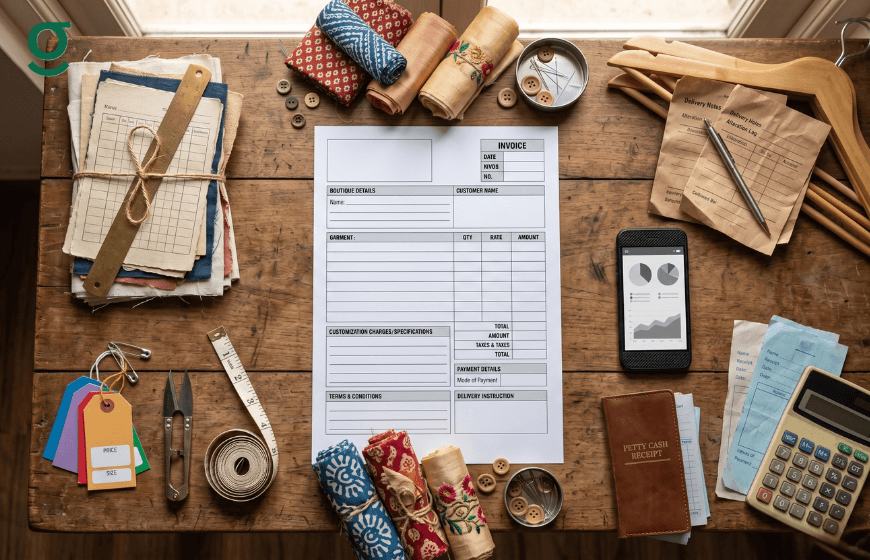
A generic billing or invoicing app generates a standard retail bill: product name, quantity, rate, total, GST. This format is designed for physical goods with a fixed price. It is not designed for a boutique order where the price is constructed from stitching charge, fabric charge, add-on services, advance deducted and balance due. Forcing a boutique billing workflow into a retail invoice format produces a bill that is either incomplete or confusing. Generic apparel billing software fails tailoring businesses for exactly this reason.
GrowStitch's boutique bill book function generates a cloth bill that reflects how tailoring transactions actually work: advance-first, balance-at-delivery, multi-component service breakdown and GST compliance. The bill format is built for the boutique context. The customer receives a bill that explains what they paid for, what they paid upfront and what remains due. A tailoring software platform versus a generic billing app is a meaningful distinction for boutiques that need this format.
Sending the Bill Professionally: WhatsApp and Print
A professional cloth bill format is only as useful as the channel through which it reaches the customer. GrowStitch sends the digital bill to the customer via WhatsApp at the point of payment. The bill arrives as a formatted message or PDF attachment. The customer has a digital record. The boutique has a sent confirmation. There is no ambiguity about whether the bill was received or what it contained.
For customers who prefer a printed bill, GrowStitch's bill can be printed from the app or from any connected printer. The printed format follows the same structured layout as the digital version. Setting up the digital billing workflow in GrowStitch takes one session to configure service rates and invoice format. After that, every bill is generated automatically from the order data.
A free bill book app is insufficient for a growing boutique because it cannot handle the advance-and-balance cycle or produce GST-compliant itemised bills. GrowStitch provides the complete billing infrastructure that a professional boutique requires.
Conclusion: Your Bill Is a Reflection of Your Business
A boutique that hands a customer a crumpled chit with a total scrawled in pencil is communicating something about how it operates. A boutique that sends a WhatsApp bill listing every service, the advance paid, the balance due and the GST amount is communicating something very different. The cloth bill format is not paperwork. It is the customer's first impression of the boutique's professionalism after the garment is delivered. GrowStitch generates this professional format automatically from every order, without the owner needing to design or manually fill a bill template. Download GrowStitch and generate your first professional cloth bill today.
Frequently Asked Questions
1. What should a professional cloth bill format include?
A professional cloth bill format should include the boutique's name and GST number, the customer's name and contact details, the garment type and fabric description, individual service charges, the advance paid at booking, the balance due at delivery, the applicable GST and the payment method and date. GrowStitch generates all of these automatically from the order record.
2. Does GrowStitch produce a GST-compliant cloth bill?
Yes. GrowStitch applies GST to each billable service based on the tax rates configured in the service catalogue. The GST amount and rate appear on the generated bill automatically. For GST-registered boutiques, this ensures every bill is compliant without the owner manually calculating or applying GST at billing.
3. How is a boutique cloth bill different from a retail invoice?
A boutique cloth bill format is structured around a custom order: advance at booking, multiple service components and balance at delivery. A retail invoice is structured around a product quantity and fixed price. Generic billing tools generate retail invoices. GrowStitch generates boutique bills that reflect how tailoring transactions actually work, including the advance-and-balance cycle and multi-component service breakdown.
4. Can GrowStitch send the bill to the customer via WhatsApp?
Yes. GrowStitch sends the digital bill to the customer via WhatsApp when a payment is logged against the order. The bill includes all the components of the professional cloth bill format. The customer receives it as a formatted message or PDF attachment and has a permanent digital record of the transaction.
5. What happens if the customer loses their copy of the bill?
In GrowStitch, every bill is stored permanently against the order record. If a customer loses their copy, the boutique can resend the bill from the order screen at any time. The boutique bill book function keeps a digital copy of every transaction, eliminating the lost-bill dispute that is common when boutiques rely on manual carbon copies.
6. How does tailoring software handle bills for orders with multiple garments?
Tailoring software like GrowStitch handles multi-garment orders by listing each garment and its associated charges as a separate line item on the bill. A bridal order with a lehenga, blouse and dupatta appears as three line items with individual charges, a combined total, the advance paid and the balance due. This itemised format is far clearer than a single total that the customer cannot connect to individual garments.
7. Is a digital cloth bill format legally valid in India?
Yes. A digital invoice that includes the required information: the seller's name and GST number, the buyer's details, an itemised description of goods or services, the tax applied and the total amount, is legally valid in India under the IT Act and GST regulations. GrowStitch generates bills that include all required fields for registered businesses.