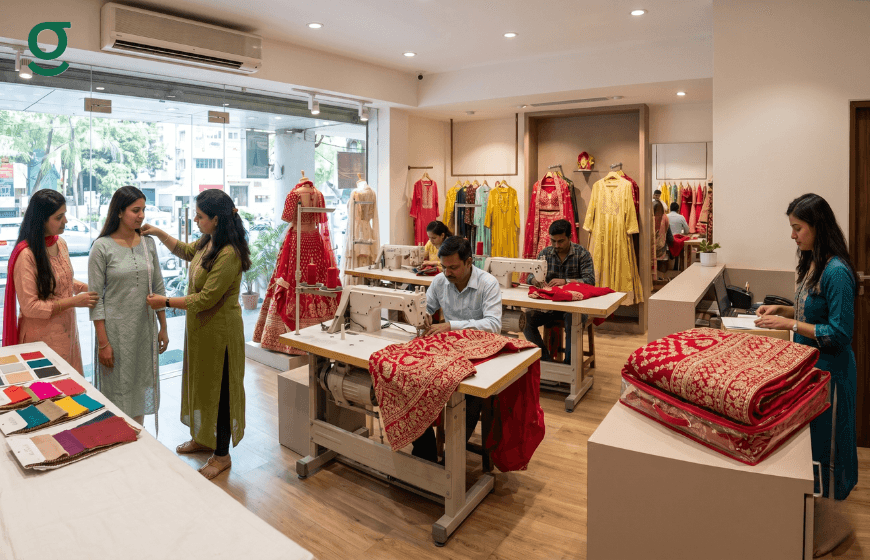
Running a boutique in India is a series of small, simultaneous decisions. A bridal lehenga is on the cutting table. A blouse alteration is overdue. A customer has just walked in for a Jodhpuri suit trial. The Masterji is asking which fabric was confirmed for the salwar suit. Every one of these touchpoints is a stage in the order lifecycle. When that lifecycle is tracked manually, things slip.
Tailoring software automates the full order lifecycle of a boutique by digitising every stage from booking to delivery. It captures orders, stores measurements, tracks production stages, sends customer updates, generates bills and closes the loop on payment in a single mobile-first platform**.** GrowStitch is built specifically for Indian boutiques and tailoring units to manage this lifecycle end to end without diaries, WhatsApp threads or generic apps.
This guide walks through every stage of the order lifecycle and shows where boutiques typically lose time, money and customer trust. If you are still piecing together your business across diaries and chats, here is why most boutiques have already moved on.

What Is the Order Lifecycle in a Boutique Business
The order lifecycle is the complete journey of a garment from the moment a customer walks in to the moment the final payment is settled. In Indian boutiques, this lifecycle has six clear stages.
Order Booking: customer details, fabric, design notes and delivery date are captured.
Measurement Capture: body measurements recorded by the Masterji or assistant.
Production Tracking: the garment moves through cutting, stitching, finishing and QC.
Customer Communication: status updates, trial reminders and pickup messages.
Billing and Payment: invoice generation, advance payment, balance collection.
Delivery and Closure: garment handover, final settlement and record update.
Every stage handled manually adds risk. A single missed handoff can cost a wedding-season delivery. Multiply that by 40 active orders during festive months and the operational cost is severe.
How Tailoring Software Automates Each Stage of the Lifecycle

A purpose-built tailoring software enforces the right action at the right stage. The platform prompts, alerts and updates automatically. This is how digital order management replaces ad-hoc tracking.
1. Automated Order Booking and Customer Capture
When orders are booked manually, the fabric is not noted, the delivery date stays vague and the advance is not recorded against the order. By the time the garment reaches the workshop, the Masterji is calling the front desk to ask what was confirmed. With GrowStitch, the order entry screen has mandatory fields: customer, fabric, garment type, design reference, trial date and final delivery date. Each order gets a unique ID linked to the customer profile and returning customers' measurements pull in automatically.
2. Centralised Measurement Capture
Measurements are the most repeated and most error-prone data point in a boutique. A tailoring application stores measurements in a structured digital template against each customer. Garment-specific fields (blouse, lehenga choli, Anarkali, salwar) ensure no critical measurement is missed. When the same customer returns, the measurements are instantly available. No flipping through pages.
3. Real-Time Production Stage Tracking
Production is where most delivery delays originate. A garment can sit for two days waiting for finishing because no one knows it has finished stitching. GrowStitch breaks the order into trackable stages: Cutting, Stitching, Finishing, Quality Check and Ready. Each stage update is logged with a timestamp and the staff member who moved it. The owner sees which orders are stuck where and reassigns a Karigar before delays compound. This stage-wise visibility removes the daily where-is-that-order chaos.
4. Automated Customer Communication
In a manual setup, the boutique receives 15 to 20 calls a day asking the same question: is my order ready? Each call interrupts the workshop. Automated WhatsApp updates cut this entirely. When an order moves from Stitching to Ready, the customer is notified. Trial reminders go out the day before. Pickup reminders trigger after delivery.
5. Auto-Generated Billing and Invoicing
Once an order moves to Ready, the bill is already prepared. Order data, fabric charges, stitching charges and any add-ons (express delivery, embroidery, lining) flow directly into a GST-compliant invoice. The advance paid is deducted. The pending balance is shown clearly. This is exactly why digital invoicing has replaced the traditional boutique bill book.
6. Payment Tracking and Order Closure
The lifecycle ends only when the final balance is collected. In a manual setup, partial payments are scribbled on the back of bill book pages and forgotten. Owners discover months later that lakhs of rupees are sitting in pending balances. With GrowStitch, every order has a real-time payment status: Paid, Partially Paid or Pending. Here is how this single feature plugs the biggest cash flow leak in most boutiques.
Manual Workflow vs Tailoring Software: Stage-by-Stage Comparison
The contrast between a manual boutique and a software-driven one is sharpest when you look at the same lifecycle side by side.
| Stage of Order Lifecycle | Without Tailoring Software | With GrowStitch Tailoring Software |
|---|---|---|
| Order Booking | Written in a diary, often missing fabric details or unclear delivery dates. | Digital order entry with mandatory fields for fabric, design, trial and delivery date. |
| Measurement Capture | Recorded in a separate measurement book the Masterji has to flip through. | Saved to the customer profile and pulled into every future order automatically. |
| Production Tracking | Shouted across the workshop or chased on WhatsApp. | Stage-wise status: Cutting, Stitching, Finishing, QC, Ready. |
| Customer Updates | Customer calls to ask if the order is ready. | Automated WhatsApp updates trigger when status changes. |
| Billing and Payment | Manual bill book, calculation errors, partial payment confusion. | Auto-generated GST invoice with paid and pending balance visible. |
| Delivery Handover | Order is found, packed and handed over with no closure record. | Status moved to Delivered. Final balance settled. Customer record updated. |
Why Generic ERPs and Billing Apps Cannot Automate This Lifecycle
Many boutique owners try a generic POS app or a free billing tool. These products are built for retail shops that sell finished goods, not boutiques that sell a process. They have no concept of measurements, production stages, trials or Masterji handoffs. A purpose-built tailoring software captures the boutique workflow exactly as it happens. Three things a generic app cannot do:
Track production stages: a billing app stops at the invoice; a boutique workflow continues through five more stages.
Store garment-specific measurements: no retail app has fields for shoulder, neck depth or armhole.
Handle the trial loop: custom garments need one or two trials before final delivery. Generic apps have no trial booking.
What End-to-End Automation Looks Like in a Real Boutique

Consider a designer studio in Bengaluru running 60 to 80 active orders during wedding season. Before GrowStitch, the owner spent two hours every morning calling the Masterji and answering customer queries. Trials were missed. Two orders were delivered late. One bridal lehenga went out unbilled because the bill book page was lost. After moving to GrowStitch, the same studio handles the same volume in 20 minutes a day, with at-risk orders surfaced on the dashboard, automated WhatsApp updates handling customer follow-ups and the pending payment list current to the minute.
Choosing a Tailoring Software That Fits Indian Boutique Workflows
Not every tailoring application handles the full lifecycle. Some only do billing. Some only track production. The test is simple: can it run every stage from order booking to payment closure without a second tool? GrowStitch is built around this principle, with Order Management, AI-Assisted Measurements, Production Tracking, Billing, Digital Payments and Analytics in one app. If you are evaluating boutique management software more broadly, this 2026 guide breaks down what to look for.
Conclusion: From Reactive to Run-Ready
A boutique that automates its order lifecycle stops being reactive. The owner moves from putting out fires to running the business. Late deliveries fall. Pending payments shrink. The Masterji and Karigar know exactly what to work on each morning. None of this requires more staff or longer hours.
GrowStitch is built for Indian boutique owners, master tailors and designer studios who want to run their business with clarity instead of guesswork. Stop chasing diaries and chats. Start running your boutique like a Pro. Download GrowStitch and automate your full order lifecycle today.
Frequently Asked Questions
1. What does tailoring software actually automate in a boutique?
A purpose-built platform automates order booking, measurement capture, production stage tracking, customer WhatsApp updates, GST-ready billing and pending payment tracking. Instead of using a diary, a measurement book and a billing app separately, all six lifecycle stages run in one mobile platform like GrowStitch.
2. How is tailoring software different from a regular billing app?
A regular billing app stops at generating an invoice. A platform like GrowStitch continues through production stages, trials, customer updates and final delivery. It is built for the boutique workflow where a sale begins with measurements and ends weeks later. Generic billing apps cannot capture this multi-stage process.
3. Can tailoring software help reduce late deliveries?
Yes. By tracking each garment through Cutting, Stitching, Finishing and Quality Check, the owner sees bottlenecks before they become delays. At-risk orders are flagged so the team can reassign work. This stage tracking is the single biggest reason boutiques eliminate late deliveries.
4. Does tailoring software work for small boutiques with one or two tailors?
Absolutely. A single-Masterji boutique benefits even more because the owner is wearing every hat. Automating order booking, customer updates and billing frees up the owner to focus on design, fittings and growth. GrowStitch is built for boutiques of every size from a one-person studio to a multi-branch designer chain.
5. How does tailoring software handle measurements for repeat customers?
GrowStitch stores measurements against the customer profile. When a returning customer places a new order, the existing measurements pull in automatically. The Masterji can adjust them if the customer has gained or lost weight. This saves time and eliminates re-measurement errors.
6. Will my staff and Masterji be able to use tailoring software easily?
Yes. GrowStitch is designed mobile-first with role-based access. The Masterji sees only the production screens. The front-desk staff sees only order booking and billing. The owner sees the full dashboard. Most boutiques onboard their team in under a week with no formal training.
7. Is my boutique data safe in tailoring software?
Yes. GrowStitch stores all customer measurements, order data and financial records in encrypted cloud storage with role-based access controls. Unlike a paper diary that can be lost or damaged, digital records are backed up automatically. Only authorised staff can access sensitive data.